

People who love the Mazda MX-5 Miata tend to have a cult-like obsession with the plucky roadster, and for good reason. The Mazda Miata is an example of a quintessential sports car and has garnered a reputation for being fun to drive. This recipe has been refined and honed over 35 years, improving on excellence to the level that the Miata continues to win awards to this day.
In early 2025, Mazda unveiled the most powerful iteration of the Miata ever in Japan. Officially titled the Mazda Spirit Racing Roadster 12R, it finds itself on the receiving end of 200 metric horsepower and a host of other refinements developed through Mazda’s motorsport exploits.
Only 200 examples of this hardcore Miata were produced, but there is another that’s even rarer, and it’s missing an extremely important roadster feature.
Mazda Roadster Coupe: The Only Factory-Built Miata Coupe
179 Units Built
Close
The year was 2003, and Mazda had just released the Mazda Roadster Coupe. Like the previous iterations of the Roadster (the Japanese market name for the MX-5 Miata), it was a two-seater sports car, but for the first time since the birth of the Mazda MX-5, it now had a fixed roof. Originally, Mazda had placed no cap on how many it would produce – although production was on an order-only basis. Four versions were available, and only two of these would be limited in number – to 150 and 200 units respectively. But total production of the Roadster Coupe only barely surpassed that 150-unit figure for all four variants, with the official number sitting at 179 examples.
2003 Mazda Roadster Coupe Type A Exterior Finished In RedMazda
It was designed to retain the Miata’s fun-to-drive characteristics while delivering an even more driver-focused package. During the development of the Roadster Coupe’s body, Mazda’s engineers revised the structure of the standard frame to improve the rigidity of the body. Typically, you’d expect a weight penalty, especially compared to the lightweight manually-folding oft-top on the base MX-5, but the fixed roof only added 22 lbs to the overall weight while adding rigidity.
Another change to the standard MX-5’s formula for the Roadster Coupe was a change in styling, said to advance the design of the standard MX-5 through a combination of computer-aided design (CAD) and hand modeling. The various versions had unique styling traits, too, with some being extra sporty while others leaned into the British sports car ethos – arguably unsuccessfully.
Four Flavors To Choose From
When Mazda introduced the Roadster Coupe, it offered four different grades it believed customers seeking uniqueness and styling would appreciate. These four grades were:
- Roadster Coupe: This was the vanilla configuration of the Roadster Coupe model and was the only grade to rely on a 1.6-liter inline four-cylinder engine paired with a five-speed manual. This was the least powerful option, mustering 123 hp for its plucky engine compared to the other grades.
- Type S: Visually, the Type S was similar to the standard Roadster Coupe model, but mechanically, it was completely different. Instead of a 1.6-liter inline-four-cylinder engine, the Type S employed a 1.8-liter inline four-cylinder engine paired with a six-speed manual transmission and commanded a total output of 158 hp.
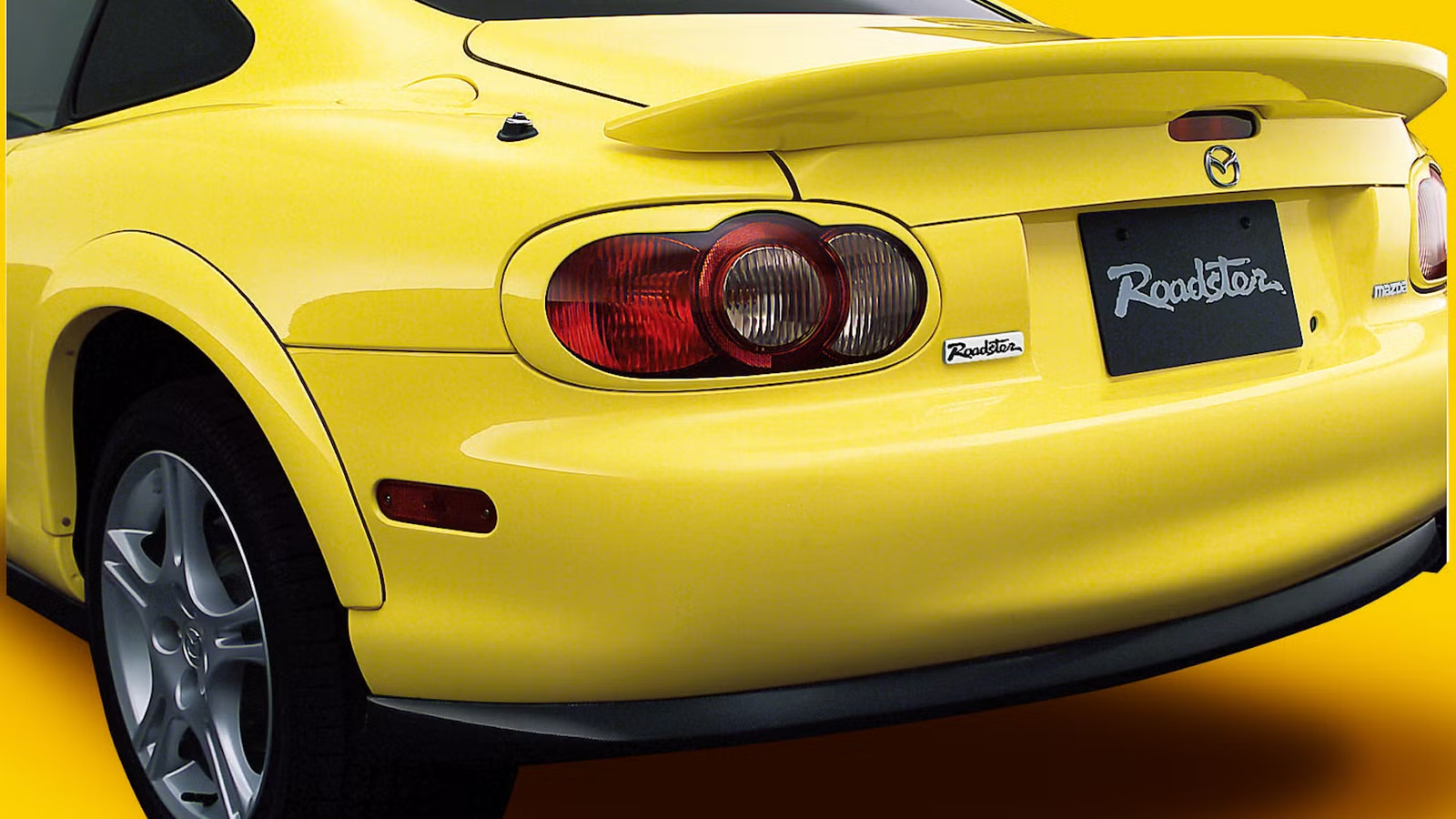
- Type A: The Type A was designed to serve as a nod to race cars and, as such, it featured bespoke styling elements like a unique front end with a model-specific grille, larger front fog lights, headlight covers, and fiberglass arch extensions. Mazda had planned to produce a maximum of 200 examples of the Type A, but far fewer were made before the plug was pulled. This derivative of the Roadster Coupe was the most expensive grade in the model range.
- Type E: Production of this grade was intended to be limited to 150 examples, making it the rarest configuration of the rarest MX-5 model ever. In contrast to the Type A, the Type E was characterized by a more classic British sports car design, sporting a fine mesh grille and more simple headlight bezels. It was the only one to feature an automatic transmission.
Close
The Type A and Type E were available in only two vivid paint colors – Lightning Yellow and Velocity Red – but the base version and Type S could be specced in three: Pure White, Sunlight Silver, and Classic Red.
Mazda Roadster Coupe Sales Breakdown
Variant
Units Sold
Price
Base
53
JP¥ 2,350,000
Type S
63
JP¥ 2,750,000
Type A
40
JP¥ 3,100,000
Type E
23
JP¥ 2,800,000
TOTAL
179 Units
When it debuted, the Roadster Coupe had a starting price of 2,350,000 yen, roughly $26,128 when adjusted for inflation. As the range-topping derivative, the Type A was offered at a retail price of 3,100,000 yen, which, when adjusted for inflation, would be roughly $34,467. All 179 examples of the Roadster Coupe produced were sold in the Japanese Domestic Market.
The Roadster Coupe remains the only fixed-top version of Mazda’s beloved MX-5, and the reason for its poor production volumes remains a mystery. Yes, it was built to order only, so perhaps it was a direct result of poor demand that it was culled, but it’s impossible to ignore surrounding circumstances that may have had an impact, like the fire that damaged the Ujina No.1 plant on 15 December 2004, where the MX-5 was produced alongside the RX-8. Mazda had to rearrange production and may have deemed these unique models superfluous in the grand scheme.
How To Get This Rare Miata In The USA
2003 Mazda Roadster Coupe Exterior Finished In RedMazda
Importing an ultra-rare 2003–2004 NB Mazda Roadster Coupe—one of only 179 ever built with a factory fixed steel roof—presents a unique legal and financial hurdle for American collectors. Because it was produced strictly for the Japanese domestic market, federal law prevents it from being imported for normal street use under the 25-year rule until 2028. Attempting to bring one stateside today via NHTSA’s strict “Show or Display” exemption pushes the total landed cost to roughly $45,000 to $60,000 or more.
2003 Mazda Roadster Coupe Finished In RedMazda
The vast majority of that total stems from the vehicle’s purchase price in Japan, where fierce auction competition easily drives pristine models to anywhere between $35,000 and $50,000 depending on the trim grade and condition. On top of the hammer price, an importer must account for $500 to $1,000 in JDM auction and export processing fees, alongside $2,000 to $3,500 for containerized ocean freight. Once the car hits a US port, Customs and Border Protection levies a standard 2.5% passenger vehicle duty, which adds roughly $875 to $1,250 based on declared value.
When combined with $1,500 to $2,500 in customs brokerage, port handling, and domestic flatbed transport, bringing home this holy-grail Miata demands serious capital—and under “Show or Display” rules, limits driving to just 2,500 miles per year until it turns 25.
For this kind of money, you could buy one of the few Porsche 718 Boxsters still left on dealer floors, but it will just be another 718. This Miata is extremely special, and will only increase in value.
Sources: Mazda
