

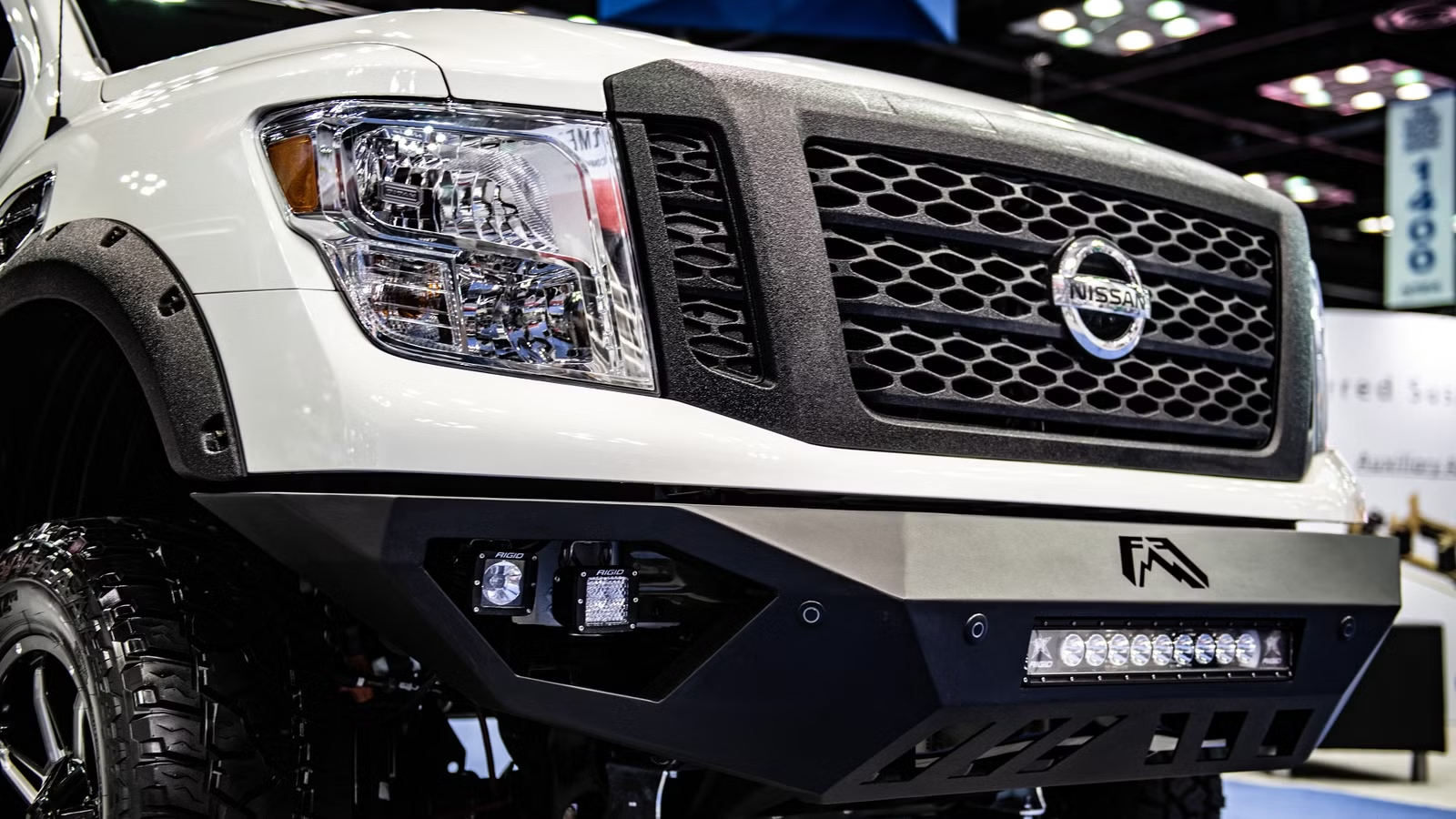
Trucks absolutely dominate the aftermarket segment when it comes to sales. A recent report from the Specialty Equipment Market Association (SEMA) found that nearly a third of the money spent on post-purchase modifications went to pickup truck parts and accessories – around $15 billion of the $52 billion total industry-wide – and that 22 percent of new truck owners plan to modify their vehicles within 90 days of purchase.
That massive number shakes out to around $1,900 per truck, and while that may not seem like much, bear in mind that it also represents the 78 percent of owners who spend very little or nothing at all. That means that in addition to the ever-rising cost of vehicles in the US, some owners are spending $6,000 or more on their Jeep Gladiator and Ford F-250 Super Duty trucks in their first three months. And unfortunately, the latest data suggests that investment isn’t likely to pay off.
A Huge Market With Minimal Returns
2011 Chevrolet Silverado 2500HD Realtree ConceptChevrolet
Let’s take a few examples. One of the most commonly modified trucks as of the 2022 SEMA report – the most recent one with publicly available data – was the Ford F-Series, and anyone who’s spent time in Orange County, California, or Tampa, Florida, will suspect that the Super Duty lineup is perhaps a bit over-indexed in terms of mods. According to our marketplace sources, a stock 2021 Ford F-250 with four-wheel drive and fewer than 60,000 miles has an average asking price that ranges between $45,000 for a base-model XL with a gasoline V8 to around $75,000 for a higher-spec Lariat or Platinum trim with the Power Stroke turbodiesel V8.
However, while adding a lift kit or significant cosmetic modifications may increase the asking price of your truck, it likely won’t be enough to compensate for the added parts cost. One 2021 Ford F-250 Lariat with a diesel engine for sale in Texas had an asking price of $70,995 at the time of its sale last July, near the top of the range that we’ve established for a stock truck. However, it runs an aftermarket air suspension from Kelderman, and according to that company’s website, the cheapest lift kit for the Super Duty costs $8,005, while more expensive kits are just over $10,000.
Ford Super Duty pickup at SEMA 2025Ford
And owners who lift their trucks generally don’t stop there. For starters, they need some new wheels and tires to fill out that newfound atmosphere under the fenders. Even the cheapest 24-inch rims cost at least $250 each, while a cheap, off-brand set of 35-inch tires to fit would run an additional $350 per, bringing the rolling stock total to $2,400. If you want rubber from a proven legacy brand and wheels with an established reputation for quality, that number could easily be $5,000 or more.
Supporting upgrades such as a steering stabilizer and higher-performance shock absorbers, which aren’t included in the aforementioned Kelderman lift kits, would demand an additional $3,000, while the cheapest controller the company offers is $2,675. Suddenly, the seller who’s asking $71,000 for their bro-dozer is only getting $55,000 back on their investment, far less than a non-modified pickup in similar condition.
Ford Super Duty pickup at SEMA 2025Ford
Although this math is specific to the F-250, it generally applies across most market segments. Unless the truck is professionally built to a show-quality standard ornotable in some wayfor its provenance in the modified community, getting your money back from modifications is very, very difficult. In fact, some modded trucks are worthlessthan their stock counterparts.
So, Should You Lift Your Truck?
That’s not to say there’s no reason to lift your truck. Not everything has to be an investment, and in general, automobiles are the most significantly depreciating assets most of us will ever own, so it’s not as though keeping your F-250 (or Gladiator or Silverado 1500 or Tundra) showroom-fresh is suddenly going to make it worth the money you forked over at the finance department. But significant truck modifications certainly aren’t for everyone.
The pros and cons of lifting a truck are:
- Pro: Added ground clearance for off-road driving
- Pro: Customized, one-off appearance
- Pro: Fun to drive, in its own way
- Con: Worse fuel economy and aerodynamics
- Con: Potentially increased tire wear and altered handling characteristics
- Con: Reduced hauling and towing capability
If you’ve decided that you simply must have the extra elevation that a lift kit provides, then there are a few ways to avoid some of those pesky pitfalls. Foremost, do your research and learn what brands and products provide the best performance for your needs. If all you want is a bit more space under the truck to fit slightly larger tires, don’t break the bank on a long-travel 6-inch lift when a simple leveling or body lift will do.
Close
And if you’re chasing mall-crawler vanity with a huge lift, chrome steamroller wheels, and low-profile tires—your author and many other truck enthusiasts will judge you for it—you should at least chase the highest quality that money can buy. When professionally installed, set up, and aligned, the best lift kits out there can reduce the negative ride, handling, and tire wear effects common to modified trucks. The more reputable the brand, the better your truck will perform – both on the road and when it’s time to trade in.
What’s more, a few automakers produce their own in-house modifications, such as the Jeep Performance Parts 2-inch lift kit for the Gladiator. Ford Custom Garage also offers a package for the F-150 that includes a 2-inch front-end leveling kit. Chevrolet Performance offers similar parts and accessories for its trucks and SUVs. Whichever route you take, buying and installing those parts at an official manufacturer franchise usually leaves your pickup’s warranty intact.
The Right Way Is Always The Best Way
The bottom line is that your truck’s suspension and tires are the only things keeping it from becoming a 6,000-pound, chrome-trimmed, out-of-control torpedo, so opting for cheap components and hoping for the best is a reckless way to modify your truck. Keeping things stock certainly isn’t for everyone, and there’s some pleasure in building exactly the vehicle you want. Personally, my 1996 Lexus LX 450 has a 2-inch suspension lift and 33-inch tires, and I love the added clearance and traction when I hit the dirt. I also can’t deny that I love the traffic-beating seating position and towering stance.
Slightly modified 1996 Lexus LX 450Courtesy Brett T. Evans
But at the same time, I’m very aware of how, even with a high-quality kit and excellent Firestone Destination X/T tires, my SUV handles differently (read: worse) on the road than it would if it were stock. And if I ever go to sell it, prospective owners might prefer a different setup, and its resale value will likely suffer a bit as a result compared to an unmodified Land Cruiser.
As long as you’re aware of the risks and compromises that come with a lifted and modified bro-dozer, who are we to tell you what to do with your money? Just recognize that you’ll likely be spending it all on yourself, rather than getting some of it back from the next owner.
Base Trim Engine
6.8L V8 Gas
Base Trim Transmission
TorqShift 10-speed automatic
Base Trim Drivetrain
Rear-Wheel Drive
Base Trim Horsepower
405 HP @5000 RPM
Base Trim Torque
445 lb.-ft
Base Trim Battery Type
Dual lead acid batteries
Infotainment & Features
7 /10
Source: Specialty Equipment Market Association
