

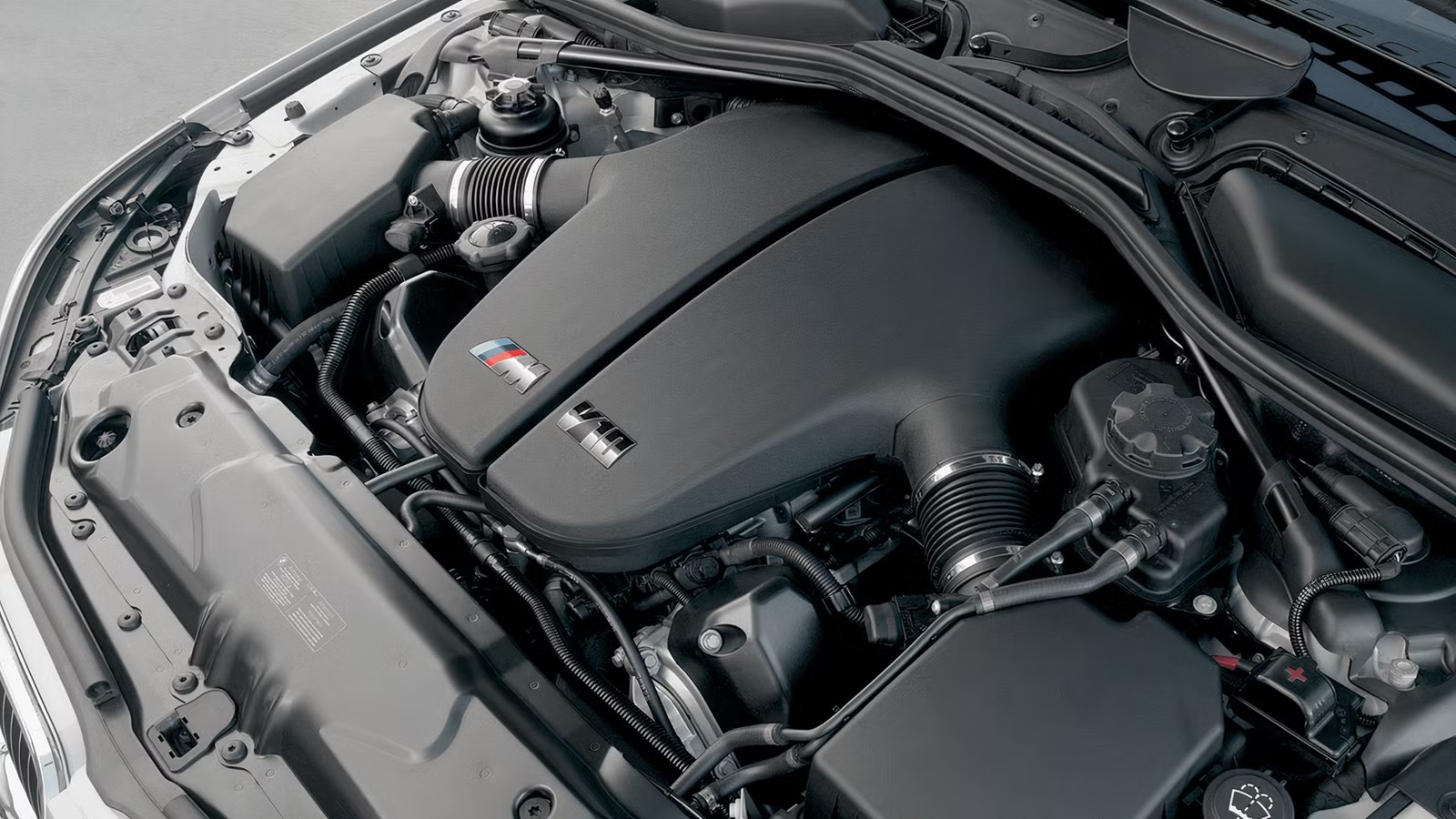
The BMW M5’s S85 V10 was the result of a series of brave decisions made feasible by a specific moment in time. In the mid-2000s, naturally-aspirated power-per-liter was a major engineering flex for high-performance engines on the world stage. By this point, automakers around the globe were pushing their combustion engines to higher speeds to deliver the sort of drama and excitement big-dollar shoppers expected.
There were bigger and more powerful engines on the market, but few as exotic–let alone installed in a sedan. The BMW M5 had big shoes to fill. The previous-generation E39 model had been on duty from 1999 until 2003, retiring after captivating a generation of car enthusiasts with its legendary S62 5-liter V8 engine, delivering 400 hp by way of some of the most advanced technologies at BMW’s disposal at the time. For the M5’s next act, things were going to get stepped up a notch.
BMW Bosses Wanted Formula One For The Street
The E39’s all-motor V8 had the big revs and dramatic power curve popularized by some of the foremost performance cars of the day at a growing range of price points—from the 8,000-RPM Honda Civic Si to the 9,000-RPM Mazda RX-8, the 8,900-RPM Honda S2000, and the 8,500-RPM Ferrari F430. While those high-revving sports cars traded low-end muscle for top-end thrust, the E39’s S62 V8 bridged two worlds with a 7,000-RPM redline while still delivering 369 lb-ft of torque down lower in the rev range.
The E39 product life cycle came and went, and the following E60-generation M5 needed to deliver something even more thrilling, which wouldn’t be an easy feat. While Mercedes-Benz sold American shoppers supercharged V8 engines in their rocket-propelled AMGs, BMW worked away to build on the reputation and success of the E39 for the next M5. As the M5’s engine makes up such a significant part of its personality, the latest unit would need to be something particularly spectacular.
This arrived in the form of the S85 V10 engine, which gave BMW shoppers of the day an excellent reason to dig deep into their wallets. Not only would the incoming replacement M5 place a V10 engine commonly reserved for exotics into a sport sedan, but it would also achieve 100 horsepower per liter without boost and bring a host of F1-derived technologies to the road in the process.
Reyn Speed Shop reveals BMW 8 Series (E31) restomod with E60 M5 V10 powertrain and manual transmission Engine Shotreynspeedshop/Instagram
Many BMW fans were watching the brand’s F1 efforts on TV or at the F1 circuit, and the automaker wanted this generation M5 to deliver F1 technology for the street. Delivering 500 naturally aspirated horsepower from five liters of displacement, this V10 would go down in the books as one of the era’s pinnacles of free-breathing engine design for a production car. The S85 also powered the M6, a two-door coupe or convertible based on the M5’s platform and sold alongside it to give the V10 a second home in a sleeker, lower form factor.
That’s the “why” behind the S85 V10 engine in a nutshell; now, let’s move on to the “how”.
F1 Power For The Executive Parking Lot: The S85 Was A Technical Masterpiece
2006 BMW M5 V10 (E60)BMW
Even BMW admitted that a 10-cylinder engine was a really unusual choice, even for an ‘M’ car. Primarily, V10s were used in Formula 1 cars and by BMW Motorsport. The development of the E60 M5 began in the early 2000s, just as its V8-powered predecessor, the E39, was enjoying peak popularity.
According to BMW, the “gold standard in motor racing at the time was 333 cc per cylinder, and for series production engines, 500 cc per cylinder.” With the engineers targeting 500 horsepower from an engine that would achieve the naturally-aspirated ‘ideal’ of 100 horsepower per liter, the solution became five liters of displacement distributed across ten cylinders. The S85 was born to give drivers a taste of an F1 power curve in a roadgoing sedan. In fact, the engine blocks for both BMW’s Formula 1 engines and those for the E60 M5 came from the same German foundry in Landshut, though BMW notes that this was the only connection to the Formula 1 car engines.
2006 BMW M5 V10 (E60)BMW
Though the E60 packed 500 horsepower, the real attention-grabbing specification was the redline—the furious 8,250-RPM orchestra awaiting drivers in the upper reaches of the tachometer.
Numerous elements made the S85 V10 incredibly exotic, and also incredibly complex. The ‘short-stroke’ over square ratio of the engine’s bore and stroke reduced overall piston travel, meaning this engine was built to rev fast from its very core. Most engines use one or maybe two throttle bodies to control the amount of air flowing into the engine’s cylinders downstream. To improve breathing and throttle response, every cylinder in the S85 had its own throttle body instead. That’s ten little butterfly valves working in unison on a cylinder-by-cylinder basis, a trick normally reserved for dedicated race cars and exotic supercars to eliminate air intake latency and provide instantaneous, razor-sharp throttle response.
2006 BMW M5 Exhaust (E60)BMW
Another complexity was the knock detection system. At extreme revs, conventional knock sensors can have trouble ‘hearing’ the telltale sounds of approaching pre-ignition within the engine. For more precise control of the combustion process under extreme load and RPM, the S85 could instead measure knock on a cylinder-by-cylinder basis using its spark plugs.
“To avoid engine problems, it was decided to use complex ion flow measurement. Here, the spark plugs are given a voltage of 400 v between ignition processes. When the current flow is measured, current spikes can be registered, indicators of uncontrolled combustion processes.” – BMW
To help keep things properly lubricated at screaming revs, two electric scavenging oil pumps were used in high g-force cornering to prevent oil from collecting in certain parts of the engine, instead forcing it back into circulation and preventing dangerous oil starvation. Features and technologies like these made the E60 M5 the closest thing to an F1-powered sedan that has ever existed, or ever will again.
Why BMW Never Repeated It
2005 BMW M5 E60 Silver Front Driving on roadBMW
Consider the lifespan of the S85: it arrived in 2004 (for model year 2005 in Europe), died at the end of the M5 and M6 life cycle in 2010, and was never updated or evolved into a subsequent application. This bespoke engine existed for exactly one purpose, at exactly one moment in time, and wouldn’t be repeated.
A few key reasons why. First, developing a high-performance, low-volume engine for a single generation of a single product is incredibly expensive. Even the fastest Porsche 911s and Chevrolet Corvettes use engines and hardware derived from more modular engine architectures and shared platform families to distribute massive research and development costs across higher sales volumes.
2005-2010 BMW M5 E60 Blue Rear View Desert DrivingBMW
Second, emissions regulations were threatening the screaming revs and furious exhaust notes of the 2000s. Engines would quickly need to perform better while using less fuel, which wasn’t so compatible with V10 engines or race-car rev limits. Instead, turbocharging was about to overtake the market as the solution, replacing most of the free-breathing, fast-revving performance power plants of the prior decades.
In fact, after the E60 generation M5, all subsequent models would switch to a twin-turbo V8 engine family used by various other BMW models.
Of course, there was also the reliability factor. The S85 engine is not built like the engine in a Toyota Corolla, designed to go hundreds of thousands of miles without much more attention than the occasional oil change. Successfully keeping an S85 ticking for the long haul requires more frequent servicing and inspections, and successful owners carefully research and plan their maintenance, keep a contingency fund, and budget accordingly for upkeep.
The End Of An Era
For many in the enthusiast community, the strict maintenance demands and high upkeep are simply part of the price of admission to the last naturally aspirated M flagship car. That’s a small price to pay for a machine that represented the absolute apex of an era, and the last time BMW M engineers were given free rein to build an uncompromised, race-derived engine of the purest, naturally aspirated form.
Because of this, the E60 M5 and E63 M6 maintain immense collector appeal to this day. Newer M models are faster and more powerful, but die-hards miss the revs, the high-pitched mechanical symphony, and the direct throttle response that came with them. Among enthusiasts, the S85 has become a legend as a daring gamble that gave the scene one of the best performance sedans ever made. Ultimately, the E60 is a car that remains unmatched today because it disappeared alongside the era of engineering excellence it was built to epitomize.
Base Trim Engine
5.0L V10 Gas
Base Trim Transmission
7-Speed Automatic
Base Trim Drivetrain
Rear-Wheel Drive
Base Trim Horsepower
500 hp
Base Trim Torque
383 lb-ft @ 6100 rpm
Fuel Economy
11/17 MPG
Infotainment & Features
10 /10
Sources: BMW, BMW Blog
