

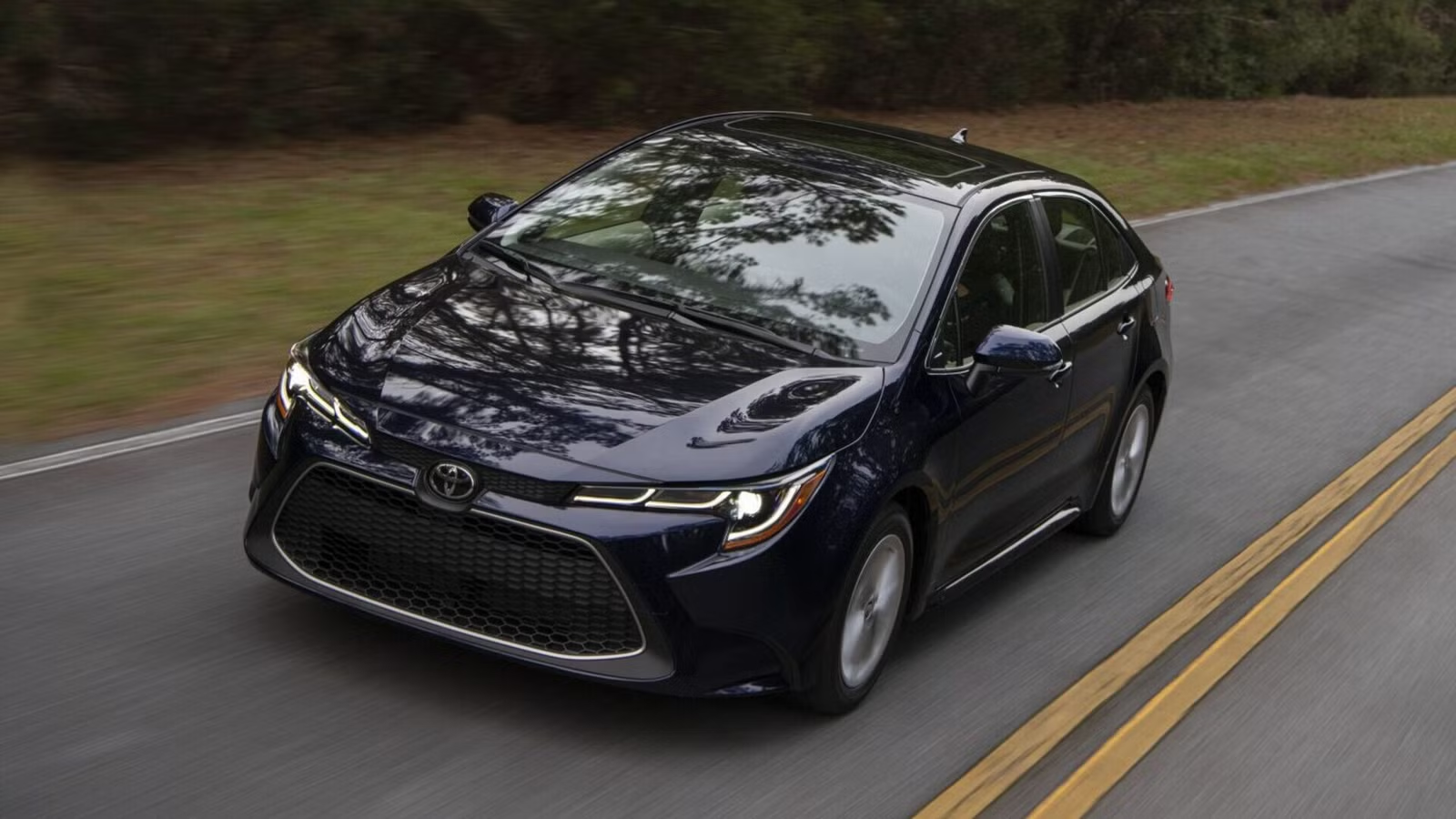
For years, the three letters “CVT” – that’s continuously variable transmissions – were an instant deal-breaker on the used market, synonymous with rubber-band throttle response, slipping belts, metal debris contamination, and four-figure replacement bills if your unit happened to kick the bucket outside its warranty period.
But the Toyota Corolla quietly solved the engineering flaw that made many continuously variable transmissions a liability, and the result is the anxiety-free CVT alternative you might be looking for. In fact, mounting evidence shows that this could be a 250,000-mile-plus gearbox with a little extra attention to maintenance.
Why Buyers Were Avoiding CVTs And Why Some Still Do
Jacto CVT AutoJacto
The CVT had a rushed and rocky start in North America. Today’s CVTs are light-years ahead of these pioneering units when it comes to performance and durability, as automakers, transmission manufacturers, and even lubrication experts joined forces to perfect the technology after the initial public beta testing of the early 2000s soured many on the idea of a belt-driven transmission.
Along that timeline, mounting regulations meant the latest cars started to arrive with new, often unheard-of and sometimes unproven fuel-saving tech under their hoods. Turbocharging, direct injection, hybrids, smart variable valve timing and growing transmission gear counts were among them. If you needed to sell customers a car that delivered improved smoothness, performance and efficiency compared to last-generation machinery, a shiny new 7-, 8- or 9-speed transmission was an increasingly popular way to do it.
2017 Nissan Pathfinder rear 3/4Nissan
The CVT took the “more gears the better” ideology to the next level, giving the transmission a virtually infinite number of gear ratios to choose from, between an upper and lower limit dictated by physical hardware. Early CVTs were quickly scalable to various car and lighter SUV models, where they touted smoother acceleration, the required on-paper fuel consumption improvements, and sometimes faster acceleration.
This gear-free transmission was further popularized by emerging hybrid models that tended to favor them, and were even widely adopted as the sole automatic transmission option of entire model lineups, from Dodge to Nissan to Honda to Subaru.
Honda. CVT. Continuously variable transmission. GearboxHonda
During this era, many shoppers started avoiding models with CVTs because of at least two things they kept hearing over and over: this type of transmission wasn’t very good to drive, and it could turn into a particularly problematic liability if it kicked the bucket once the warranty was up.
This was happening as mainstream models including the Jeep Patriot, Nissan Pathfinder, Dodge Caliber, Scion iQ, and early CVT-equipped Toyota Corollas were flooding the market with a newfangled transmission technology that owner communities, mechanics, and reviewers weren’t enthusiastic about.
The 2015 Subaru Outback uses the brand’s Lineartronic continuously variable transmission (CVT). It is one of the better examples of the CVT species.Subaru
The solution of using more (or virtually infinite) gears to solve the fuel economy and performance battle would remain, though the hardware to achieve it needed a few generations of work to get dialed in. Today’s CVTs are largely settled and given little second thought in the mainstream, though some shoppers, even two decades on, might still prefer to stick to a conventional automatic or manual where possible, just to be safe.
Toyota saw this skepticism as a design problem to be engineered around – and the solution they landed on wasn’t more gears or a better belt. It was a completely different approach to how the transmission starts.
How Toyota Engineered A Physical First Gear Into The Corolla’s CVT
2021 Toyota Corolla rear 3/4 angle in silver while parkedToyota
Today, Toyota is perhaps best known for selling some of the most popular SUVs and hybrids on the road, though that wasn’t always the case. In fact, for decades, Toyota made plenty of money selling cars: that is, coupes, wagons, sedans, and even various high-performance models, which have expanded in recent years.
When Toyota launched the GR Corolla in the US for the 2023 model year, it went on sale alongside a variety of other car models that were doing well as automakers largely abandoned the form factor. Alongside the GR Corolla with its 300-horsepower three-cylinder engine and race-ready AWD, shoppers could also pick up the latest reincarnation of the Supra, or the boxer-powered Toyota GR86. These sporty models joined other well-established nameplates like the Corolla and Camry, proving that the car was alive and well at Toyota.
Front shot of a 2021 Toyota GR Supra 2.0Toyota
As these exciting performance models drew enthusiast shoppers into showrooms with their choice of conventional automatic or manual transmission options, Toyota’s more mainstream sedans retained their CVT hardware. This type of transmission is excellent at smooth performance and fuel savings, though it’s not popular with enthusiast drivers for a variety of reasons we’ll cover below.
No matter, enthusiast drivers were well covered with three-pedal and stepped gearbox options elsewhere in Toyota’s lineup, and the rest of the Camry and Corolla demographic was much more concerned with MPG figures than the intricacies of transmission operation anyway.
2020 Toyota Corolla rear 3/4Toyota
Still, with cars making up a surprising part of Toyota’s sales mix in recent years, it was clear the automaker’s reputation was changing, and efforts were made to make the Corolla and Camry lineups even more exciting.
Case in point: The Toyota Camry added a V6-powered TRD trim grade in 2020, complete with Toyota’s famous 2GR-FKS 3.5-liter V6 engine and a conventional eight-speed automatic gearbox. The Corolla lineup was enhanced for its 12th generation, launching the hatchback for 2019 followed by the sedan for 2020 and splitting the family into distinct sporty (SE/XSE) and luxury (LE/XLE) grades with aggressive styling, stiffer TNGA underpinnings, and an available 169-hp 2.0-liter engine.
The gist: Toyota was attempting to get the attention of a more enthusiast-oriented driver with a model range known primarily for sensibility and MPG, largely driven by that CVT driving experience, which was still a dealbreaker for some shoppers.
2022 Toyota Corolla XSE Sedan Blue Front Angled View DrivingToyota
The solution came in the form of a new transmission that combined the attributes of a conventional automatic and a CVT into a single unit, giving Corolla shoppers the best of both worlds. The resulting transmission was called the CVT with Launch Gear, and it arrived as part of a major powertrain overhaul conducted as Toyota switched numerous models to a new global architecture called TNGA, along with new powertrain technology and engines designed to accompany it.
Front dynamic shot of a 2020 Toyota CorollaToyota
Result? A new powertrain unit that amounted to the world’s first launch gear in a passenger vehicle CVT transmission. Now, instead of trying to engineer around the indirect, “rubber-band” off-the-line acceleration feel of a CVT, the unit was given a first gear like a conventional automatic.
The Launch Gear’s Mechanical Fix: Faster Shifts, Less Belt Wear, Better Fuel Economy
2022 Toyota Corolla ApexToyota
By adding a launch gear to the CVT, Toyota engineers sidestepped numerous earlier CVT downsides – including an inherent wear issue with belt slippage. When drivers press the throttle, the launch gear on Toyota’s latest CVT acts like first gear in a regular automatic, delivering torque quickly to the wheels and shoving the car away from a stop. This results in a far more conventional, direct, and responsive feel from the driver’s seat, eliminating one of the biggest drawbacks of the CVT “feel” from a driving enthusiast’s standpoint.
2022 Toyota Corolla Cross CVT shifterToyota
Once the vehicle is up and moving, the driver eases off the throttle, and the transmission shifts out of its launch gear and hands things over to the CVT. In this way, drivers get a snappy first gear for response and slip-free launches, as well as the fuel-saving benefits of a CVT, from a single package. By switching from gear drive to belt drive when the driver wouldn’t notice, the Launch Gear CVT ensured a snappy start and CVT-like fuel efficiency could peacefully coexist, and eliminated belt-slipping CVT starts in the process.
Another benefit was the launch gear’s ability to open up gear ratio bandwidth within the transmission. Not only could the new CVT improve the efficiency of belt use, but the launch gear also unlocked the ability to use wider gear ranges to further improve performance and efficiency.
With the launch gear handling the load during the toughest moments the transmission would face, the size of the belt and pulley components within could be reduced. According to the engineers, the narrower belt angle and smaller pulley diameters enabled shifting speed to be increased by 20 percent. All said, the latest Launch Gear CVT improved the performance feel experienced by its driver, while reducing fuel consumption by six percent versus the outgoing unit.
The Fluid Change Habit That Separates 150,000-mile Failures From 300,000-mile Success Stories
2021 Toyota Corolla front 3/4 angle in silver while drivingToyota
It looks that way, provided owners take a few extra steps. In one Reddit discussion, owners chimed in about the longevity of their Toyota CVT transmissions against their fluid change habits. Some owners report driving 150,000 to 200,000 miles with no issue on the factory transmission fluid.
Many drivers prefer to have the fluid in their CVTs replaced every 60,000 miles or so, which is Toyota’s recommendation if the vehicle is used in more severe driving conditions like extreme temperatures, stop-and-go traffic, or in dusty/dirty climates.
Still, for extra insurance, fluid change enthusiasts sometimes swap CVT fluid every 30,000 to 50,000 miles.
2023 Toyota Corolla SE Hybrid Steering Wheel And ClusterToyota
This may be overkill for some, though it is not possible to change fluids too frequently, and many owners consider doing so to be inexpensive insurance. Some of them are likely among the Canadian owners reported by Clutch.ca to have experienced nearly 200,000 miles of use with minimal trouble, even with regular use in extreme cold.
All said, Toyota’s Launch Gear CVT seems to be easily 250,000-mile capable, provided owners are extra generous with fluid changes.
Base Trim Engine
2.0-liter 4-cylinder
Base Trim Transmission
CVT
Base Trim Drivetrain
Front-Wheel Drive
Base Trim Horsepower
169 HP @6600 RPM
Base Trim Torque
151 lb.-ft. @ 4400 RPM
Segment
Compact Sedan
Sources: Toyota CVT life expectancy, Toyota, EPA, Reddit
