

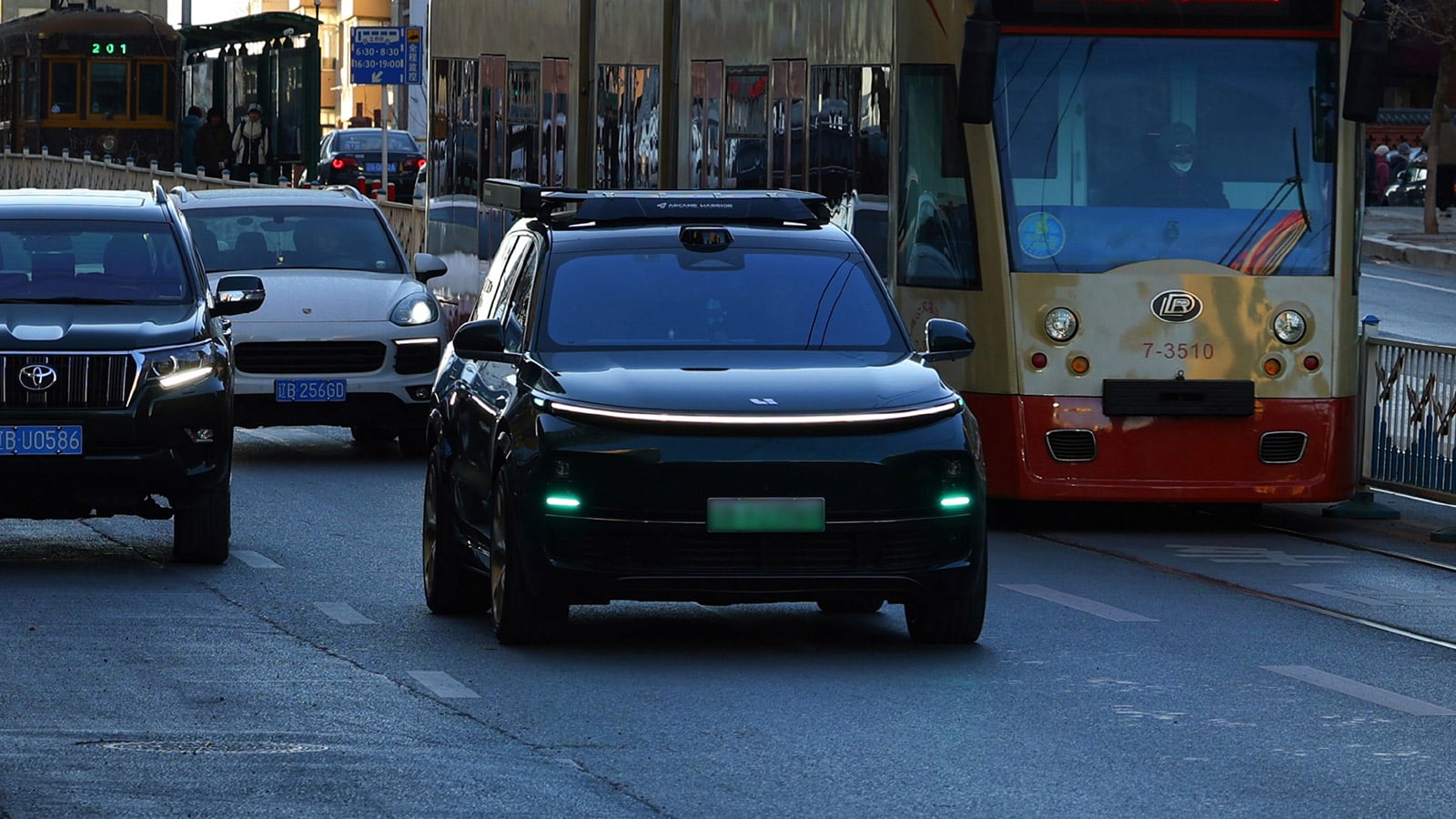
A file photo shows a Li L9 with its smart driving blue indicator light on. Credit: Li Auto
- China’s industry regulator has reportedly ordered that passenger vehicles no longer be fitted with blue lights indicating the activation of driver-assistance systems.
- The blue indicator lights do not comply with existing national standards governing vehicle-light colors.
China’s industry regulator is set to prohibit passenger vehicles from being fitted with external blue indicator lights designed to show when driver-assistance systems are operating, commonly known in the industry as “little blue lights.”
A screenshot of a notice shared Wednesday by auto industry blogger Sun Shaojun showed that China’s Ministry of Industry and Information Technology, or MIIT, had ordered passenger vehicles to stop installing the lights immediately because they do not comply with GB 4785 requirements.
The MIIT will next study how to handle vehicles already sold with the blue lights, according to the text shown in the screenshot.
Local media outlet Yicai later cited Geely Auto (HKEX: 0175) as saying it was aware of the directive and would strictly comply with national regulations while awaiting further requirements.
An employee at an automaker confirmed to Yicai that China had prohibited the use of the blue lights on newly certified vehicle models from July 27, 2026.
The MIIT has yet to publish a public document on the matter.
The existing GB 4785-2019 standard, titled Prescription for installation of the external lighting and light-signalling devices for motor vehicles and their trailers, was issued in December 2019 and took effect in July 2020.
The standard specifies the permitted purposes and colors of vehicle lights, listing only white, yellow, red and amber. Blue is not included.
The official name for the “little blue light” is the Automated Driving System Marker Lamp, or ADS lamp.
Li Auto (NASDAQ: LI) first introduced the light on its Li L9 extended-range SUV (sport utility vehicle) in August 2022. Most major EV makers, including Xpeng (NYSE: XPEV), Nio Inc (NYSE: NIO), BYD (HKEX: 1211) and Xiaomi (HKEX: 1810), subsequently followed.
The lights were intended to alert other road users that a vehicle was operating with the driver and assistance system sharing control. However, in the absence of mandatory unified standards, automakers adopted different installation positions, brightness levels and shades of blue.
Criticism has mainly focused on 2 issues: excessive brightness and poorly chosen installation positions. On some models, the lights are mounted directly at the eye level of drivers in following vehicles, making them particularly distracting at night and in rainy conditions.
The ban continues Chinese regulators’ efforts to tighten rules governing intelligent-vehicle design. Hidden door handles, single-pedal driving, touchscreen gear selectors and unconventional steering wheels have all faced regulation after periods of largely unchecked adoption.
Two mandatory national safety standards take effect on July 1, establishing the world’s first “no fire, no explosion” requirement for EV batteries.
