

- Li Auto rose 11%, Nio about 5%, while Xpeng and BYD gained more than 4.6%.
- The MIIT said it will speed up the drafting and release of a 15th Five-Year Plan for the smart, connected NEV industry.
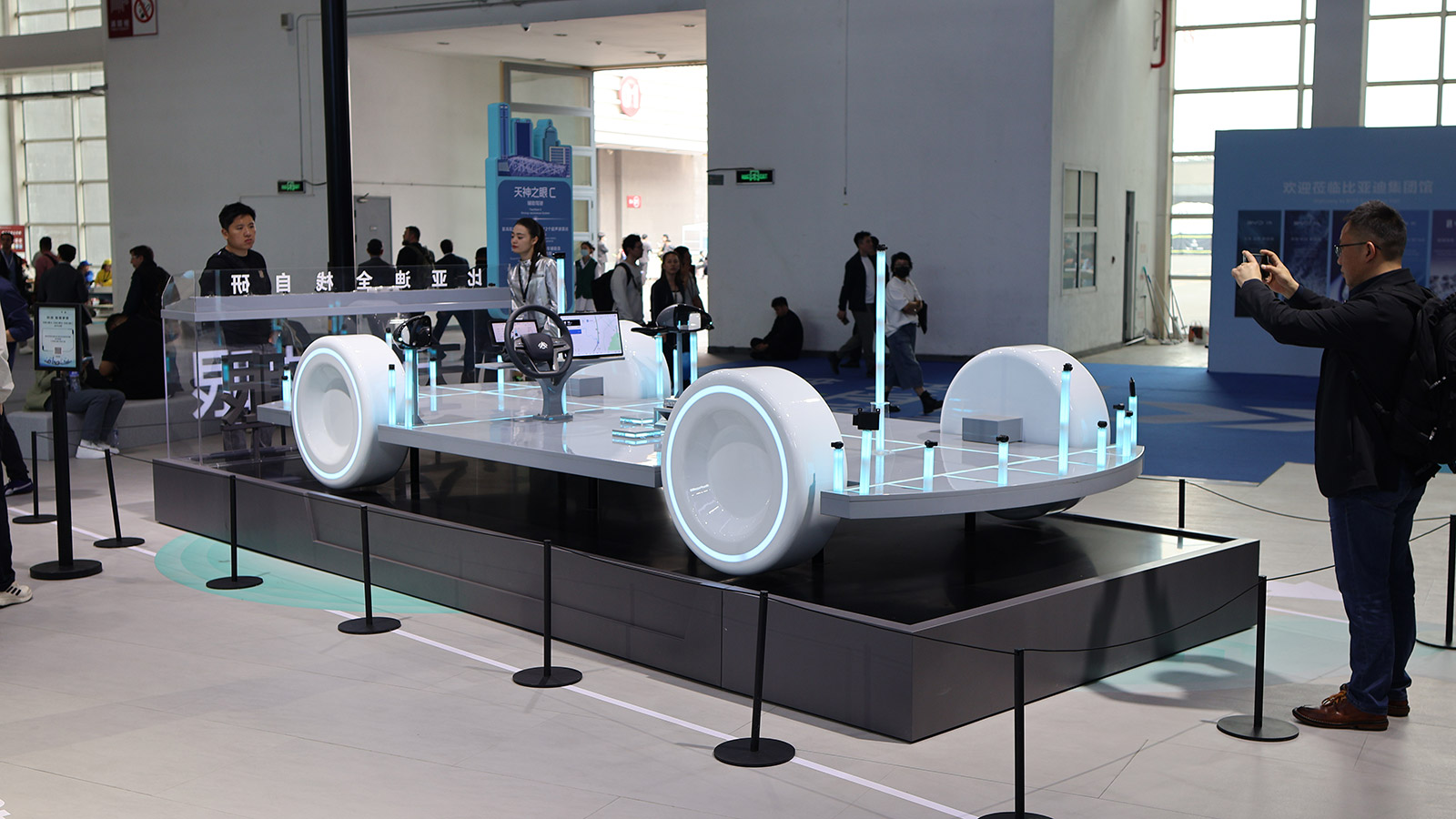
A prototype of BYD’s intelligent driving solution showcased at the Beijing Auto Show in April 2026. Credit: CnEVPost
Auto stocks in Hong Kong surged across the board on Wednesday, after China’s industry regulator said it will speed up the drafting and release of a 15th Five-Year Plan for the smart, connected new energy vehicle (NEV) industry.
As of the time of writing, Nio Inc’s (HKEX: 9866) Hong Kong-listed shares were up 5.08% at HK$38.86. Xpeng (HKEX: 9868) was up 4.82% at HK$51.95.
Li Auto (HKEX: 2015) led the EV startups, at one point soaring 11.01% to HK$55.15, its highest level in more than a month.
BYD (HKEX: 1211) rose 4.62% to HK$93.95. Geely Auto (HKEX: 0175) was up 6.90 percent, Chery gained 7.79% and GAC Group climbed 7.27 percent.
Xiaomi (HKEX: 1810) rose 7.59 percent, Leapmotor (HKEX: 9863) gained 7.11% and Seres (HKEX: 9927) was up 6.63 percent. Battery giant CATL (HKEX: 3750) rose a more modest 0.58 percent.
Vehicle makers listed on the mainland’s A-share market also extended their strength. BAIC BluePark was close to its daily limit up, while Anhui Jianghuai Automobile Group Corp (JAC) and Changan Automobile also rose.
Guo Shougang, head of the Ministry of Industry and Information Technology’s (MIIT) equipment industry department, said at a media roundtable on July 27 for the 2026 World Intelligent Connected Vehicle Conference that the ministry will next speed up the drafting and release of a 15th Five-Year Plan for the smart, connected NEV industry, according to a Xinhua report on Tuesday.
China will accelerate breakthroughs in a batch of key core technologies, speed up the development of major standards, their international coordination and implementation, and further advance pilot programs for “vehicle-road-cloud integration” applications, production access and road use, he said.
So far this year, the penetration rate of passenger vehicles with Level 2 combined driving assistance has reached 70.5 percent, and that of vehicles with navigation-on-autopilot (NOA) features has reached 34.2 percent, Guo said.
The first batch of Level 3 conditionally autonomous driving models has also begun operating on roads in designated areas, he noted.
Regions across China have issued more than 20,000 test and demonstration license plates for smart, connected vehicles, opened more than 57,000 kilometers of roads for testing and demonstration, and logged over 220 million kilometers of cumulative test mileage, he said.
The 2026 World Intelligent Connected Vehicle Conference is co-hosted by the MIIT, the Ministry of Transport and the Beijing Municipal People’s Government, and is scheduled to be held in Beijing’s Yizhuang from October 21 to 23, 2026.
The goal means China’s NEV fleet needs to more than double within five years.
