

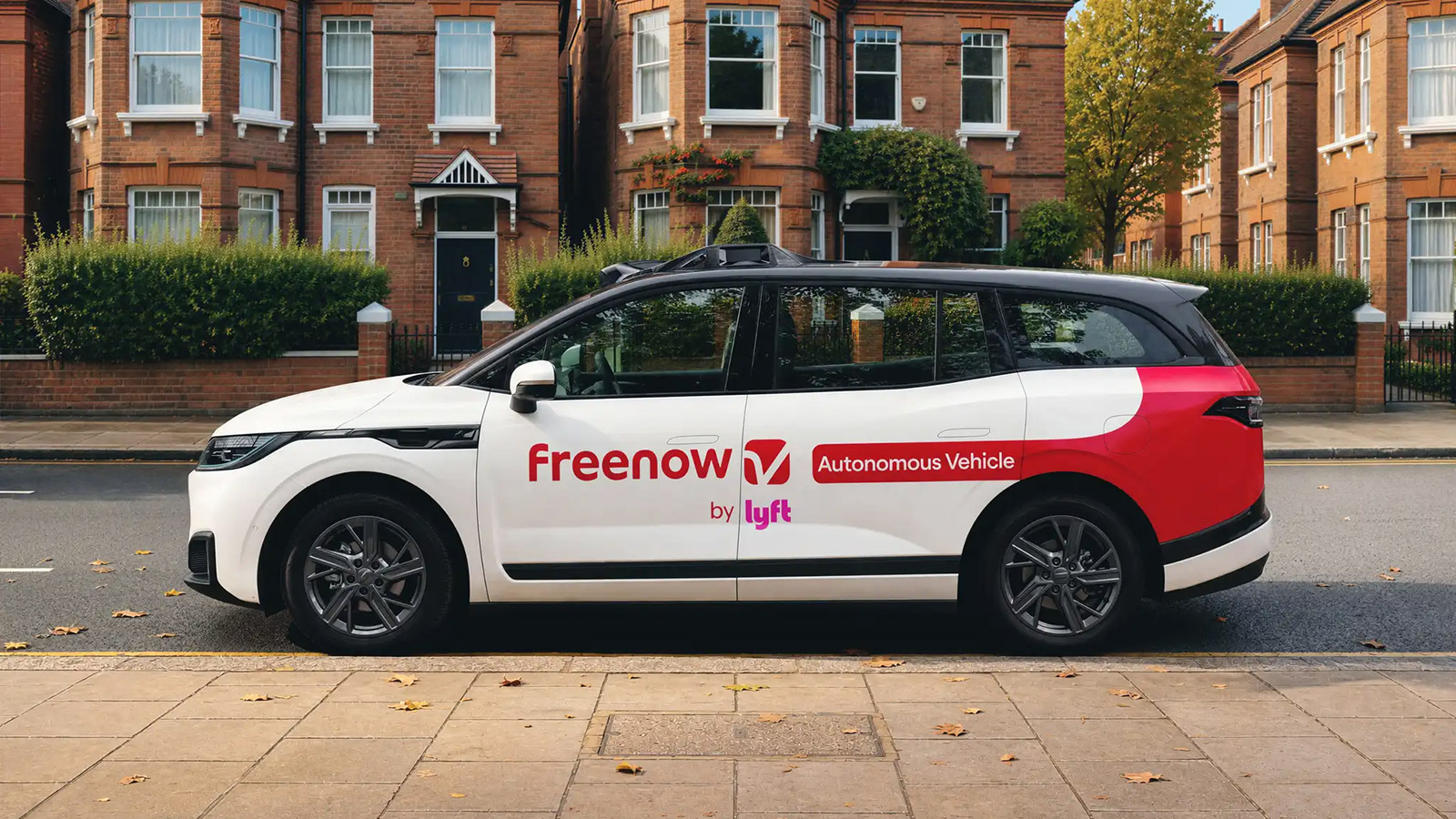
Baidu’s Apollo Go and Lyft’s Freenow have begun testing RT6 vehicles in the London borough of Brent. Credit: Freenow
- Apollo Go and Lyft’s Freenow have begun testing RT6 vehicles in London’s borough of Brent, with safety operators on board.
- Baidu won its first fully driverless testing permit in Hong Kong last week, the first such trial in any right-hand-drive market globally.
Apollo Go, the autonomous ride-hailing platform of Baidu (NASDAQ: BIDU), has begun road testing in London, marking a new phase in the Chinese tech company’s expansion in Europe.
Baidu said on Tuesday that the testing is being carried out with Freenow, the European mobility platform owned by Lyft (NASDAQ: LYFT), using Apollo Go’s sixth-generation autonomous vehicle, the RT6.
Testing will begin in the borough of Brent in north-west London, covering a mix of urban and suburban driving environments, with safety operators on board.
The two companies plan to welcome public riders starting in 2027, subject to regulatory approvals.
The deployment builds on the strategic partnership Baidu and Lyft announced in 2025. Baidu provides the RT6 vehicles and autonomous driving technology, while Freenow contributes local operations.
Freenow and Lyft have held extensive discussions with Transport for London (TfL) and the Centre for Connected and Autonomous Vehicles (CCAV).
Credit: Baidu
The London program builds on Apollo Go’s experience in Hong Kong, its first right-hand-drive market.
On July 23, Apollo Go received the first fully driverless trial permit from Hong Kong’s Transport Department, with testing beginning on Airport Island on July 27.
That was Hong Kong’s first Level 4 autonomous trial on public roads without an on-board safety operator, as well as the first fully driverless trial in any right-hand-drive market globally.
In London, the RT6 vehicles will operate as part of a hybrid network alongside Freenow’s established taxi and private hire vehicles. As the number of vehicles on the platform increases, pickup times should get shorter.
A survey conducted by Censuswide in March on behalf of Freenow showed that 48% of Londoners have never ridden in an autonomous vehicle, yet 58% said they would be likely to try one.
Among respondents under 35, nearly two-thirds are in favor of autonomous vehicles being available in the capital.
As of April 2026, Apollo Go had provided more than 22 million cumulative rides to the public.
In the first quarter alone, it completed 3.2 million fully driverless rides, a volume growing at over 120% year-on-year.
As of May, Apollo Go’s footprint spanned 27 cities globally, and its fleets had accumulated over 330 million autonomous kilometers, including more than 220 million fully driverless kilometers.
Apollo Go and Kazakhstan’s TPH signed a strategic cooperation agreement to jointly explore introducing robotaxi services in the country.
