

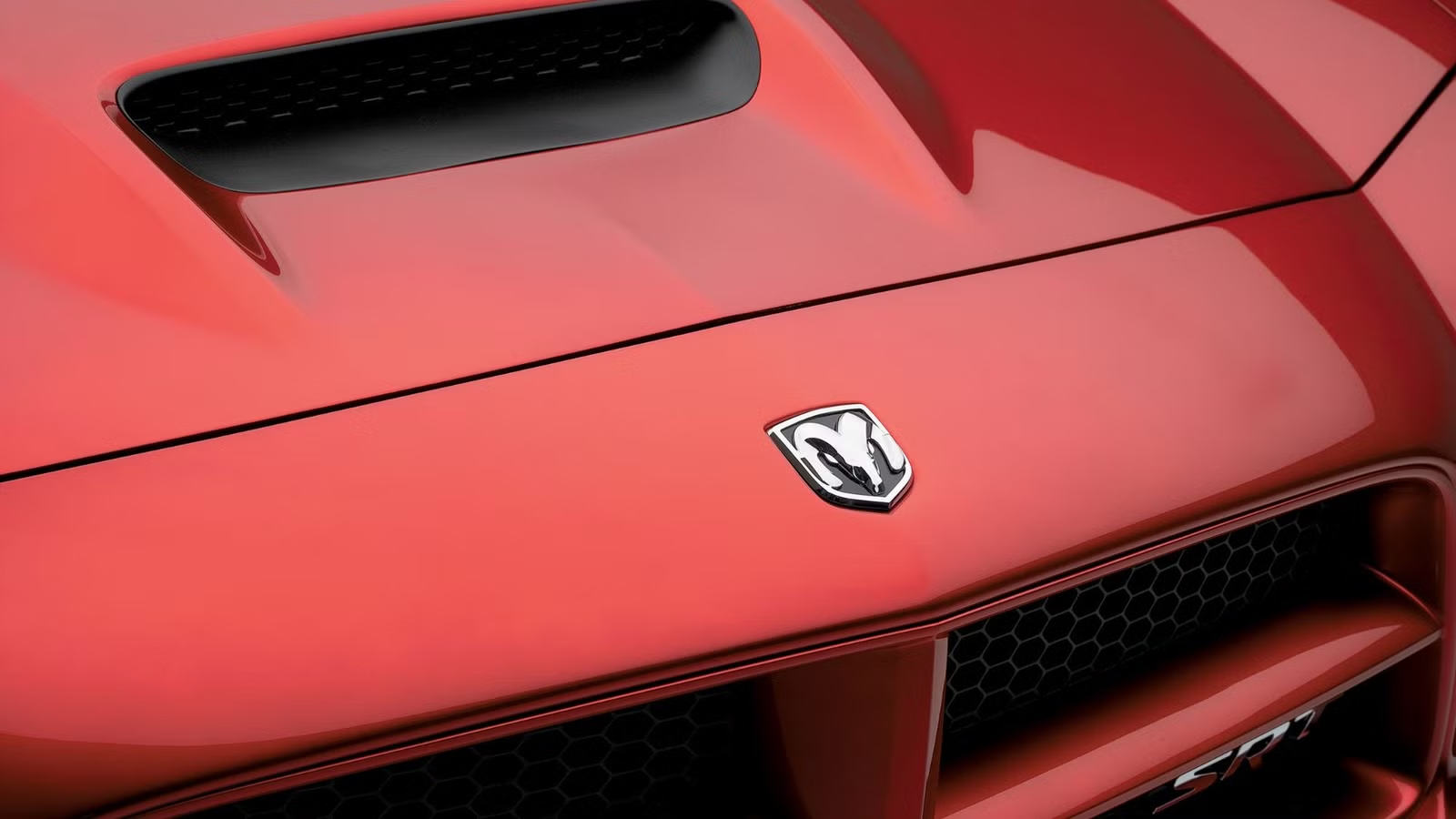
When you think of a quintessential American car, it’s likely the muscle vehicle breed is the first that comes to mind. North American manufacturers like Chevrolet, Dodge, and Ford perfected the recipe of taking a relatively normal-looking sedan or coupe, and then equipping it with an engine larger than an offshore oil rig. With all the extra grunt that resulted, you had a car that would get down the straights like a fighter jet, but then corner like an Airbus A380.
When it came time for Dodge to reimagine a muscle legend in the mid-2000s though, there were hidden depths that were decidedly German in nature.
Dodge’s Parent Company Joined Up With Mercedes’ Owners
2005-2006 Chrysler Crossfire SRT6 Roadster Front Angle ViewChrysler
The story starts in 1998, when Chrysler and Daimler merged in a deal that was described as a “merger of equals.” Chrysler had been struggling to maintain its momentum and sales success against the likes of Ford and General Motors in the United States, while Daimler’s Mercedes-Benz was starting to feel the pressure not only from German rivals Audi and BMW, but also rising Japanese contenders like Lexus.
By merging as one, the two companies would be able to leverage each other’s advantages for themselves, which would ideally allow both firms to prosper long into the future. As part of the deal, Chrysler was able to take advantage of Mercedes’ engineering prowess in an effort to improve its own offerings. Of course, since the companies’ respective brands couldn’t fight each other to maintain profitability, Chrysler’s products tended to remain on the cheaper side of the coin, whereas Mercedes’ retained its place at the premium end of the market. The Chrysler Crossfire and Mercedes-Benz SLK are prime examples of this strategy.
Still, Chrysler had a lot to gain by working with Mercedes, and it took advantage of this access when the time came to resurrect the legendary Charger nameplate after nearly 20 years on the sidelines.
The Charger Utilized Several Key Design Features From Mercedes
2006 Dodge Charger SRT8 front quarterDodge
The new Charger would be built on Chrysler’s LX platform, which was developed for full-size sedan models. The more upmarket Chrysler 300 was the first to utilize it, with the Dodge Charger being unleashed on the underpinnings in 2006. Having been based on Chrysler’s previous LH platform, which was designed for front-wheel drive cars, the LX was changed to suit a rear-wheel drive configuration. While elements such as the front suspension were designed by Chrysler, it heavily studied the designs of Mercedes’ similarly sized models when originally conceiving the LX.
In the end, Mercedes’ multi-link rear suspension setup was employed to improve ride comfort and handling, while the front suspension setup was heavily inspired by the arrangement used by the high-endS-Class. Beyond that, the rear differential and five-speed automatic transmission found in the earlier V6 and all V8 models were also sourced from Merc.
The German bits didn’t end there, either, as the Charger also made use of several electronic systems developed by Mercedes, such as Stability Control.
That meant that while muscle versions of the Charger, such as the SRT8, got traditional American muscle engines and looks, much of its underpinnings were pure Mercedes. The same could be said for the Challenger, which came along a couple of years later in 2008. It used a shortened version of the LX platform to suit its two-door coupe philosophy, and went even further in that it used a Mercedes-sourced steering column.
This may dilute the pure American muscle DNA for some, but the decision allowed Chrysler to include well-developed hardware without having to spend a fortune designing it itself, while also adding to its knowledge base.
But if so much was German, what exactly made these cars feel like true American muscle?
The Real Important Bits Were Still Unashamedly American
2006 Dodge Charger SRT8 HEMI engineDodge
That said, the primary components that American muscle enthusiasts really cared about, the out-there aesthetics and the commanding V8 engine, were purely American-born and bred. The Charger SRT8’s muscular and imposing styling was thought up by American designers Ralph Gilles and Freeman Thomas, with the car’s wide arches and chunky grille giving it an angry look that made it clear to other road users that it would be coming past whether they liked it or not. The same could be said for the Challenger, which featured a design inspired by its mid-20th century forerunners.
And then there is the awesome Hemi engine. Developed by Chrysler’s Street and Racing Technology department, the 5.7 and later 6.1-liter Hemi V8s were engineered using the most advanced technology available at the time. This allowed the power plants to not only produce a great deal of power and the traditionally expected V8 rumble of a thoroughbred muscle car, but also to be clean enough to maintain compliance with modern emissions regulations.
With 425 horsepower being delivered to the rear wheels of either model in SRT8 spec, but with softer suspension settings that ensured they retained the wayward handling of classic muscle creations, Chrysler’s offerings felt as un-German as was possible.
At the same time, the more advanced underpinnings and hidden bits meant that the cars weren’t as agricultural as previous creations, and proved crucial as Chrysler tried to keep up in a rapidly evolving automotive landscape.
Chrysler’s Muscle Cars Weren’t The First To Gain From This Treatment
The Chrysler Crossfire, a Mercedes-Benz SLK playing dress up.Chrysler
While the Charger and Challenger were the first cars from Dodge to feature components and engineering borrowed from Mercedes, they weren’t the first within the Chrysler umbrella. The more luxury-focused Chrysler brand came out of the blocks first in this regard, with three models emerging between 2004 and 2005. TheCrossfire was a two-seater sports car that was essentially a reskinned R170-generationMercedes SLK. It went much further than the Charger and Challenger, since the Crossfire shared 80% of its components with the SLK.
It used the same platform, engines, and transmission as the SLK, with the only real differences coming from new interior and exterior designs. Like Chrysler’s later muscle cars, the Crossfire was built to look chunkier and more aggressive than the SLK, which sported a sleeker and classier silhouette.
Aside from the Crossfire, there was also the Pacifica crossover. It used a bespoke platform called Chrysler CS, which was essentially a tweaked version of the firm’s RS foundations that were usually found hidden beneath the skin of its various minivans. As the only Chrysler model ever to use the CS platform, the main differences could be found in the rear, where you’d find the multi-link Mercedes suspension layout later used in the Charger and Challenger. By the same token, it also used some electronic elements, as well as Merc’s 5-speed auto transmission. Around the same time, the 300 sedan was also prowling the streets, of which the Charger was pretty much a reskin.
Chrysler And Daimler’s Relationship Quickly Shattered
2007 – 2008 Chrysler Pacifica front 3/4 profileChrysler
As it turned out, the merger of equals turned out to not be particularly equal. Daimler tended to have more control over the relationship than Chrysler, which meant Mercedes was generally prioritized over Chrysler’s brands. The American side also became frustrated that the Chrysler marque, in particular, was seen as beneath Mercedes, despite its long history competing with high-end luxury brands like Cadillac and Mercury.
These dynamics played out in Chrysler’s product range, which was full of previous-generation Mercedes parts that effectively meant the vehicles were out of date from the moment they reached the showroom. These rifts continued to grow within the organization during the 2000s as the two sides disagreed on the way forward, while Chrysler had also started posting heavy financial losses. Merc wanted out, so it eventuallyagreed to sell 80% of the Chrysler Group to investment group Cerberus Capital Management for $7 billion in 2007. Considering the DaimlerChrysler Group was initially valued at $38 billion, this was a serious loss for both parties.
By 2009, Daimler had cast off its remaining shares in Chrysler to make a clean break. Ultimately, the vastly different corporate cultures and approaches proved too great a hurdle to overcome, resulting in a costly and inevitable divorce only a decade after the landmark deal was reached. As a result, there are few successful examples of the partnership that exist, leaving a question mark over what could have been had both sides tried to change their approaches somewhat to improve co-operation.
At least the Chrysler ME FourTwelve concept emerged from the partnership, so it was not all bad.
Sources: Chrysler, Mercedes-Benz.
