

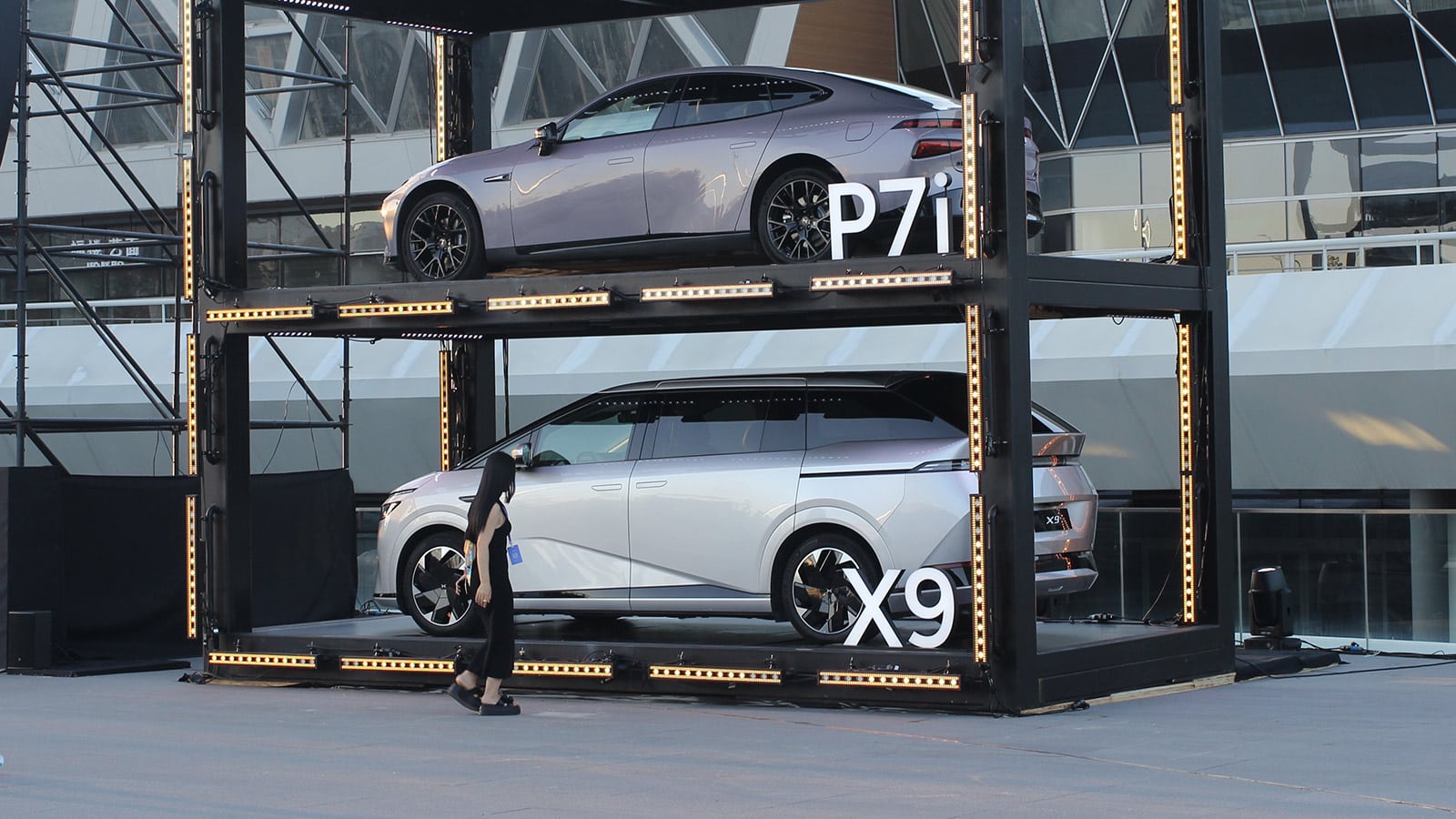
File photo shows the Xpeng X9 and P7i. Credit: CnEVPost
- Inspectors randomly selected sample vehicles and power batteries on-site and sent them for testing to verify compliance with national standards.
- The inspections came just a week after the MIIT held a meeting with key automakers, urging them to firmly resist irrational competition.
China’s Ministry of Industry and Information Technology (MIIT) has conducted on-site inspections at plants of GAC Aion and Xpeng (NYSE: XPEV), signaling that the regulator is moving quickly to implement the vehicle quality and safety checks it outlined a week ago.
On July 24, the MIIT’s first department of equipment industry visited the two automakers to conduct supervisory inspections on their product safety assurance capabilities and production consistency, according to a statement on Friday.
The inspections focused on how the companies maintain production access conditions, including intelligent connected vehicle safety assurance capabilities, design, development and production capabilities, and production consistency assurance capabilities, the MIIT said.
Inspectors randomly sampled vehicles and power batteries on site and sent them to relevant institutions for testing, including compliance with national standards, the statement showed.
The MIIT said it will continue to organize supervisory inspections of automobile and motorcycle manufacturers and their products, deal seriously with companies found to have problems, firmly hold the bottom line of vehicle product safety, and effectively protect consumers’ legitimate rights and interests.
GAC Aion is the new energy vehicle (NEV) subsidiary of GAC Group. The Xpeng facility inspected was its Zhaoqing plant, the company’s first self-built plant.
The inspections are the MIIT’s latest move to tighten oversight of the auto industry. On July 17, the ministry held a meeting with key vehicle manufacturers, requiring them to firmly resist irrational competition and strengthen product testing, validation and safety assessment.
The meeting placed particular emphasis on strengthening the safety assessment of combined driving assistance and autonomous driving functions, as well as enhancing safety assurance capabilities in functional safety, cybersecurity, data security and software updates.
The meeting also required automakers to systematically identify problems in production consistency, reliability, durability and new technology testing and validation, both in-house and at key parts suppliers, meaning regulatory scrutiny has extended from vehicle makers to the supply chain.
China’s auto industry is facing fierce competition. Regulators have repeatedly vowed to curb irrational competition this year, while rolling out a series of mandatory national standards covering power batteries, door handles, driving assistance systems and other areas.
A week ago, Xpeng apologized for air spring failures on the X9 in high temperatures and extended the warranty on the related system.
