

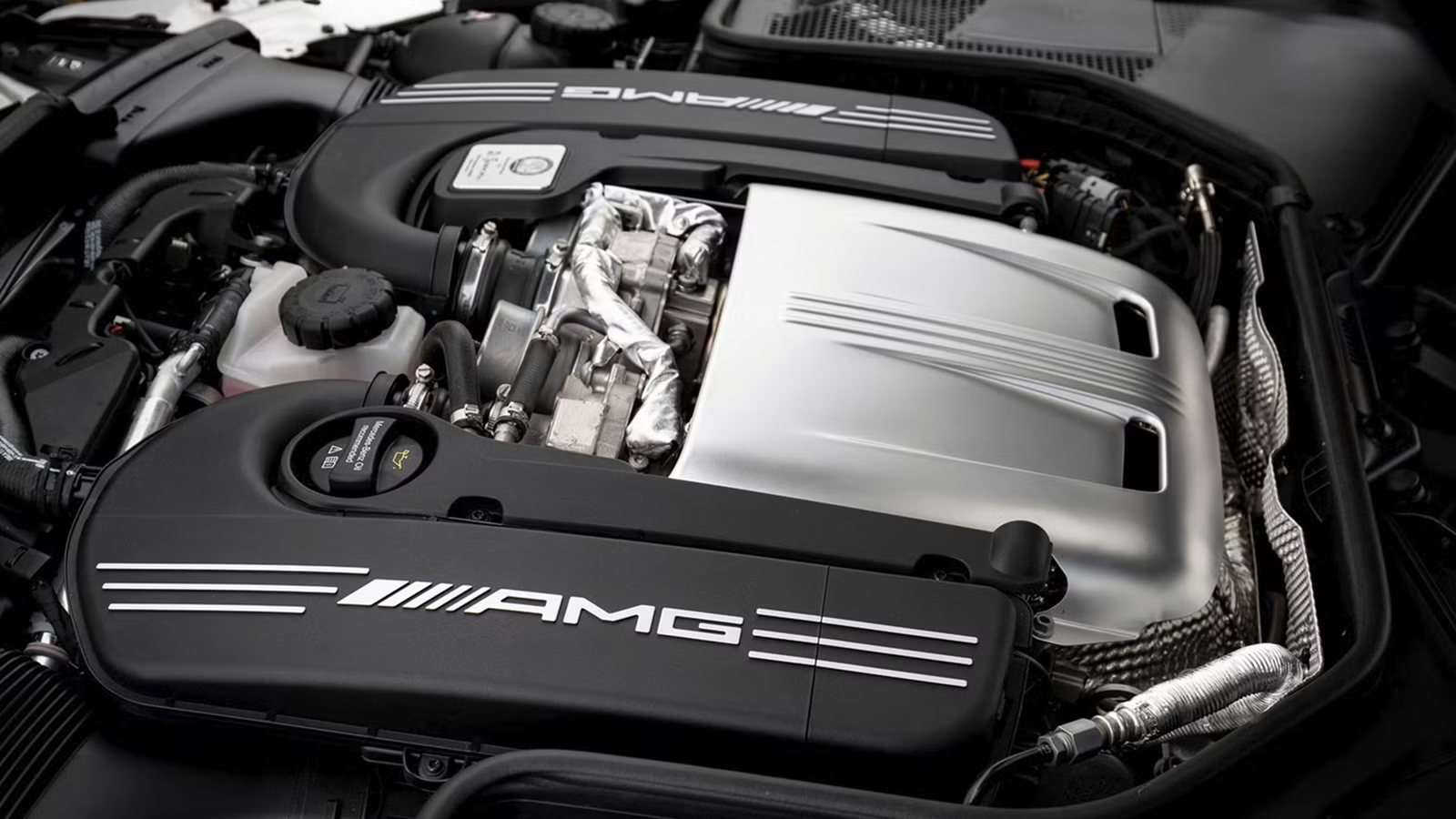
It’s official: Mercedes-Benz is obsessed with performance. Sure, one could simply turn up the boost on a turbocharged engine for more horsepower, but it’s not as simple as it sounds. One must find balance – more boost means more air, which needs more fuel, which creates a bigger boom, stressing other components, and so forth.
The 2025 Mercedes-AMG GT 63 S E Performance Coupe on track.Mercedes-Benz
The quest for horsepower is a vicious cycle of give-and-take, and through it all, heat is the number one enemy. Too much heat can cause lubricants to break down. It can melt vital components. It causes air to expand, meaning less in the engine and that means less power. That’s why automakers have all kinds of solutions to battle heat, but CarBuzz just found a recent patent from Mercedes-Benz that goes after heat in a very interesting way.
Air And Fuel Enter, Exhaust Gases Leave – With A Twist
Mercedes-Benz Exhaust PatentMercedes-Benz Group AG
Regardless of design, every internal combustion engine works in the same fundamental manner. Air and fuel enter the engine, the mixture is detonated, exhaust gases leave the engine. The quicker you do that, the more power you make. Components like turbochargers or superchargers can shove more air into the engine, but if the exhaust can’t get out, it’s all rather pointless.
That’s why aftermarket exhaust systems are a very common first upgrade for gearheads seeking more horsepower. It’s not just the size of the pipes that matter though. Without getting too technical, intermingling the flow of exhaust gases can help that flow be more efficient. It’s why you often hear terms like “equal length” and X-pipe” mentioned regarding exhaust systems. Mercedes is kind of doing that here with this new patent.
The difference, however, is that the intermingling isn’t happening further down the exhaust system. It’s happening right at the engine, though a series of “branch channels” that funnel exhaust out and about in multiple ways. It all eventually finds its way into manifolds, which then carry the gases out in the normal manner. And since this applies to a turbocharged engine, some of those gases spin turbos to feed more air back into the engine.
Lower Temperatures, Less Complexity, More Power
The glory days, when the Mercedes-AMG C63 S was powered by a big and nasty V8 engine, and brought thunder to the game. Lovely.Mercedes-AMG
According to the patent, the point of all this isn’t so much about balance and optimizing flow. It’s all about lowering exhaust gas temperatures. Remember above when we talked about heat being the enemy? By introducing these flow channels, Mercedes engineers think they can bring temperatures down and thus create more power. Per the patent:
“Compared to conventional solutions, the invention enables a reduction in the exhaust gas temperature, also referred to as the exhaust gas temperature, so that, compared to conventional solutions, an increase in the engine power of the internal combustion engine is possible, particularly in lambda-1 operation of the internal combustion engine, i.e., in operation of the internal combustion engine with a stoichiometric air-fuel ratio, without excessively complex additional technologies. In other words, the invention makes it possible to achieve a particularly high engine power output in operation of the internal combustion engine, particularly with a stoichiometric air-fuel ratio, while simultaneously enabling particularly low-emission operation of the internal combustion engine, without having to use complex additional technologies.”
There’s some techno-speak in there, but that last bit is of particular interest. Automakers, especially certain German brands, have come under scrutiny for ever-complex performance vehicles that have big power, but offset it with a bigger curb weight. With this design, Mercedes is actively looking for ways to increase power and engine efficiency without plugging in “complex additional technologies.” Of course, one might see all this and shudder about the possibilities of exhaust leaks from all the passages, but hey, it’s not adding undue weight, right?
CarBuzz Insight – Why This Matters:
Weight in modern vehicles, performance or otherwise, is a legitimate problem. No matter how good the engineering is, basic physics says you need more power to move around more weight, and more power takes more fuel. We’re in a bit of a lull regarding emissions and efficiency, at least in the US, but that lull will not last. And the rest of the world, particularly Europe, is still very focused on efficiency in the near-term.
Even though this solution could deliver a bit more efficiency and power, it’s hard to see the design being that effective in the grand scheme of things. And while this isn’t complex technology, we’re still talking about a complex design that opens the door for more failure points. This is a very clever idea, no doubt about that. But is it clever just for the sake of being clever, or is it a sign that automakers are simply running out of ways to evolve V8 engines for a more efficient future that is still coming?
Patent filings do not guarantee the use of such technology in future vehicles and are often used exclusively as a means of protecting intellectual property. Such a filing cannot be construed as confirmation of production intent.
Source: German Patent And Trade Mark Office
