

While Mazda has positioned itself as an automotive giant over the decades, it’s had to live in the wide-reaching shadows the likes of Toyota and Honda have cast over the industry. On top of its agreeable civilian vehicles, Mazda has also worked hard to help create and apply some truly left-field innovations over the years, the most famous of which is the Wankel rotary engine, which saw regular use in a few of Mazda’s greatest hits, such as the RX-7. This in addition to staples from the brand like the Mazda MX-5 Miata.
Despite all the work the brand has put in, that shadow has always been tough to escape from, but not without multiple efforts to do just that. One such effort was the attempted creation of a luxury sub-brand, much like what Toyota did with Lexus or Nissan with Infiniti. Mazda had grand goals to rival the world’s best, not just the likes of Lexus, but Mercedes-Benz. Today, names like Lexus are synonymous with luxury, but if Mazda had succeeded in the early 1990s, we’d all be clamoring to drive cars with a different name on them: Amati.
But just when Amati was about to take off, tragedy struck for Mazda.
The Beginnings Of “Project Pegasus”
The logo of the Amati luxury brand from Mazda.Mazda
Amati Fast Facts
- Established in 1988 under the codename “Project Pegasus”
- First model, the Amati 1000, intended to launch in 1994
- Target audience of US consumers with annual incomes over $75,000
- Headed-up by Dick Colliver, an American Mazda executive
- Amati was declared dead on 26 October, 1992
- At the time of its closure, the Amati brand had plans for 67 US dealerships and 35-50 employees
- The mid-1980s saw an extremely prosperous Japanese economy. A couple of key points contributed to this, mainly the 1985 Plaza Accord, which sought to equalize the currency of several world superpowers and ended up increasing the Japanese Yen’s value. The Louvre Accord of 1987 further equalized world currency and increased the Japanese Yen’s value even more.
This meant the Japanese automotive industry was enjoying a near-endless supply of money it was eager to put to use.
Mazda’s answer to the cash surplus was the creation of four new sub-brands, responsible for targeting different demographics both in Japan and abroad. By 1991, Mazda had created the ɛ̃fini, Eunos, Autozam, and Amati brands. Ɛ̃fini and Amati were luxury-oriented marques, while Autozam handled small Kei cars, and Eunos produced sportier vehicles. Chronologically, Amati was the first of these sub-brands, founded in 1988, but it was also the only one of the four never to officially launch a model.
Amati was born out of what Mazda referred to as “Project Pegasus,” and was initially believed to be nothing but a rumor by the American arm of Mazda. More specifically, Project Pegasus was thought to be mere busywork for Colliver to handle and, as the American Mazda staff put it, to “put Colliver out to pasture.” Surprisingly, Amati was a serious idea of Mazda’s and was officially announced in 1991, three years after it was initially plotted.
The Amati Lineup Wanted To Hit BMW Where It Hurt
Mazda
The reason for the delay was to keep Mazda’s larger competitors from getting the jump on the smaller, less resource-rich Mazda, which was only Japan’s fourth-largest automaker. Considering the world-beating Lexus LS arose from a $1 billion check, Mazda couldn’t rush a subpar product and brand to market.
Following the announcement to the public, Amati and Mazda revealed plans to build three models, targeting the BMW 3, 5, and 7 Series sedans:
- Amati 300 – a compact version of the Eunos 500
- Amati 500 – a mid-sized sedan based on the Eunos 800, which featured cutting-edge tech such as a miller-cycle engine, which contained two separate power strokes, and yaw-controlled four-wheel steering.
- Amati 1000 – a full-size luxury sedan targeting the Lexus LS and BMW 7 Series, powered by a V12 engine.
A Bespoke V12 To Challenge The World’s Best
Mazda’s W12 engine concept from the 1989 Tokyo Auto ShowMazda
The Amati 1000 was the car that could’ve been Mazda’s Lexus LS, and what a car it would’ve been. Initially, many believed Mazda was developing a W12 engine for the Amati 1000 after the automaker revealed a 4.0-liter W12 at the 1989 Tokyo Auto Show – producing a claimed 276 hp which we now know was a lie. But it later emerged that the W12 was shown to throw rivals off the scent of what Mazda was really developing.
Speaking of the Amati brand, former Mazda executive Bob Hall told Jalopnik, “There was never a W12, it was always a V,” and was to be built by effectively binding two Mazda V6s nose-to-tail. “[It used] rotating assemblies of the K series in a new block,” said Hall, explaining that the block itself had been designed to accommodate engines up to 5.0 liters in displacement.
“They had done a 3.6 [V12] of the two 1.8 [V6s],” Hall said. “The block was designed up to a 5.0-liter. North America would be a 4.6 [liter] from two 2.3s.”
Hall likened the sound of Amati 1000 prototypes to that of a Ferrari V12, but its performance was on par with the Lexus LS400 – slower from 0 to 60 but quicker from 60 to 80.
A Revolutionary Design With Porsche Lines And Closed Arches
The engine at the heart of the Amati 1000 wasn’t to be its only unique attribute. It was also going to look unlike anything else out there – at least that was the plan. Peter Birtwhistle was the man tasked with designing the new flagship, and in his book, An English ar Designer Abroad, he speaks of what the 1000 was going to look like.
“The car, which measured over 5 meters [197 inches] in length, featured covered rear wheel-houses and a smooth front face similar to a Porsche 928 (My previous employee had been Porsche). By now the name of the range of cars had been decided and would be called Amati.”
– Peter Birtwhistle, former Mazda Motor design manager
But it never became Birtwhistle’s vision for a luxury car, which you can see in the design sketches embedded below. “I would join the team in Hiroshima to finalize the design, however Mazda deemed the car too advanced for the conservative luxury car buyer and the design was gradually diluted,” explains Birtwhistle. “Both the smooth front end and later the covered rear wheels would go from the design, which ended up as a rather generic design statement similar to the Lexus LS 400.”
“That, as it turned out, was as far as the development went. Mazda overextended themselves financially and the program was canceled.”
The Downfall Of Amati Opened The Door For Ford
Shortly after the Amati lineup was teased, the Japanese price bubble burst. The same accords that had seen the Japanese economy swell pushed it to unsustainable highs followed by remarkable lows. The Japanese economy plunged into what’s known as Japan’s Lost Decade, a period of crippling economic stagnation that lasted nearly 20 years. Japan’s own unstable economy, paired with a looming worldwide recession, forced Mazda to axe plans for the Amati brand, with the official announcement made on October 26, 1992.
Had US sales of luxury cars sustained through this time, Amati may still have come to fruition, but as the LA Times reported, “Since then [Amati’s announcement in 1991], car sales in the United States have dropped another 15%, although sales of several luxury models, including Lexus, Infiniti and BMW, are up substantially this year compared to the first nine months of 1991.”
Wikimedia Commons: Rudolf Stricker
The Right Move At The Time
The decision to kill the Amati brand was widely lauded as the right one, even among Mazda’s industry rivals. Richard Lepley, senior vice president of sales and marketing at Mitsubishi labeled the decision “an inevitable business decision in today’s automotive climate, and it will prove to be a good one for Mazda and Mazda’s dealers,” while Douglas Kevorkian of J.D. Power & Associates said the move was “probably a sound one, given the terrible economy in Japan and the U.S.”
The sudden cancelation of Amati created quite a bit of fallout. 67 American dealerships had signed on to sell Amati-branded vehicles, and Mazda’s Hofu plant, based in Japan, was already re-tooled to begin producing the Amati 1000’s V12 engine. Mazda had also sunk $75 million into an upcoming ad campaign for the Amati brand. At the time, Ford owned a 24 percent stake in Mazda and ended up purchasing another 12 percent in 1995 to help give Mazda a funding boost necessary for the brand’s survival.
Dick Colliver, the man who ran the short-lived Amati brand, would retire from Mazda in 1994. The entire Amati staff was laid off indefinitely, and Colliver was famously quoted commenting on the reason for Amati’s marketing department losing their jobs, saying they had “researched their way out of a job.” After Ford had taken a larger stake in Mazda, a period of grueling brand stagnation began for Mazda, with only the RX-7 and MX-5 Miata being of any note during this time.
What Happened To Mazda’s Other Sub-Brands?
Wikimedia Commons: Tennen-Gas
Amati wasn’t the only Mazda sub-brand to be unceremoniously given the axe. Following the Japanese Price Bubble collapse, Mazda was stretched too thin to handle all the new brands it had launched. It didn’t have the necessary capital to weather such an economic downturn.
- Ɛ̃fini, which was meant as a separate luxury marque more focused on personal luxury and sports cars, officially began producing cars in 1991. It offered models such as the MS-9 – a luxury sedan – and a rebadged version of the Mazda RX-7. Ɛ̃fini had a modest run of six years, discontinued in 1997 after less-than-satisfactory sales figures.
- Eunos was the fun sibling. The brand was focused on spry, fun-driving coupes and sedans. Its run began in 1989 and was most well known for the Eunos Roadster, a rebadged version of the Mazda MX-5 Miata. It also sold the rotary-powered Eunos Cosmo, a more luxurious sports coupe that was allegedly going to be made more luxurious under the Amati brand. After a seven-year run, Eunos was given the axe in 1996.
- Autozam was focused solely on building small, affordable Kei cars. The brand was the longest-lasting of the four we’ve discussed, running from 1989 to 1998. Many of Autozam’s models were rebadged Suzukis, such as the Autozam Carol kei car, the tiny Autozam AZ-1 mid-engine sports car, and the strangely-named Autozam Scrum mini MPV.
Mazda Isn’t Done With Luxury
2025 Mazda CX-90 front 3/4 angle in red while drivingMazda
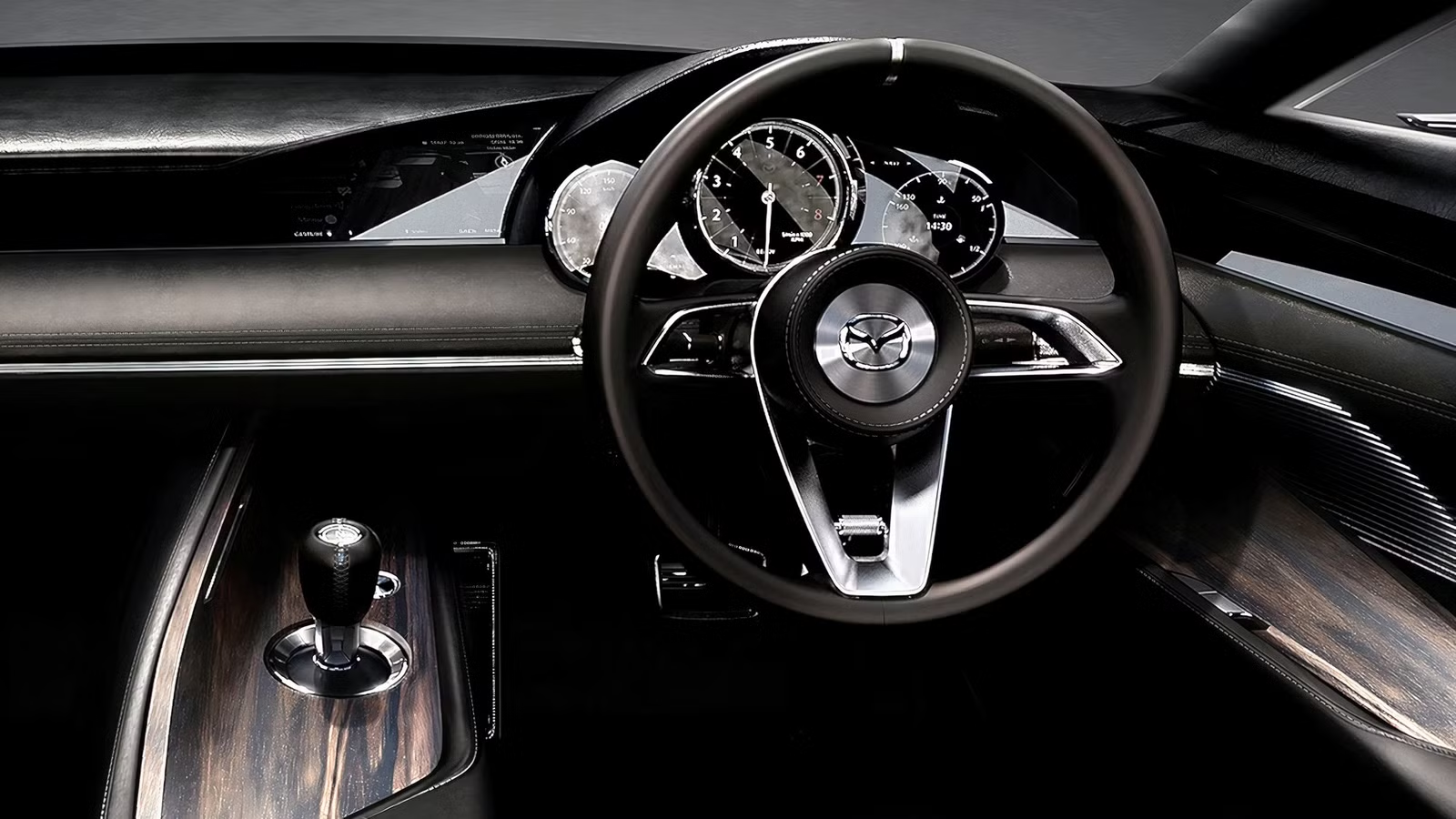
Just a few years ago, Mazda expressed interest in a sort of brand reinvention, one it could undertake modestly, without alienating its current customers. The Japanese automaker wanted to become more luxurious at an affordable price and began unveiling and releasing models that adhered to this new mantra. It even revealed the Mazda Vision Coupe Concept (interior in the featured image), giving a preview of the design and upmarket interiors it was aiming for. It hasn’t reached those levels yet, but it’s getting there.
While the Mazda6 may have lost out, a slew of premium SUVs followed, most notably the CX-50, CX-70, and the flagship CX-90, the latter pair underpinned by a new longitudinal platform with the option of inline-six engines.
Sources: Mazda, Jalopnik, Car Design Archives, LA Times
