

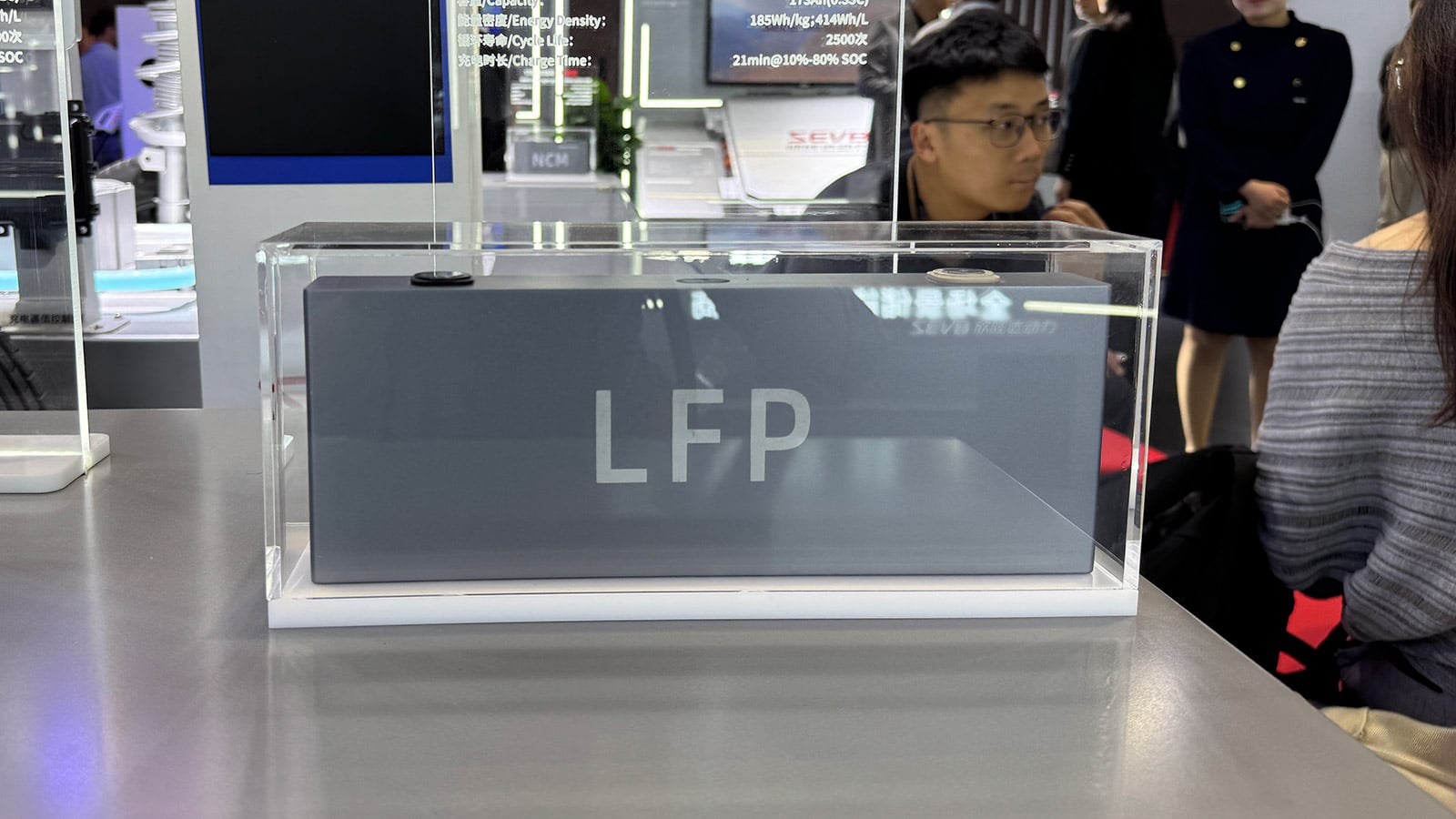
File photo shows a LFP battery cell. Credit: CnEVPost
- Aion S vehicles equipped with CALB’s 177-Ah LFP battery cells have seen a surge of complaints over swelling, leakage, and other faults.
- GAC Aion has extended the battery warranty for the affected model, while CALB has pledged to provide direct maintenance services.
Chinese power battery maker CALB (HKEX: 3931) is in the spotlight of a mass quality controversy, as GAC Aion’s Aion S vehicles equipped with its 177-Ah lithium iron phosphate (LFP) battery cells have seen a surge in cell failures.
State-run Xinhua News Agency highlighted the issue in a July 14 report, which did not directly name CALB, though subsequent media reports and the responses from the two companies clearly pointed to the battery maker.
Information on complaint platforms shows that since the beginning of 2026, a large number of commercially operated vehicles equipped with the 177-Ah cells have experienced cell swelling, leakage, and insulation faults, the Xinhua report noted.
Third-party inspection reports from multiple vehicle owners confirmed that after ruling out external factors such as collisions and water immersion, the faults pointed to internal manufacturing defects in the batteries.
Separately, according to a report by National Business Daily on Saturday, complaints about the power batteries of the “relevant automobile brand” reached as many as 182 cases from July 1 to July 18 alone, with most involving issues including insufficient battery range, swelling, and leakage.
Notably, the failures were concentrated in the 150,000-kilometer to 300,000-kilometer range. This happens to be a sensitive point at which many commercially operated vehicles have just passed, or are about to exceed, the manufacturer’s warranty period. Multiple vehicle owners said they encountered buck-passing from after-sales services when seeking redress.
One vehicle owner in Suzhou experienced a system failure after driving 230,000 kilometers. The after-sales store confirmed a battery quality defect, but refused compensation on the grounds that the vehicle had exceeded the 150,000-kilometer warranty, asking the owner to pay 80,000 yuan ($11,811) out of pocket to replace the entire battery pack.
Facing mounting public pressure, GAC Aion and CALB both issued announcements in response on July 18.
GAC Aion said a preliminary investigation confirmed that some Aion S vehicles equipped with CALB’s 177-Ah batteries and used for commercial operations had experienced battery failures. The company decided to extend the battery warranty for such vehicles from 8 years or 150,000 kilometers to 8 years or 300,000 kilometers.
The company also pledged to strengthen remote monitoring of battery data, proactively contact users when anomalies are detected, and provide free inspection, free repair, or free battery pack replacement services.
CALB, for its part, said in its announcement that it attaches great importance to the matter and immediately initiated relevant maintenance work through GAC Aion’s 4S stores.
The company promises to take responsibility for product quality throughout the entire lifecycle, and vehicle owners can go directly to the company’s service outlets for free inspection and repair services, CALB said.
A battery repair engineer in Tianjin, who declined to be named, told Xinhua that he has handled more than 30 cases involving the problematic battery, spanning multiple locations in the Beijing-Tianjin-Hebei region.
He believes the problem most likely stems from the battery design side, and that the manufacturer may have drastically shortened validation testing time in a rush to grab market share — a consequence of compressed validation cycles amid excessive “involution” in the industry.
Similar problems are not isolated cases. In late 2025, Geely-affiliated Vremt sought 2.31 billion yuan in compensation from Sunwoda over manufacturing consistency defects in battery cells the latter delivered, and the two sides eventually reached a settlement in early 2026.
Geely EV unit Zeekr subsequently recalled 38,277 Zeekr 001 WE edition vehicles to replace their power battery assemblies free of charge.
The controversy comes as China tightens battery safety regulation. On July 1, two mandatory national standards, dubbed the “strictest ever” by the industry, officially took effect, requiring power batteries to achieve “no fire, no explosion” after thermal runaway in a single cell.
However, the new national standards apply to models newly applying for type approval, and quality assurance for vehicles already on the road still relies on the enforcement of existing regulations.
CALB has expanded rapidly in recent years. According to SNE Research data, the company’s installed volume in the first 5 months of this year grew 36.3% year-on-year to 23.8 GWh, ranking fourth globally by market share.
In the Chinese market, CALB overtook Gotion High-tech (SZSE: 002074) in June to rank third in the industry with a 6.82% share, behind only CATL (HKEX: 3750) and BYD (HKEX: 1211).
Share of top EV battery makers in China (June 2026)
0%
10%
20%
30%
40%
50%
60%
China Automotive New Energy Battery
Share of Top EV Battery Makers in China (June 2026)
Company
Installations (GWh)
Market share (%)
Share vs prev month
CATL
32.59
42.70%
-3.43
BYD
14.11
18.49%
+1.92
CALB
5.20
6.82%
+0.82
Gotion High-tech
4.96
6.49%
+0.30
Eve Energy
4.45
5.84%
+1.33
Rept Battero Energy
2.71
3.55%
-0.12
Sunwoda
2.12
2.78%
-0.30
Zenergy
2.07
2.72%
-0.49
Energee
1.85
2.42%
-0.11
Svolt Energy
1.54
2.02%
+0.21
LG Energy Solution
1.46
1.91%
-0.23
Yinpai Battery
0.93
1.22%
+0.08
Cornex
0.82
1.08%
+0.24
Sany Hongxiang
0.32
0.42%
-0.18
China Automotive New Energy Battery
0.25
0.32%
+0.01
CATL remained China’s largest power battery maker in June, though its market share fell 3.43 percentage points from May.
($1 = 6.7733 yuan)
