

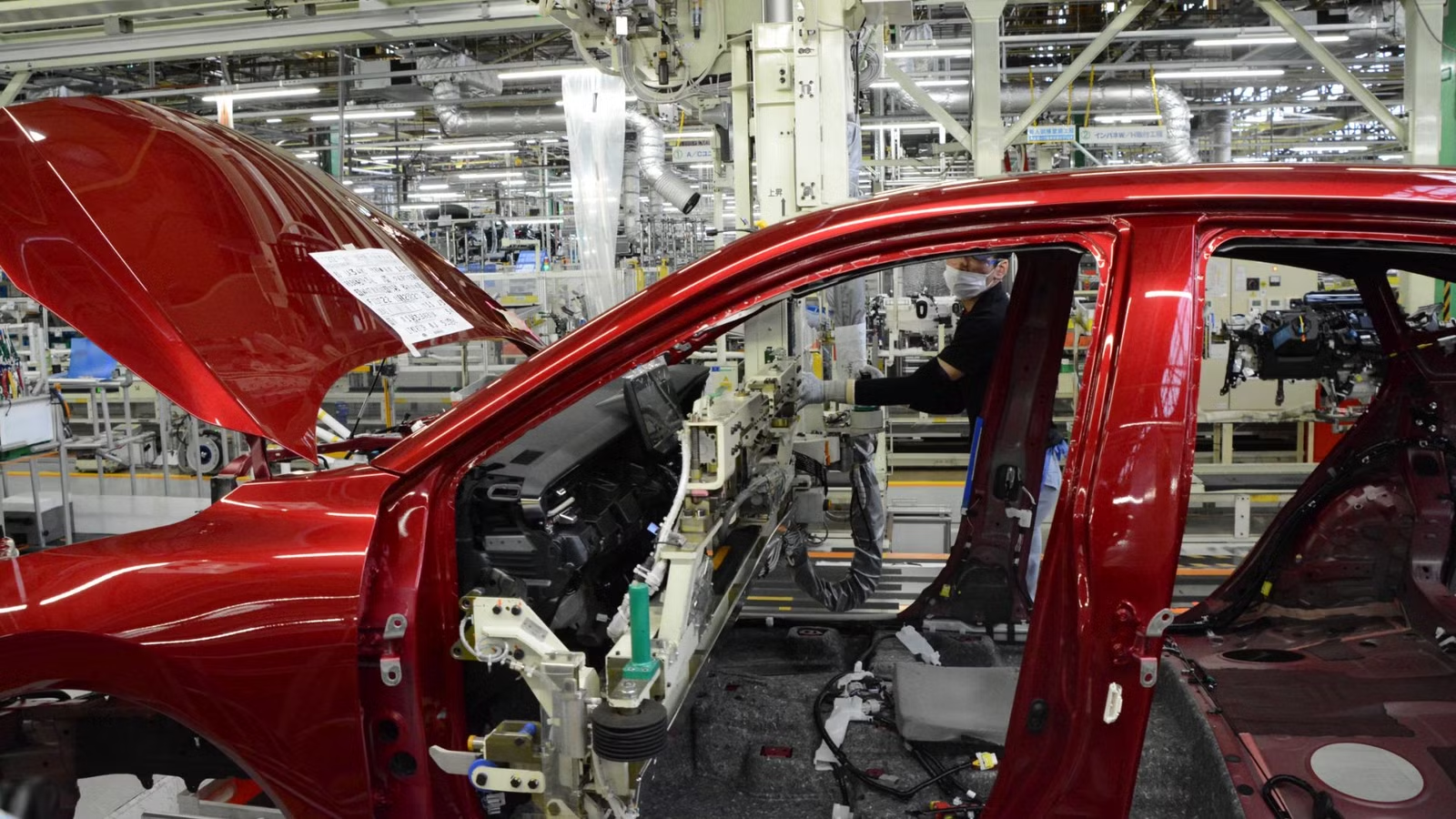
The supply chain necessary to design, engineer, and manufacture an automobile is vast, tiered, fiercely competitive, prone to disruption, and under constant pressure to cut prices. A consumer sees a car and may think of only one brand, but the 30,000 parts necessary to build it convey a carefully orchestrated ballet involving hundreds of companies contributing their know-how.
Toyota, Mazda, and Subaru are working together to develop new engines for the electrification era.Toyota
The often contentious relationship between automakers and their component suppliers plays out somewhat differently from North America to Europe to Asia, and each region brings particular challenges that somehow elude fixing, despite repeated attempts over many years.
In Japan, seven automakers that have been rivals for decades are considering an unconventional path forward: collaborating on common parts that consumers don’t see as a way to make Japan’s industry more competitive.
Rather than having each automaker and their suppliers devoting massive resources to developing every component for individual brands, Japanese automakers – with a healthy push from the country’s largest automobile manufacturer association – could be ready to identify those parts that can be standardized and share them. This would reduce complexity, allow suppliers to manufacture much larger batches of fewer component sets, free up resources to develop new technologies, boost productivity, and potentially reduce vehicle prices and improve profitability across the industry.
But can they actually do it? That’s a question not so easily answered.
Joining Forces To Battle China
This effort also could help automakers – and this is a biggie – compete more effectively with Chinese companies and suppliers.
“We have a strong sense of crisis that the Japanese auto industry is in a massive period of transition,” former Toyota CEO Koji Sato told Automotive News recently while spelling out the new initiative.
Toyota CEO Koji Sato presenting the new engine family and Toyota’s plans to combine electric and combustion.Toyota
Sato became chairman of the Japan Automobile Manufacturers Association this year, and thinks collaboration is the way forward. “Now is exactly the time to further develop and evolve with the challenges and reform initiatives that the auto industry as a whole must face.”
Collaboration In The US?
If the Japanese auto industry can chart this course, should General Motors, Ford, and Stellantis do the same in the US? Long-time analyst Dave Andrea, who recently retired after studying the automotive supply chain for more than 30 years, sees good reason for Detroit automakers to abandon their long-standing insistence that every component be designed to their unique specification for every newly launched model.
BYD-Fully-Intelligent-Production-LineBYD
Last year, the Detroit Section of the Society of Automotive Engineers published a white paper urging the industry to work at “China speed” and get to “China cost” in a necessary attempt to remain competitive with the world’s largest auto industry, accounting for about 30% of global car production. “One way you do it is to start with industry standards for what’s already been designed, engineered, and validated,” Andrea told CarBuzz.
“You accept it, you pick it up, and you use it, even if it was invented and developed somewhere else.”
–Retired Automotive Analyst Dave Andrea
Roadblocks To Collaboration
After stints at the Original Equipment Suppliers Association, the Center for Automotive Research in Michigan, and Plante Moran, Andrea has as many stories about efforts to standardize parts in the US industry as he does about the inertia that prevented any substantive change.
Honda Dual-Axis Front Suspension and Brembo BrakesHonda
Long ago he was talking to an OEM suspension engineer who was working on a new tie rod for a vehicle that was adding a hybrid powertrain. Andrea asked the engineer if the new component was necessary because the hybrid drivetrain meant different weight distribution, or because the company wanted to improve steering and handling.
“He said, ‘No, it’s because we have the budget to do it.’ And I said, ‘What?'” When the chief engineer was requesting capital for the program, he included a new front suspension, even though the vehicle didn’t need one. “‘But we got the money,'” the engineer told Andrea. “‘So we’re doing it.'”
The Skyactiv-G series engines are not perfect. All the upgrades and refinements are incorporated in the X series.Mazda
Nowadays, Andrea said the money’s not there for needless component development, which is forcing automakers to consider new options which had been unthinkable. There have been many attempts to achieve voluntary, industry-led standardization to improve efficiency while preserving competition from organizations such as the Motor Equipment Manufacturers Association, SAE International, AUTOSAR, USCAR, and the GENIVI Alliance.
“Those efforts have allowed suppliers to compete on performance, technology, quality, and customer value rather than duplicating foundational work.”
–Meghan MacDonald, Corporate VP for MEMA Vehicle Suppliers Association
MEMA, now known as the Vehicle Suppliers Association, supports the latest proposal from the Japanese automakers, arguing that OEMs sharing non-differentiating components could reduce capital investment, accelerate vehicle development, and potentially lower part costs, Meghan MacDonald, MEMA corporate vice president, told CarBuzz via email.
“The key is identifying components that do not differentiate vehicle performance, feel, or appearance, while addressing considerations around capital investment, design ownership, and intellectual property,” MacDonald said.
Vehicle Teardowns Are Most Revealing
2025 Nissan Murano at Smyrna assembly lineNissan
Analyst Sam Abuelsamid, vice president at Telemetry, told CarBuzz the collaboration concept from Japan makes a lot of sense because many car parts don’t need to be unique. He points to the long-standing practice by automakers to use off-the-shelf parts from suppliers, then tweak them in ways that add a lot of cost but barely impact performance.
“Parts like wiper motors, window actuators and so on that aren’t customer-facing or really do anything to distinguish the product.”
–Analyst Sam Abuelsamid
Treating parts like these as commodities would save tons of cost, which would help make vehicles more affordable. Abuelsamid referred to industry “teardowns of Chinese vehicles by companies such as Caresoft Global and Munro & Associates that reveal how the Chinese brands move fast and cut costs while working with parts already available.
CarBuzz
Standardizing certain parts in the US might make sense, but even the example of wire harnesses is problematic because each one is unique to a certain body style or feature set, and different automakers use different connectors, Andrea said. In general, he sees too much deep-seated inertia at automakers to prevent meaningful change in the US industry.
“Maybe it’s the legacy engineering teams here that kind of prevent it from happening,” he said. This could ultimately be the stumbling block that kills collaboration and cost-cutting for brands in either region.
CarBuzz Insight – Why This Matters:
It’s mystifying that the US industry, after enduring two recent bankruptcies, massive supply-chain disruptions during the pandemic, and vehicle sticker prices ballooning out of reach for many Americans, has not moved to standardize particular parts that do not differentiate one vehicle from the next. Perhaps the inertia stems from Detroit automakers realizing that the US is now a truly global market where automakers from around the world have set up plants and supply chains. Perhaps the concern is that such an effort in the US would benefit transplant OEMs as much as the domestics.
Source: Automotive News
