

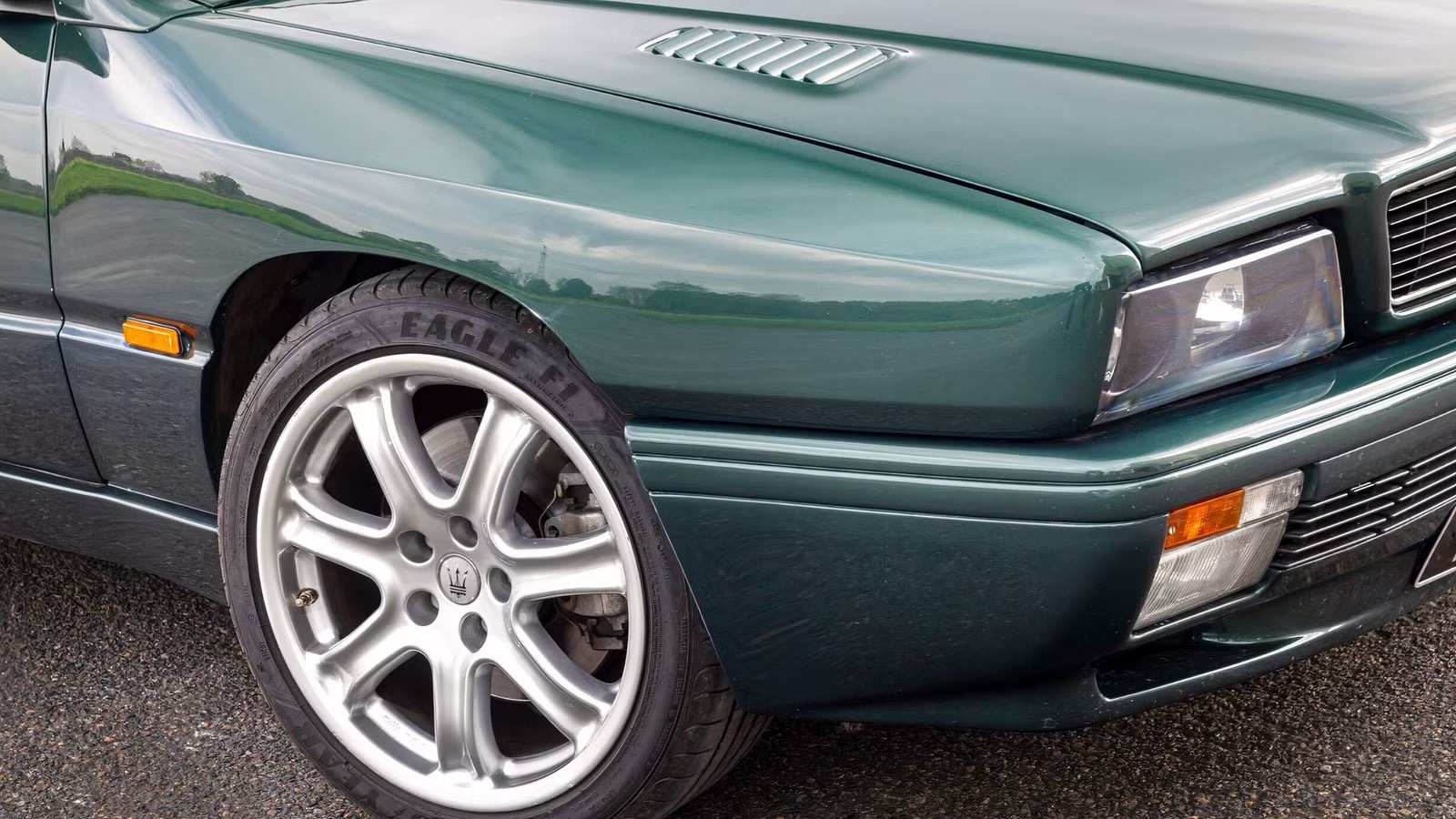
In 1973, Italy imposed a tax on cars with large-capacity engines in response to the oil crisis of the era. Some performance cars were a lot softer than they should have been as a response. In contrast, one automaker decided not to compromise, and instead set about developing a mighty twin-turbocharged V6 that also snuck under the 2.0-liter limit for a reduced tax bill.
That automaker was Maserati, and in developing such an interesting engine, the company also revived an immensely important model, one which could happily show Germany’s best its exhaust pipes.
Maserati Revived A Great Nameplate
Maserati Ghibli 1967 – 1972 ExteriorMaserati
In the 1960s, Maserati was a force to be reckoned with, churning out some of the most beautiful sports and GT cars the world has ever seen. From earlier efforts such as the 3500GT to the striking Mistral, luxurious Quattroporte, and, of course, the devilishly handsome Ghibli. The latter was Maserati’s flagship GT car, with both the lines and performance to take on the very best from Ferrari and Lamborghini, thanks to the hand of a young Giorgetto Giugiaro and a large, naturally aspirated V8.
It first hit the scene in 1967, which gave it a good six years of success before the Oil Crisis hit and production was curtailed. American customers were by far the biggest buyers of the Ghibli – even Henry Ford II couldn’t resist. When the spiraling costs of ’70s motoring set in, the bed was made for the Ghibli. Following on from this point, Maserati went through a period of change, swapping hands and launching new models.
Alejandro de Tomaso bought Maserati from Citroën in ’75, with some financial assistance from the Italian government. Under his leadership, the company found success again. The Biturbo family dominated much of the era, but the Quattroporte also performed well as a large luxury offering. There were also smaller production-run models such as the Khamsin and Kyalami. Chrysler bought in with a 49% stake in ’87, and in ’93, everything was sold to Fiat.
1996 Maserati Ghibli IICollector Cars Auction
Just before that, though, in 1992, Maserati decided to revive one of its all-time greats as the ultimate iteration of the Biturbo family, the Ghibli II. The new Ghibli was really quite different from those earlier Biturbo cars. It sported a refreshed design, a wider track, uprated suspension and brakes, a remarkably plush interior, and crucially, a surprisingly potent engine, worthy of the nameplate.
Italian Tax Laws Posed A Dilemma
1996 Maserati Ghibli IICollector Cars Auction
When looking to reinvent Maserati with a new lineup of models, an Italian law stood in the way. Cars with engines displacing 2.0 liters or more were subject to a 38% value-added tax on top of the purchase price. That might be acceptable for supercars like the Lamborghini Miura, but Maserati needed to appeal to a wider audience.
Maserati’s Ingenious Solution
1994 Maserati Ghibli II V6 engineCollecting Cars
Fortunately, a solution was available. Maserati could take the 3.0-liter V6 from the Merak (and earlier as a 2.7-liter unit in the Citroën SM), scale it back to a capacity of 2.0 liters, and bolt two turbochargers onto it to make up for the smaller displacement. Thus, the Maserati Biturbo gained a motivator and a namesake, in turn making it the world’s first mass-produced twin-turbocharged car, too.
Early cars made do with just 180 horsepower and 187 lb-ft of torque. Still, by the time the Ghibli name was ready to resurface, Maserati engineers had worked out how to squeeze a mightily impressive 306 hp from that same 2.0 liters, along with 275 lb-ft of torque.
It was a remarkably complicated engine, sporting dual overhead camshafts, four valves per cylinder, the aforementioned twin turbochargers, accompanying twin intercoolers, electronic fuel ignition, and electronic engine management. A complex recipe indeed, and one that no doubt put the fear of God into many an Italian mechanic. Such complexities were actually necessities if Maserati was truly going to do the Ghibli name justice with such a small engine. With more than 150 horsepower per liter, the little Ghibli had a higher specific output than even the Ferrari F40, demonstrating just how impressive the engineering work here really was.
1996 Maserati Ghibli IICollector Cars Auction
After decades of hard work and continuous improvement, Maserati finally had its flagship GT car back. While it took a completely different approach to the recipe than the ’60s model did, the Ghibli II still boasted all the key characteristics that made the earlier car so great: striking looks, a plush, touring-capable interior, and enough grunt to silence almost anything else on the roads at the time.
The Export Answer
1994 Maserati Ghibli II V6 engineCollecting Cars
That aforementioned tax applied only to cars sold in Italy, and other markets probably wouldn’t be so excited about owning such a small-capacity sports or GT car, so another solution was required to sell the car on a global scale. Maserati opted to produce a 2.8-liter variant that would produce fewer horsepower, at 280 hp, but slightly more torque, at 297 lb-ft.
It boasted better drivability at lower speeds and a smoother power delivery, which really suited the Ghibli’s cruising nature. It also ensured it looked like a desirable alternative to other large-capacity cars of the era, and not some sort of 2.0-liter oddity that might have been easier to overlook.
Maserati’s Dinky V6 Left A Lasting Impression
1996 Maserati Ghibli IICollector Cars Auction
Maserati’s 2.0-liter V6 delivered impressive numbers on paper and a marvelous soundtrack, too, but how it made the Ghibli drive was the real highlight. The stocky GT was reportedly tricky to pull away cleanly with any sort of haste, but once the tires had stopped squealing at around 30 mph and some form of traction had been found, it would quickly wind the speedo up to 70 mph and beyond.
In-gear acceleration is where the Ghibli really impressed period reviewers, darting around far quicker than any contemporary BMW M3 or Subaru WRX could, all while ferrying its occupants around in sumptuous comfort. While early Biturbo cars may have wallowed from one corner to the next, those that have sampled it claim the Ghibli to be notably more composed, with beefy brakes dishing out much improved stopping power too.
Other Italian automakers attempted to pull off the same trick by dropping 2.0-liter V6 engines into sports cars of the era. These other efforts simply looked like cheap tax workarounds, rather than capable sports cars in their own right. The Ferrari 208 GTB, for example, churned out just 155 hp, or 220 hp in GTB Turbo guise, while Alfa Romeo produced the 201-hp 164 V6 Turbo. They gave domestic buyers compromises rather than equal options, which is why the Ghibli stands out as a shining example of how to do things correctly from this gaggle of small-capacity sports models.
Buying And Owning One Today
1996 Maserati Ghibli IIOsenat Auction
A large majority of Ghibli II models were produced with the larger 2.8-liter engines. As a general rule, these tend to trade hands for between $10,000 and $25,000, with exceptional examples commanding more, and restoration projects generally selling for whatever a brave enthusiast dares to offer. These cars were never sold in the United States, but they’re now old enough to enter the country under the 25-year rule.
In 2023, a well-kept yet high-mileage 2.0-liter example sold at auction in France for just 200 euros shy of its top estimate, for the equivalent of $22,650. Another 1996 car with the 2.0-liter engine managed to fetch just shy of $36,000, being a really fine example, highlighting the top end of the market for these cars. The available data would suggest that condition largely dictates the desirability and value of these cars, rather than whether it’s a 2.0- or 2.8-liter car, but the obscurity of the former might be enough to see so-equipped cars command slight premiums over the latter.
1996 Maserati Ghibli IICollector Cars Auction
In terms of reliability and running costs, the fact that so many of these are low-mileage cars should be quite telling. It’s a ’90s Maserati with electronic fuel injection and electronic engine management, and twin turbos. This car probably isn’t the safest bet for anyone not intimately familiar with every corner of their toolbox. Still, for anyone who can afford to regularly see a specialist and keep such a car in fine fettle, the Ghibli II should make for a delightful sporting tourer which will turn more heads at a Cars & Coffee meet than any E36 M3 could ever dream of. It’ll get you home quicker, too.
Sources: Maserati, Hagerty, Classic
