

For North Americans, driving cars designed and/or built on their continent is important. Patriotism aside, owning a car that’s built in the US, or North America, does instill a sense of pride, knowing that an American worker earned their living for the day byassembling your car.
It wasn’t always this way. Most folks incorrectly claim that the first Japanese car to be built in North America was the 1982 Honda Accord, but it wasn’t. In reality, the Isuzu Bellett,a forgotten compact, had actually been built on this continent all the way back in 1968. The Bellett’s tragedy, though, was its obscurity: virtually no one remembers it.
Nova Scotia Housed Japan’s North American Manufacturing Origin
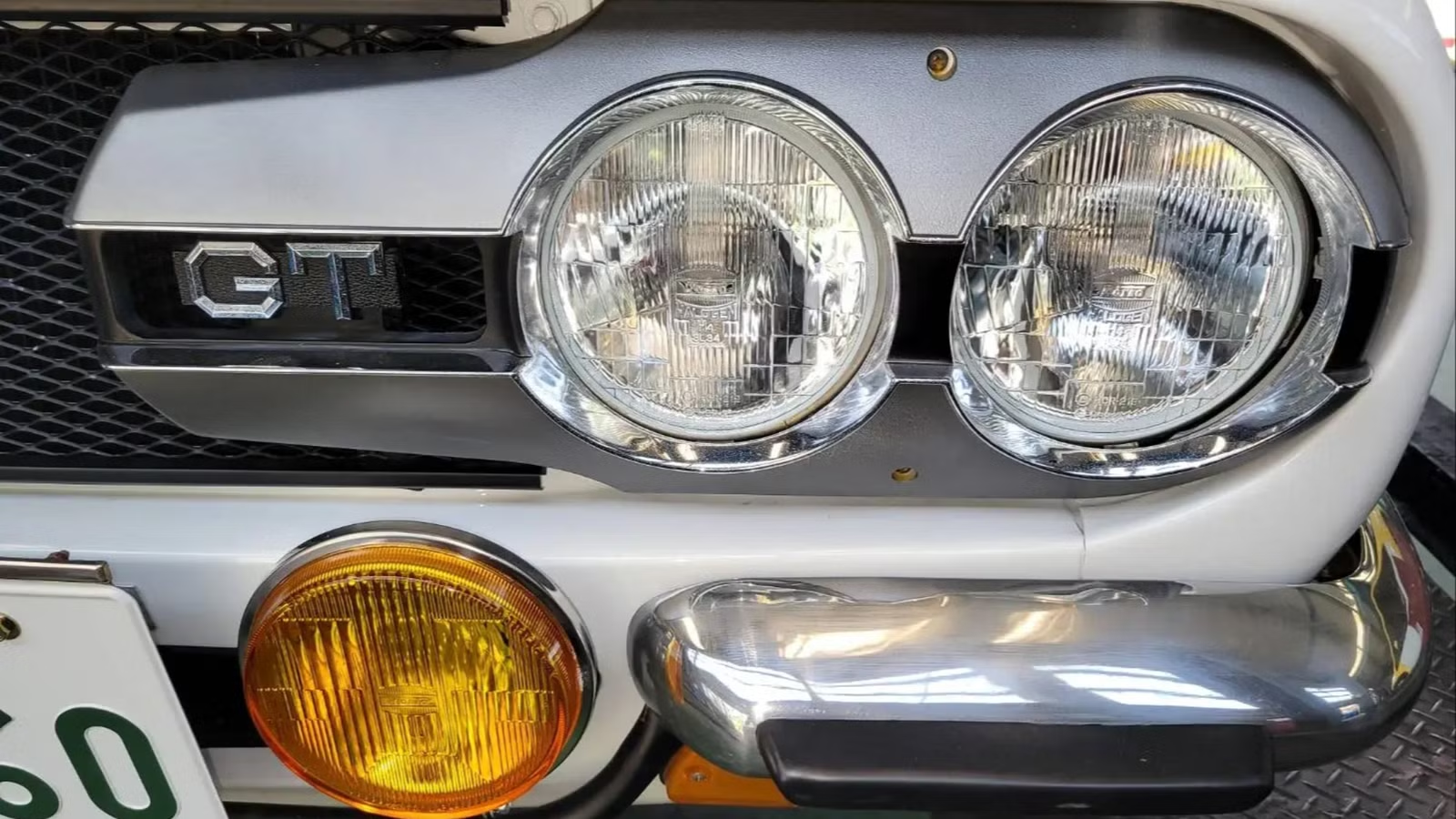
1972 Isuzu Bellett finished in white with black interiorBring A Trailer
In the early 1960s, Canada was looking to expand its automotive horizons beyond small-batch imports and US-built cars. To solve the issue, a group of investors led by two men, Peter Munk and David Gilmour, pooled money into something called Canadian Motor Industries (CMI). Both men were executives at an electronics company called Clairtone and were looking to diversify their business interests. CMI was to act as a large-scale importer of complete knockdown kits (CKD) from Japan. A factory was established shortly after the company was founded in Point Edward, Nova Scotia.
1972 Isuzu Bellett finished in white with black interiorBring A Trailer
The project wasn’t without its doubts, however. At the time, importing vast quantities of heavy car parts all the way from Japan to the eastern edge of Canada was no small feat, and it was not without significant expense. But, while the stakes were high, both Canada and Japan were keen to make the unlikely partnership work. For Canada, it was about expanding its horizons and offering its citizens a broader choice of automobiles. For Japan, it was about broadening its business dealings into those of a semi-major player on the world stage.
Four years after CMI’s establishment, it began to import its first major batch of CKDs from Isuzu. The Bellett’s assembly at the CMI plant made it the first Japanese passenger car to be assembled on the North American continent. The model chosen, the Bellett, was a compact car with little in the way of performance prowess or luxurious amenities. However, it did packone or two surprisesup its sleeve.
The Bellett Was Better Than Its Obscurity Suggests
1972 Isuzu Bellett finished in white with black interiorBring A Trailer
The Bellett came equipped with sophisticated – for its time – suspension engineering. Its rear end was supported by a fully independent suspension setup, while most other compact cars still sported live rear axles held up by leaf springs. This meant the Bellett rode considerably better than a lot of its competitors. It also offered front disc brakes, another advantage over compacts of its era, which still largely relied on drum brakes at all four corners.
Under its hood sat an engine that was adequately powered for both the Bellett’s size and the era. It was a 1.5-liter, inline-four unit producing 70 horsepower. Either a four-speed manual or a three-speed automatic transmission was available, and rear-wheel drive was the sole drivetrain layout.
1972 Isuzu Bellett finished in white with black interiorBring A Trailer
Across the world, the Isuzu Bellett was vastly more popular than its tiny Canadian sales figures suggest. It’s reported that roughly 170,737 examples were built throughout its production run, which spanned from 1963 to 1973. Its most popular market was in its home country, Japan, where it was produced at Isuzu’s Kawasaki plant. Australia and New Zealand allegedly loved the little Bellett, too, as examples destined for those markets were produced at a plant in Thames, New Zealand.
In Canada, though, CMI only managed to build about 584 examples before axing it – but the reasons behind that failure run deeper than bad luck. The real culprit was a logistical miscalculation that nearly doomed North American Japanese car manufacturing before it began.
Logistics Were The Bellett’s Downfall
1972 Isuzu Bellett finished in white with black interiorBring A Trailer
We briefly touched on the complex and expensive undertaking of getting CKD kits from Japan to the east side of Canada. While exact cost figures are impossible to find nearly 60 years on, one anecdotal estimate posited that roughly 70 percent of each car’s market value was spent just on transporting the CKD from Japan. Beyond that, payroll, factory upkeep, and administrative costs added further financial burden.
As costs mounted and production quickly slowed to a crawl because of it, the Bellett’s sales stagnated in a major way. Much of the time, consumers weren’t buying them simply because they weren’t available for purchase. The model’s extremely low sales figures don’t necessarily reflect poor design or any other inherent flaw; it was simply expensive, hard to produce, and rare to even find for sale in Canada.
1972 Isuzu Bellett finished in white with black interiorBring A Trailer
The Bellett’s failure seemed to prove one thing: assembling Japanese cars in North America simply didn’t work. It would take another manufacturer 15 years to prove otherwise – and they’d need an entirely different approach.
Honda Succeeded Because It Learned From Isuzu’s Failure
1985 Accord LX Sedan White Front Hatch Black RearHonda
CMI quickly came to its senses and decided to do something about the Bellett’s logistical and cost issues. In 1969, the company decided to cancel its contract with Isuzu to assemble the Bellett. Instead, CMI approached Toyota with an offer to assemble CKD kits for the Corolla. That same year, a deal was struck between CMI and Toyota, and the Corolla began rolling off of the Point Edward assembly line almost immediately, quietly leaving the Canadian-built Bellett to the obscure confines of history.
Some 15 years after CMI’s failed attempt at assembling Japanese cars, Honda did its homework. In 1982, Honda opened its first-ever North American assembly plant in Marysville, Ohio. The model destined to be produced at the new plant was the Accord, making it the first Japanese car to be assembled in the United States specifically, whereas the Bellett earned the same title for the entire continent.
The Marysville plant was a state-of-the-art facility for its time. In total, the factory spanned 4.4 million square feet upon its completion and was built alongside Honda’s existing motorcycle plant on the same property. Almost immediately, the Marysville plant became a wide-reaching success.
Instead of building CKDs shipped from Japan, Marysville produced the cars as a whole. The plant was equipped from the outset with everything needed for car production, including metal stamping, body painting, and component welding. Even most of the raw materials used for production were sourced locally within the US, with very little coming from overseas, allowing Honda to realize significant cost savings.
The Bellett’s Legacy: How A 584-Car Failure Paved The Way For Japanese Dominance In North America
1972 Isuzu Bellett finished in white with black interiorBring A Trailer
CMI’s hubris can largely be blamed for the Isuzu Bellett’s North American downfall. In business, costs can generally be estimated against profit margins before setting out on a venture. Of course, variables can crop up, but shipping costs are usually constant. CMI decided to plow on anyway, which proved disastrous for the little Bellett, which had no hand in its own North American failure.
In fact, the Bellett was particularly undeserving of its failure on the new continent because of its engineering prowess. Its fully independent rear suspension and front disc brakes were virtually unheard of in the budget segment, especially among foreign cars. Because of this, the Bellett definitely deserves to be remembered as more than just a blip on the radar of automotive history.
What the ill-fated Bellett did ultimately achieve, however, was a kind of martyr status. While it had to lay down its North American life due to mismanagement that was out of its control, companies like Honda took the lessons from its failure and learned from them. In a way, one could argue that the popularity of Japanese cars in North America today can be traced back to the Isuzu Bellett’s little-known failure all the way up in Nova Scotia.
Sources:OldCarsCanada.com,CBC.ca,CurbsideClassic.com,Motor1.com
