

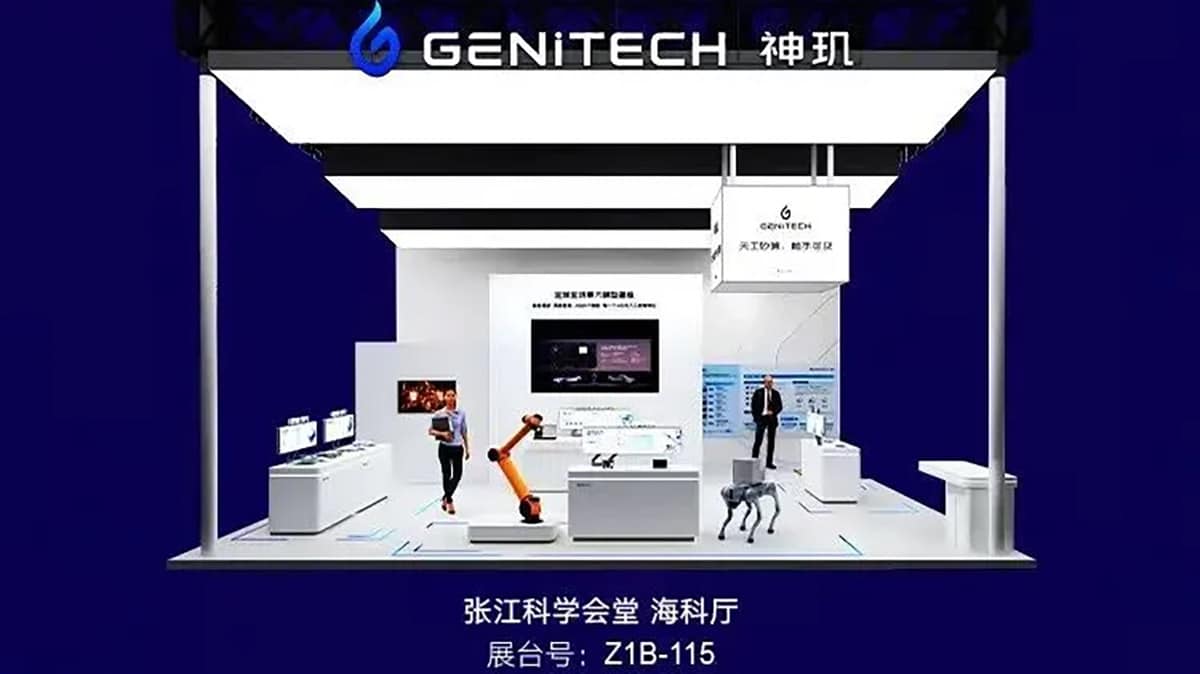
A poster from Shenji shows its booth at the upcoming WAIC 2026. Credit: Shenji
- The NX9031U has up to 800 TOPS of equivalent computing power and targets embodied AI, intelligent computing and advanced manufacturing.
- The 5nm automotive-grade intelligent computing chip has less computing power than Nio’s existing mass-produced smart-driving chip NX9031.
Nio Inc’s (NYSE: NIO) chip unit previewed a new AI computing chip, showing the Chinese electric vehicle (EV) maker is expanding its in-house semiconductor capabilities from vehicle smart driving to broader scenarios including embodied AI and Agent reasoning.
GeniTech Co Ltd (Shenji) first mentioned the new NX9031U chip on Tuesday, revealing more application directions.
The chip is called the Shenji NX9031U 5nm automotive-grade intelligent computing chip and has up to 800 TOPS of equivalent computing power, according to a statement.
The chip has rich interfaces and uses air cooling, targeting scenarios including embodied AI, intelligent computing and advanced manufacturing, Shenji said.
The wording shows Shenji is trying to repackage the computing platform Nio built for smart vehicles as broader AI infrastructure.
For Nio, that could help improve the external commercialization potential of its high-investment chip project.
Shenji will showcase multiple platforms at the 2026 World AI Conference (WAIC 2026), which will be held in Shanghai from July 17 to 20.
The company said its booth will cover autonomous driving, embodied AI and Agent reasoning, and position itself as a “full-domain, all-scenario foundation for large models.”
The distributed agent platform will feature a high-computing-power AI terminal powered by a next-generation Agent reasoning chip, providing computing capability for edge inference, localized deployment of generative AI and acceleration of large-model inference.
The embodied AI platform will be powered by the NX9031U chip and is the preferred flagship platform for embodied AI, intelligent computing and advanced manufacturing, Shenji said.
Shenji will also showcase an in-vehicle intelligent computing platform. The platform is described as a vehicle central domain-control computing platform that supports integrated computing across six domains: smart driving, cockpit, chassis, body, powertrain and cloud services.
For in-vehicle applications, Shenji said it will also bring an immersive smart-cockpit experience for Nio’s next-generation flagship SUV ES9 powered by Shenji chips. That means the company still sees cars as the core showcase for its chip capabilities.
The disclosure of NX9031U also provides a new clue for observers of Nio’s chip roadmap. Nio’s only mass-produced smart driving chip currently is Shenji NX9031. It previously said one NX9031 has computing power equivalent to four Nvidia Orin chips.
Nio’s NT 2.0-based models previously came standard with four Orin X chips, with total computing power of 1,016 TOPS.
By comparison, NX9031U’s 800 TOPS of equivalent computing power is slightly lower than NX9031’s capability, but still clearly puts it in the high-computing-power AI chip range.
All Nio main-brand and Onvo sub-brand models are currently equipped with the Shenji NX9031 chip. The switch has helped Nio reduce its reliance on external smart driving chip suppliers, while giving its chip business data and scenario support from a mass-produced vehicle fleet.
Nio unveiled Shenji NX9031 in December 2023 and announced in July 2024 that the chip had successfully taped out.
The chip uses a 5nm automotive-grade process and has more than 50 billion transistors. Nio sees it as an important product for benchmarking against and replacing Nvidia’s high-end smart-driving chips.
However, the chip business has also been one of the most expensive projects in Nio’s R&D spending. Nio founder, chairman and CEO William Li once said the R&D cost of NX9031 reached several billion yuan, close to the cost of building 1,500 battery swap stations.
To balance funding pressure and long-term technology investment, Nio brought in external investors earlier this year.
The company confirmed in February that several Chinese investors would invest 2.26 billion yuan ($334 million) in Shenji, giving the business a post-money valuation of about 8.27 billion yuan.
After the transaction, a Nio subsidiary continued to hold a controlling 62.7% stake in Shenji, and Nio Inc continued to consolidate its financial statements.
That means Shenji remains a strategic asset within the Nio system, rather than a fully independent external supplier.
But Shenji has already started seeking more external customers and application scenarios. In March, reports said Shenji and its partners were pitching a new M97 chip to automakers including Leapmotor and Geely, while also planning lower-end chips for different demand tiers.
Li proposes standardizing battery cells and reducing chip varieties to unlock over 100 billion yuan in industry-wide cost savings.
($1 = 6.7669 yuan)
