

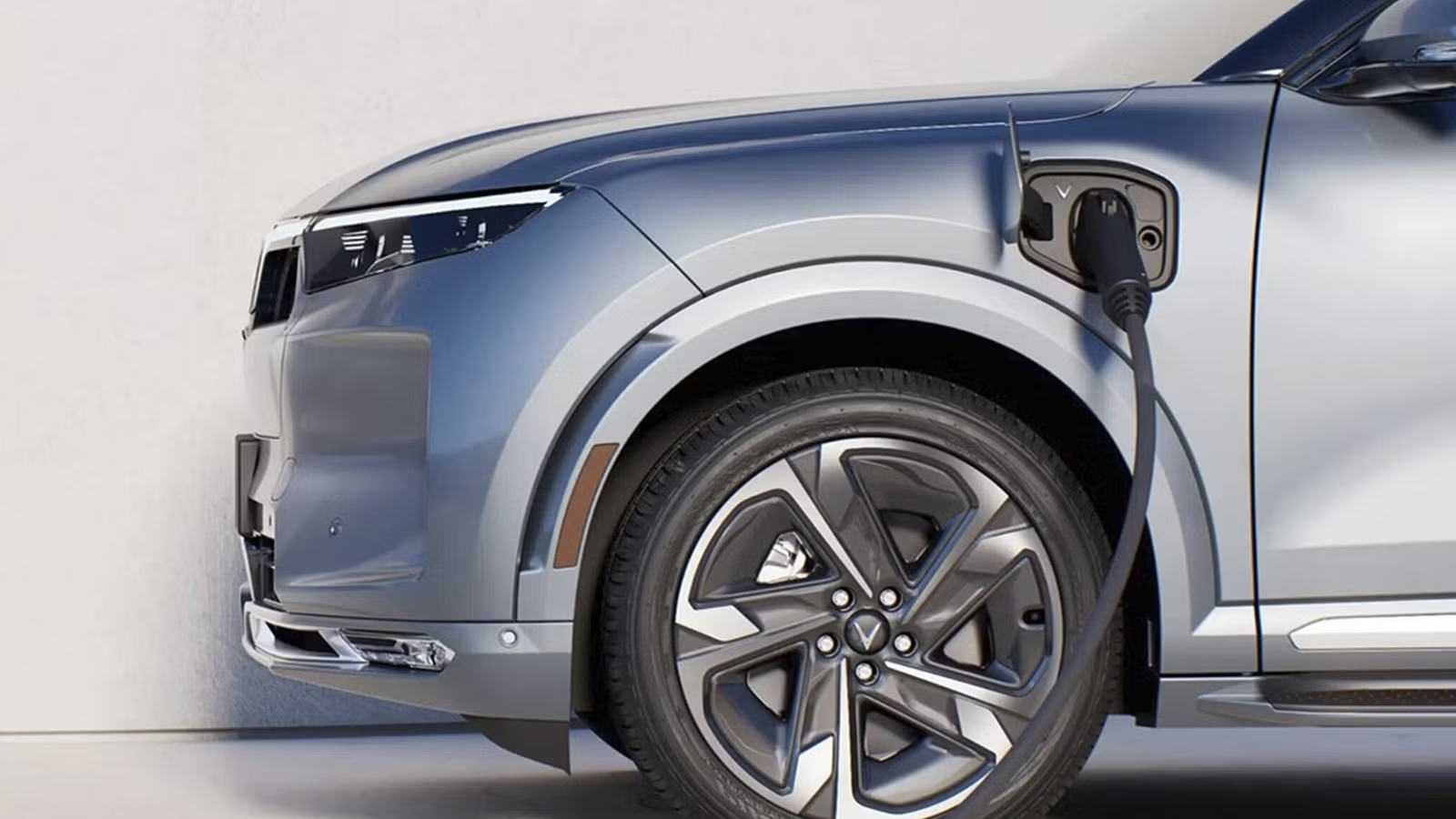
One of the most fascinating elements ofthe electric revolutionis the range of different start-up auto manufacturers that have arrived in the US, with some of the most notable being Lucid and Rivian. While rapidly rising brands from China are currently banned from reaching the US, VinFast from Vietnam is looking to make a mark on the American EV market.
Its offerings certainly provide good value on the face of it, but approach with caution. While the cars show development potential, the truly worrying signs with VinFast come from behind the scenes.
VinFast’s Future Has Been Called Into Question
Orange 2023 Vinfast VF8 side on roadIan Wright/CarBuzz/Valnet
Before you even start considering purchasing one of VinFast’s creations, it’s important to factor in some context into how the company is currently performing from a business standpoint. From the outset, the firm showed an ambitious streak, especially when it came to breaking into the lucrative US market. This was evidenced by a colossal deal with the state of North Carolina in 2022, which consisted of incentives worth $1.2 billion to help the company build a new manufacturing facility in the state.
The deal was the largest ever such arrangement greenlit by North Carolina, and was set to provide 7,500 jobs to the inhabitants of the state. VinFast expected to produce around 150,000 cars a year when the factory got into full swing, making it a key pathway to its US ambitions. The trouble is, it never happened. The site was cleared back in 2023, with the intention being that the facility would be completed by late 2026. As of July 2026, no such factory has even started construction, seemingly due to the brand not having the cash to get the project going.
In early 2026, having insisted that its plan of building the factory was still very much on, it did alter its grand plan ever so slightly. It ditched its pledge of creating 7,500 jobs and instead slashed the number to just 1,500. This, along with the lack of action on the plant, incensed the North Carolina government, leading to it issuing a lawsuit against VinFast in May 2026.
Aside from wanting to reclaim all the money it had already given to the company to get the site prepared for construction, it also wanted to reclaim the land the factory was set to be built on. This came after the state informed VinFast that it had defaulted on the agreement back in January of the same year, to which the brand replied by insisting it was still set on building the facility, but that it wouldn’t be ready until 2028.
Smelling a rat, the North Carolina government decided to kill the agreement for good.
But the lawsuit is only part of VinFast’s problem — the company’s financial picture raises an even deeper question: does it have enough runway to survive at all?
VinFast Lost Nearly $4 Billion Last Year – And Hasn’t Turned A Profit Yet
VinFast VF 8VinFast
With the benefit of hindsight, VinFast’s plans looked pretty shaky. Its new cars didn’t review very well, and while it hasn’t revealed its US sales figures, the relative lack of them on the roads suggests VinFast hasn’t sold as many as it would have liked. It isn’t doing a bad job of increasing its sales on a global basis, having doubled its sales in 2025 outside the US versus the prior year, but it’s yet to find profitability.
The firm reported a concerning $3.9 billion net loss in 2025, which doesn’t afford it particularly great odds of lasting long-term unless it can quickly turn that number around.
The numbers are bad — but the real story of why buyers are staying away lives in what’s actually happening with the cars themselves.
What VinFast Actually Sells: Two SUVs Designed to Look the Part
VinFast VF 9 – 3/4 rear viewVinFast
Despite all of this, VinFast’s vehicles do make a compelling first impression on paper – which is exactly what makes the situation so frustrating. At the moment, the brand offers two vehicles: the VF 8 and VF 9. The former is the cheaper and smaller of the two offerings, serving as VinFast’s compact crossover model.
The VF 8 has two variants, a base Eco and a higher-end Plus, both of which come with dual-motor powertrains, though the former is limited to a peak output of 349 horsepower while the latter gets 402 hp. As is hinted at by their respective names, the Eco provides a superior range of 256 miles, whereas the Plus can only manage 235 miles on a single charge.
And then we get to the VF 9. As VinFast’s range-topping full-size luxury SUV, it offers seating for seven, compared to the five that the VF 8 accommodates. Once again, you can opt for either the base Eco or the more expensive Plus trim level, though both get the same 402-hp dual-motor powertrain. The Eco’s 330-mile range is vastly superior to the Plus’ 291-mile peak distance, though the latter comes with extras such as a panoramic sunroof, plusher leather captain’s chairs, and more.
Both vehicles are positioned at the affordable premium end of the market, an approach enhanced by VinFast’s partnership with Italian design house Pininfarina. The firm penned the designs of both the VF 8 and VF 9 in an attempt to ensure they stand out among the other SUVs on the market.
On specs and price, the case looks strong. But specs don’t tell you whether the car will charge properly – or whether a wheel might come off.
The Numbers Look Compelling. The Reviews Tell a Different Story
VinFast lowers pricing for the VF 9 electric SUV.VinFast
When you factor in how the SUVs look, as well as the equipment they provide, VinFast’s vehicles look to make a lot of sense. As an example, the VF 9 Eco costs a full $30k less than a standard Tesla Model X at $62,900, but trails the American model by only five miles of range. By the same token, the VF 9 Eco is also well-equipped versus the Tesla, so it doesn’t lack anything in this regard. The main area where you’ll lose out is power output, since the Tesla produces 670 hp — a full 270 hp more.
The same kind of value can be found with the VF 8, since the base car only demands $39,900 from your bank account. This leaves it considerably cheaper than the Volkswagen ID.4 and on par with a mid-range Hyundai Ioniq 5, which offers significantly less power and inferior range. For that outlay, you’ll have powered and heated leatherette seats, a heated steering wheel, a wide range of safety systems, as well as adaptive cruise control.
Wheels That Come Off and Batteries That Won’t Charge: VinFast’s Quality Control Crisis
The VinFast VF 8 can now be leased for $299 per month, making it cheaper than the Tesla Model 3.VinFast
VinFast’s cars are undeniably cheap, but sometimes this can be a case of simply being too good to be true. Thus far, this rule looks to have stood up once more. Its models have been struck by a range of quality-control problems that have left customers frustrated, and even fearing for their safety in some situations.
A recent high-profile illustration of this involves the VF 8 Plus, which became the subject of a lawsuit from various owners who claimed the car would take 24 hours to fully charge. This was because the cars weren’t charging at the advertised 6.6 kilowatts and instead were sometimes recording charging figures of less than a third of that.
The company was also reported on by a whistleblower, who flagged VinFast for shipping its vehicles in an unsafe condition. The individual, who worked as an engineer for VinFast before being fired following his report, revealed that cars were being sold with an inferior strut-to-knuckle connection, which could lead to the car’s wheel coming off.
Then you’ve got the Creep Mode, which is meant to keep the car at a slower speed and induce traction in slippery conditions. Well, in the case of one VF 8, it instead caused the car to engage full throttle when it got stuck on a grass verge.
This unsafe practice could have caused the car to rocket away if it regained traction, and once more showed that little testing was being carried out on the car’s various systems before sale. Bearing these safety issues in mind, it’s not surprising to see why the brand is struggling to attract buyers.
Opting for a VinFast comes with an element of risk at the moment, since anyone who buys one could be left with a vehicle that will essentially be abandoned if the company collapses. We saw this exact scenario play out in mid-2024, when Fisker filed for bankruptcy.
Those who had purchased an example of itsOcean SUV were left with a car filled with bugs and issues that couldn’t be rectified, and the same kind of situation could play out if VinFast were to collapse.
Slashing Its Prices Signals a Brand Fighting to Survive
New VinFast VF 8 Front 3/4 ViewVinFast
These problems even forced VinFast to drastically reduce the base asking prices of its cars, since it knew it would likely struggle to take on the established manufacturers at a higher price point. For example, the VF 9 Eco was initially meant to cost $83,000 when it reached the US in 2024, but by the time it went on sale, this had been slashed to just $69,800. As of July 2026, the price of the car has fallen even further, to $62,900.
The same can be said for the higher-end VF 8 Plus crossover, which has seen its original $73,800 base price reduced to just over $44k in a couple of years. These price drops don’t bode particularly well, since they essentially show that VinFast believes its vehicles aren’t on the level of its rivals right now. One thing is certain: if VinFast can’t make more progress with its quality control, it’s doubtful it will reach them anytime soon.
Given its poor 2025 financial results, the clock is ticking for VinFast.
Sources: VinFast.
