

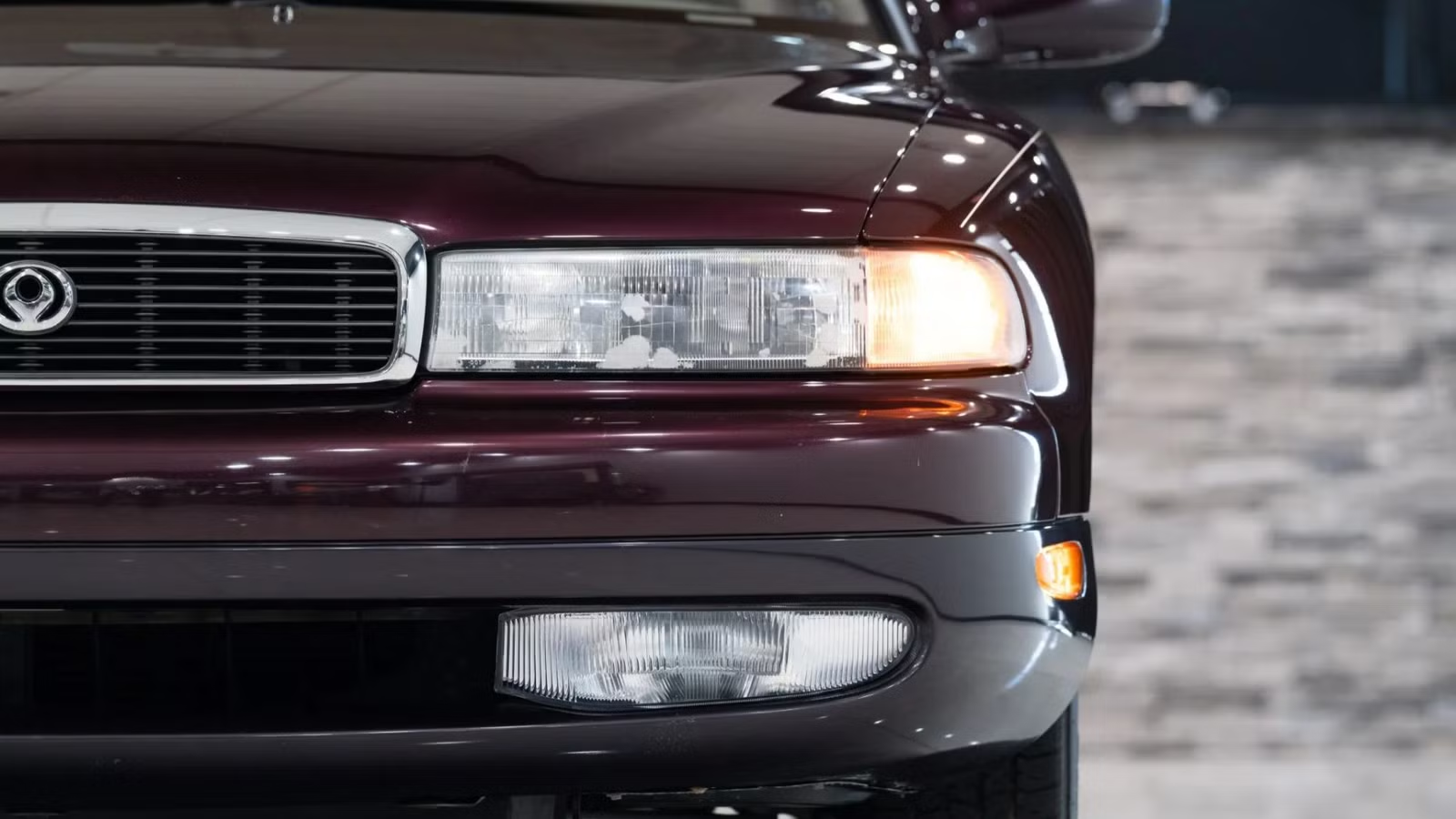
In the automotive world of the early 1990s, there was a lot at stake for luxury manufacturers. German companies were taking a long hard look in the mirror due to the arrival of the Japanese Lexus with its LS400, as this car was about to redefine levels of engineering excellence and presentation. And Lexus was doing its best to undercut its primary rivals on price with a solid vehicle that was calmer, quieter, and smoother than some of its peers. However, Lexus wasn’t the only Japanese brand that wanted to have a slice of the premium segment, as back in Hiroshima, Mazda was rolling out its 929.
The Lost Luxury Brand That Never Launched
1992 Mazda 929 frontBring a Trailer
At the dawn of the 90s, the primary Japanese manufacturers were having a serious stock take. The likes of Toyota, Honda, and Nissan were coming to realize that their current offerings were simply not good enough to help them break into the US luxury market, and they also believed that their nameplates alone wouldn’t carry much weight with those picky buyers. So, they each decided to create a new luxury brand altogether. Nissan had its Infiniti, Honda had Acura, and Toyota had Lexus, while Mazda was thinking of its own luxury moonshot and came up with a now-largely-forgotten division called Amati.
Amati should have been able to sell high-end sedans into a burgeoning overseas market, and there were even rumors of a rotary-powered halo car to lean heavily on Mazda’s differentiators. However, before it went ahead with that flagship division, Mazda already had a special luxury car in the shape of the 929, which sold in Japan as the Sentia. This car had rear-wheel drive, V6 power, and independent suspension, together with a well-crafted and serene interior.
Everything seemed poised for Mazda’s first assault with this car, right up until the Japanese economic bubble burst in 1992. This downturn meant that funding dried up and Mazda shelved its Amati idea before it ever got off the ground. However, the company wasn’t willing to withdraw its 929, as it had spent so much money developing it, so it sent it to US showrooms anyway. Rightly or wrongly, it would live or die on its own merits and have to go up against the likes of the LS400 and those German rivals.
European Elegance And Japanese Execution
1992 Mazda 929 front quarterBring a Trailer
While history will show that the 929 floundered on US shores, that failure didn’t have much to do with the car itself. After all, the 929 was competent and even ahead of the game in places, while Mazda had come up with a vehicle with subtle curves and clean lines that tended to stand out in a sea of otherwise boxy sedans. Beneath the skin, the 929 sat on a dedicated rear-drive platform that it shared with no other Mazda models. It had fully independent suspension, which engineers tuned for comfort rather than aggression, and its powertrain – the DOHC V6 – was certainly one of the smoothest motors Mazda ever built. You’d get 195 hp and almost 200 lb-ft of torque, which was certainly more than enough in 1992 to propel this luxury machine.
Road testers found that the 929 could get to 60 mph in around 8.5 seconds on its way to 120 mph, and this was quick enough in the targeted segment. The engine delivered its power seamlessly, while the gearbox was smooth and the ride sublime. The sedan also featured Mazda’s “emotional” Kansei engineering approach, which focuses on how surfaces feel to the touch, how controls respond, and how the car can tune out vibrations at the subconscious level.
On board the 929, buyers would get genuine wood trim across the dash and center console, with soft leather seats that had multiway power adjustments. There was dual-zone climate control as well as a premium stereo with a 12-speaker system and six-CD changer. One of the more unique features of this flagship car was its optional solar-powered ventilation system. Mazda had put a photovoltaic panel into the sunroof that ran a fan to try and keep the cabin as cool as possible when parked.
Lexus Causes A Problem
1992 Mazda 929 sideBring a Trailer
As predicted, the 929’s biggest problem came in the shape of the LS400. Lexus launched this in 1989, and it immediately rewrote the rule book, with its adaptive suspension, flawless fittings, and one of the quietest cabins ever seen. Its fully developed V8 turned out 250 hp and 260 lb-ft of torque, and it was certainly faster, smoother, and more spacious than the 929. Critically, the LS400 had its own badge instead of the parent Toyota brand, as well as its own dealerships and separate luxury identity.
The LS400 cost more than the 929, with a base price of about $42,600 compared to the 929’s $28,850. On paper, that should have made the Mazda quite competitive, as it wasn’t that far behind the LS400 in many areas, and it cost quite a lot less. But in the marketplace where people make buying decisions, that didn’t prove to be the case. And perhaps the biggest problem for Mazda was that much-feared brand perception.
No matter how good the 929 product was, American buyers just didn’t associate Mazda with luxury. For brand definition, they looked instead at cars like the Miata, the 323, and the RX-7, which were perfectly capable, fun, and affordable, but definitely not plush executive sedans. And remember, Mazda sold the 929 through regular Mazda dealers, unlike Toyota, which offered white-glove treatment at Lexus locations. So, while the 929 may have been a premium car, the buying experience didn’t match. And all of this meant that, slowly but surely, the 929 faded from relevance until it was quietly replaced by the front-wheel-drive Millenia in 1995. Ironically, that car was a leftover from the aborted Amati lineup, and it, too, soon faded from memory.
Rediscovering A Forgotten Gem
1992 Mazda 929 interior frontBring a Trailer
In 2025, classic car prices seem to be surging across most segments, but interestingly, this Mazda is still trading well below the radar. A good used LS400 might command between $15,000 and $25,000 today, but a low-mileage 1992 929 recently sold for $11,750. It seems you can find most used Mazda 929s for a low five-figure outlay, reflecting a big bargain. After all, you’re getting a full-size, rear-drive, V6-powered luxury sedan with timeless styling, an impressive interior, and excellent ride quality. And while it should be a good Lexus alternative, it’s still almost invisible.
Living With A 929 Today
If you’re interested in buying a 929, remember that it’s now a 30-year-old car. So, it may be hard to find some of the parts, especially trim and certain electrical components, and a fix for that solar sunroof system could be tough if it fails. There’s also not much in the way of aftermarket support, although there is a relatively small but loyal enthusiast community. The fundamentals should still be solid, and the drivetrain, if you maintain it well, should remain smooth and generally dependable, but you will need to look at the underbody for signs of rust in certain climates.
The 929 is a Collectible Outlier
1992 Mazda 929 rearBring a Trailer
The Mazda 929 may be a luxury car, but it doesn’t look as if it wants to show off. And while it may never be a future collectible or an investment vehicle, it should still deliver plenty of satisfaction to a caring owner. In many respects, it tells a story of what might have been, and in different circumstances, the 929 could well have become a true Amati flagship. However, in today’s real world, it can still deliver smoothness, comfort, and good engineering, and could well be one of the smartest luxury sedans around.
Sources: Bring A Trailer, Kelley Blue Book, JD Power.
