

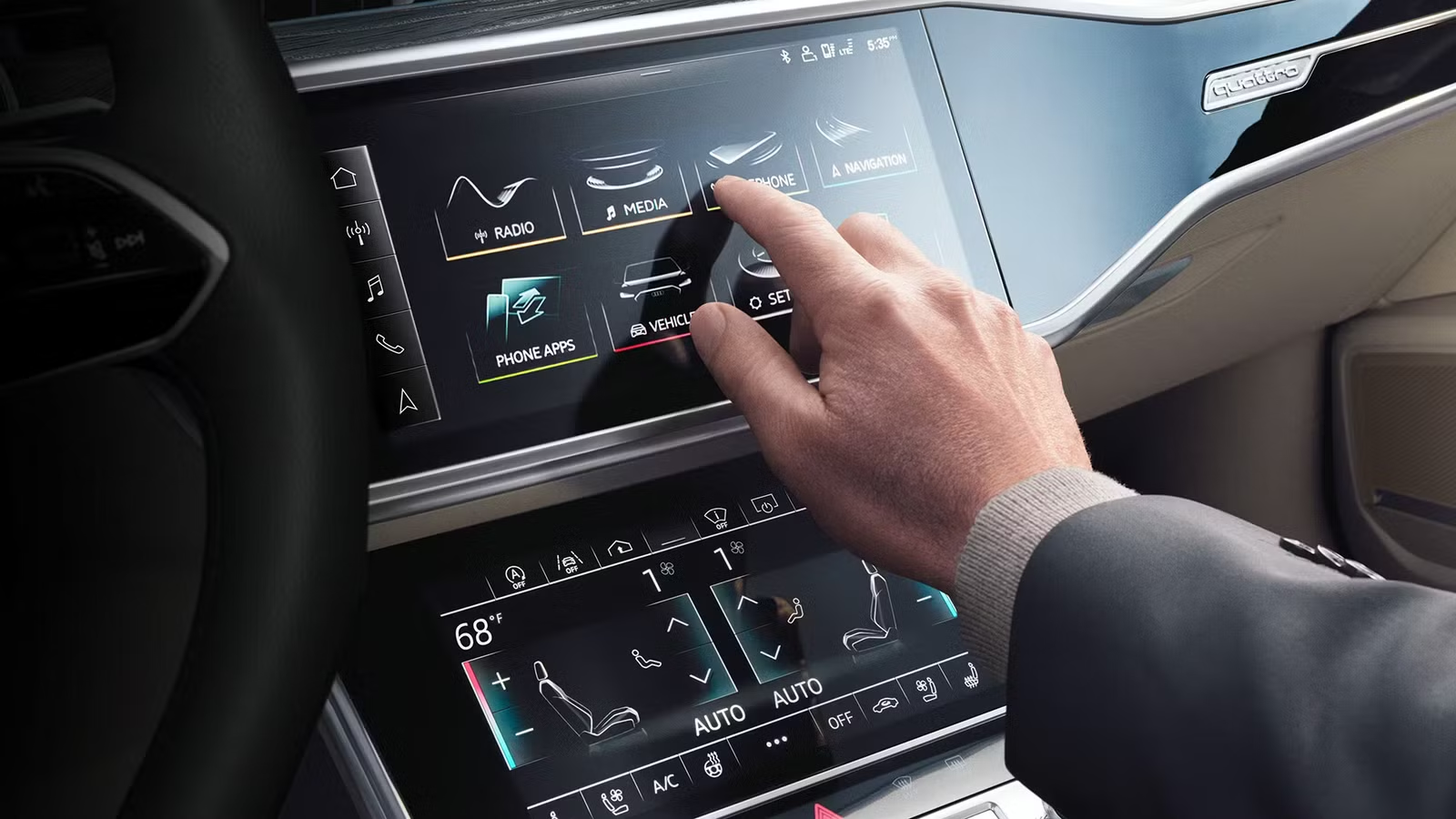
It’s hard to imagine an analog automotive future that ditches touchscreens and returns to physical buttons, switches, and knobs. If automakers had to provide access to all the features and functionality in today’s cars, but without using screens, modern dashboards would look something like a 1940s telephone switchboard.
2011-2012 Kia Optima HybridKia
That path seems highly unlikely, although righteous indignation from consumers has persuaded a number of automakers to incorporate an actual volume knob. Consider it a victory for humanity. But there is a price to pay for more screens and fewer buttons, and it’s not just automakers finding it more cost-effective touse the touchscreento change vehicle suspension settings, turn up the AC, tune to Tom Petty Radio, and much more. They require driver attention that would otherwise be focused on the road. And that could present a problem.
2027 Rivian R2Tom Murphy / CarBuzz / Valnet
Swedish car magazine Vi Bilägare studied the impact of screen proliferation on drivers four years ago, and they just conducted the same thorough tests this year with 10 new cars (and one from 2016). While traveling in a straight line at 68 mph at Lunda Airfield in Uppsala, north of Stockholm, staff writers timed how long it took to complete several simple tasks, such as raising the cabin temperature two degrees, switching the radio station, and resetting the trip meter.While the time involved might be relatively short, the distance one covers at highway speed without watching the highway is concerning. And the study doesn’t have good news to share on that front.
Mazda, Mercedes, Toyota Fare Poorly
Touchscreen test results from Swedish car magazine Vi BilägareNiklas Carle/Vi Bilägare
The testing team calculated how far each car traveled while the driver performed these functions, and the results suggest distraction behind the wheel is getting worse, not better: Drivers needed 2,667 feet on average to complete the tasks this year, compared with 2,480 feet in 2022. That’s a half-mile’s worth of making changes, and while drivers’ eyes aren’t necessarily off the road the whole time, it’s a very notable span during which drivers are distracted. And that distance has grown 187 feet since the original test. That’s more than half a football field.
“Drivers now need to spend even more time interacting with screens and controls to perform basic tasks.”
Related
Everyone Hates Touchscreens, And Automakers Are Feeling The Heat
Infotainment was the sole category not to improve in JD Power’s annual quality survey, with owners reporting lots of connectivity problems.
The vehicles that required the longest distance to perform the functions were, in order, the Mazda CX-60, Mercedes-Benz CLA, Toyota Corolla Cross, and the 2016 Volvo V60 (interestingly, with more buttons and a smaller screen). The new models requiring the shortest distance were the Volvo XC60, Škoda Kodiaq, and Tesla Model Y. But none of the new vehicles could match the performance of the screenless 2005 Volvo V70. When tested with the same protocol in 2022, its driver performed all the tasks in a mere 328 feet – nearly a football field versus a half mile. The difference is astounding.
Touchscreen test results from Swedish car magazine Vi BilägareNiklas Carle/Vi Bilägare
At issue is how much time drivers are looking at screens to perform functions – with some of them requiring multiple taps – instead of focusing on the road ahead. This problem has become more acute in recent years, when brands such as Mercedes-Benz, Ram, and even safety pioneer Volvo used vertical, tablet-oriented center screens with control tabs placed at the bottom, forcing drivers to look dangerously low near the center console just to turn on the defroster, for instance. Newer vehicles from these brands and others now use horizontal screens, positioned higher, which keeps the driver’s eyes closer to the road.
Is A Solution In Sight?
2025 Cadillac Escalade-V InteriorChristopher Smith/CarBuzz/Valnet
Does our automotive future hold bigger screens as automakers try to place more functionality at our fingertips, or are automakers making this stuff easier for consumers to navigate going forward?
Telemetry Vice President Sam Abuelsamid tells CarBuzz that distracted driving will remain a problem as long as the industry relies on touchscreens, “but I do think the situation is going to gradually improve.”
2027 Volkswagen Atlas Studio ShotsVolkswagen
Some automakers, most notably Volkswagen, have admitted they went too far with touch controls and are reverting to physical controls for many features, such as audio and climate, Abuelsamid says. But he singles out Rivian as headed “in the wrong direction,” convinced that customers are fine with touch controls, even adjusting the direction of climate control vents on the instrument panel. Abuelsamid shakes his head at that emerging technology, which also appears on the new Volvo EX60 and BMW’s Neue Klasse models.
“Personally, I refuse to recommend any vehicle that has software-defined vents. It’s just a dumb change that actually makes the system more complex.”
–Telemetry Vice President Sam Abuelsamid
There is hope as automakers also improve voice controls, which keep the driver’s eyes completely focused on the road. Also, Abuelsamid sees positive developments in China, where a new regulation taking effect next year requires core functions (such as turn signals, PRNDL, wipers, defrosters, windows, and hazards) to have physical controls. “That will put pressure on the rest of the industry to follow suit if they want to sell any of those cars in China,” Abuelsamid says.
Related
BMW Thinks One Tiny Change Will Fix Frustrating Touchscreen Controls
The piece can also serve as a ledge for resting your finger while using the touchscreen.
CarBuzz Insight – Why This Matters:
Depending on your perspective, touchscreens are either a welcome convenience or the scourge of today’s automobiles. Vi Bilägare confirms that in the past four years, screens have gotten larger, but also sharper and better positioned. While this should make newer screens easier to use, the study suggests driver distraction is becoming more of a problem, partly because automakers are trying to load even more functions behind the screen.
Maybe the solution years from now is voice control. Imagine Jean-Luc Picard behind the wheel giving a command, then saying, “Make it so.”
Source: Vi Bilägare
