

When you think of BMW’s performance-oriented models, the M-cars immediately come to mind. Over the last few decades, BMW has produced M-powered versions of the popular 3 Series and 5 Series, along with a slew of others like the M2, M4, Z4 M, and so on. In total, there have been 19 full-blooded M models built since the esteemed performance-oriented division was established back in May 1972.
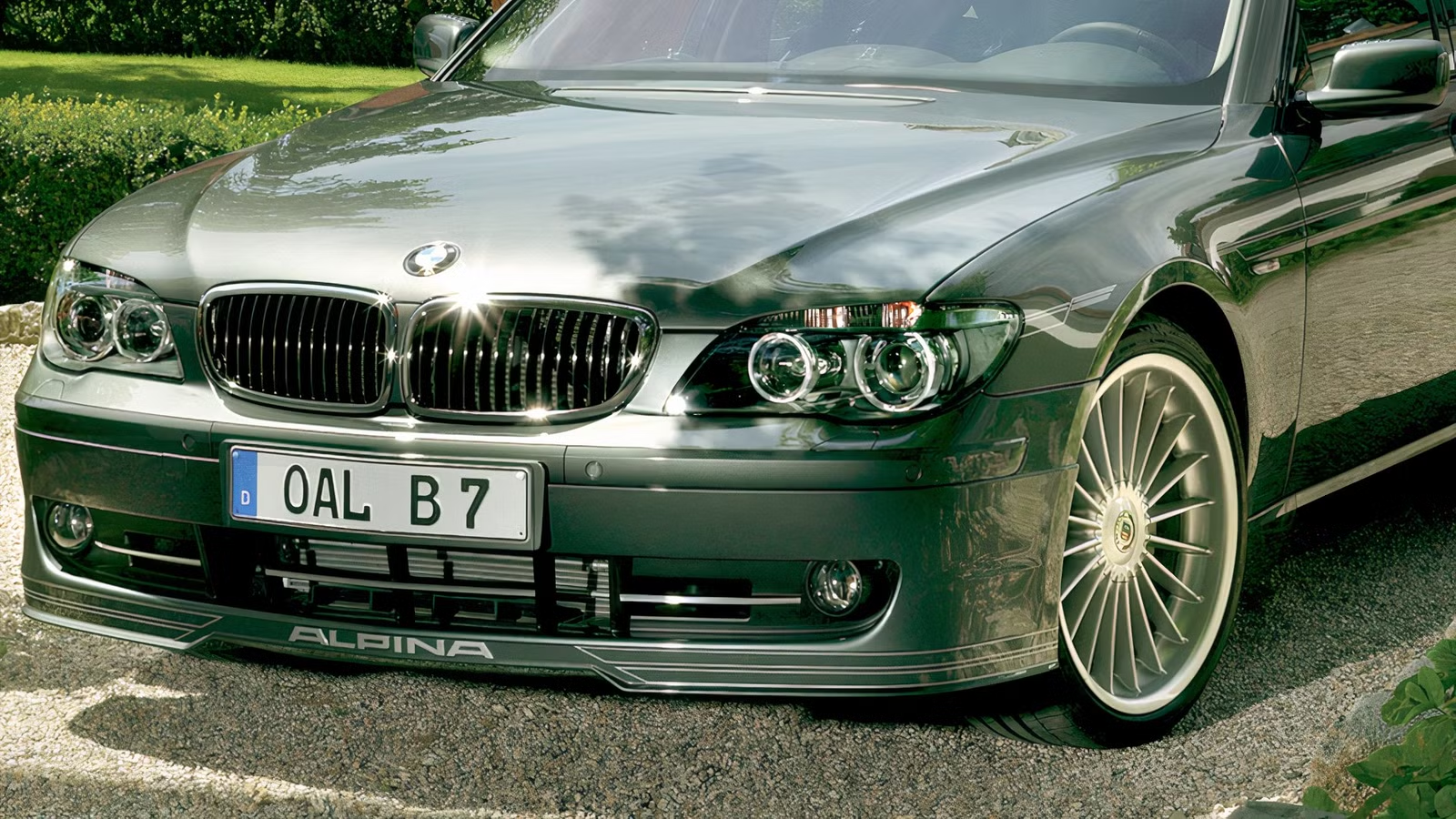
However, while it seems every BMW model has received at least one full-fat M model, there’s one that’s never been tapped for transformation: the 7 Series. There’s never been a true M7, and BMW’s luxury-oriented partner company, Alpina, decided to make one for themselves. It was called the B7, and it debuted in 2004.
Over two decades ago, its sticker price was a whopping $115,000. These days, that value has fallen substantially, to the point where even a used Toyota Camry costs more than a first-gen Alpina B7. So, it might very well be time to start paying it a bit more attention.
Alpina Built It Because BMW Refused
2004 – 2008 BMW Alpina B7 – front 3/4 angleBMW
Unlike most other automotive brand subsidiaries, like Mercedes-Benz’s AMG, Alpina is more than just a tuning company to BMW. You can think of it as what Lexus is to Toyota, albeit not in a mass-market sense. Instead, Alpina handpicks select BMW models and produces bespoke, luxurious versions of them in very low amounts.
While Alpina does, typically, increase the model’s power output, its main objective is to increase its opulence, not its performance potential. However, when it came to the first B7, performance was near the top of the priority list.
2004 – 2008 BMW Alpina B7 – rear 3/4 angleBMW
Introduced in 2004, the Alpina B7 marked the first supercharged production model to roll off the company’s glittering factory floor. In total, only 1,114 examples of the first-gen B7 were produced between 2004 and 2008. Of those, roughly 803 were slated for export to the US. Interestingly, despite making up the majority of the first-gen B7’s market, the United States only received models produced between 2006 and 2008. Those produced prior were limited solely to the European market.
2004 – 2008 BMW Alpina B7 – front 3/4 angleBMW
The B7 was meant to be what a true, BMW-sanctioned M7 would be like. Most likely, it would be quick, agile, but still contain many of the luxurious trappings and trimmings one would expect from a 7 Series, which, of course, makes up BMW’s flagship sedan slot. It would also be most at home on high-speed Autobahn cruises, rather than short bursts around a closed racetrack. Alpina knew this, and set about producing the B7 with those exact parameters in mind. No doubt an ambitious project to undertake.
Related
BMW’s Alpina Revival Kicks Off With These Two Models
Alpina is working on a big, sporty sedan and SUV.
Its Engine Brings Life To Why This Car Matters
2004 – 2008 BMW Alpina B7 – steering wheelBMW
2006–2008 Alpina B7
Engine Details
4.4L supercharged V8
Power
500 hp
Torque
515 lb-ft
0-60 mph
4.8 seconds
Top Speed
186–193 mph
Curb Weight
4,476 lbs
*Specs courtesy of BMW & Jalopnik
The crux of the Alpina B7’s high-speed cruiser personality lies with its engine. It’s called the H1, and it measures 4.4-liters in displacement. It’s based on the BMW N62 V8, although Alpina made merry with the modifications.
Sitting right on top of the H1 is an air-to-air-cooled supercharger, installed by Alpina itself, which marked the largest change to the engine made by the company. Alpina also swapped out the N62’s crankshaft for a forged one, and installed a set of high-end Mahle pistons. The H1’s block was also revised in order to breathe some extra strength into the mill, and an important addition considering the addition of a supercharger.
With the H1’s use of a supercharger, the first-gen B7 became the first Alpina model to sport a blower. In total, the bespoke tuning company has only produced three supercharged models as of this writing, the other two being the B6, produced from 2006 to 2007, and the B5, built from 2005 to 2007.
The rarity and short production window of blown Alpina models make them desirable in their own right, and the B7 being the first to actually utilize a supercharger makes it a major milestone market in Alpina’s history, although this fact typically flies well under the radar.
2004 – 2008 BMW Alpina B7 – front fasciaBMW
Hooked up to the H1 engine is a ZF-built six-speed automatic transmission, which then sends the H1’s power to the rear wheels. The first-gen B7’s suspension system consists of BMW’s tuned Active Roll Stabilization configuration, which uses hydraulically activated sway bars that can counteract body roll caused by hard cornering. The system also helps to iron out wallowing bumps when traveling in a straight line, a great addition to a car meant for long highway cruises.
So, the first-gen Alpina B7 carries an impressive and, depending on your viewpoint, historically significant engine alongside a host of bespoke tidbits here and there, such as a set of 21-inch Alpina wheels and a unique, largely handcrafted interior.
Related
The Era Of Spicy Alpina 3 And 5 Series May Be Gone Forever
BMW Alpina boss Philip Koehn says that the brand’s move upmarket could spell the end of a variant for every model line.
The Magic Of Depreciation Allows For Used Camry Pricing
2004 – 2008 BMW Alpina B7 – rear 1/4 angleBMW
One of the hallmarks of the first-gen Alpina B7’s depreciation can be attributed to the E65 BMW 7 Series’ strange styling as a whole. When the E65 7 Series debuted in 2001, it showcased a radically redesigned look which included a wild, tall trunk deck that didn’t match up with the rear quarter panels.
This decision was immediately chastised, and the term “Bangle-Butt Styling” quickly took shape to describe the weird-looking rear end. The term is derived from the E65’s chief designer, Chris Bangle. The upside to the look, however, was a dramatic increase in cargo space over the previous generation. Alpina installed a small lip spoiler onto the first-gen B7’s trunk deck to try and hide the odd look, but it’s still easily noticeable.
On top of the unconventional design, the E65 Alpina B7’s performance prowess was overshadowed by the F01-generation B7s, which came about in 2011. This newer generation ditched the supercharger for a pair of turbos, and managed to pump out 500 hp. While the output is virtually the same as the E65 B7, the F01 didn’t have the wacky Bangle Butt rear end, attracting more customers and ensuring resale value remained a bit higher.
2004 – 2008 BMW Alpina B7 – front 3/4 angleBMW
As it stands now, you can pick up an E65-gen Alpina B7 for around $20,646, at least according to Classic.com. Its value has been on a steady downward trend over the last three and a half years, dropping from about $27,943 to its current average price within that timeframe. For context, $20,646 can nearly buy you a used 2021 Toyota Camry, and while we know which of the two would probably be more reliable, the Alpina has quite a lot more going for it, as we’ve already seen.
Related
2026 BMW XB7 Manufaktur Marks The End Of An Era For Alpina
This marks the end of the XB7, the most popular Alpina model ever.
You Can Buy A Genuine Engineering Collectible With The E65 B7
2004 – 2008 BMW Alpina B7 – front fasciaBMW
So, for roughly $20,000, you can buy yourself a 500-hp, supercharged flagship sedan that was produced in very low numbers with bespoke styling, 21-inch wheels, and a sub-five-second 0-60 mph time to boot. What exactly is standing in your way? Well, there’s the question of reliability, which older German luxury flagships aren’t typically known for, simply due to the sheer amount of electronics and the cost of OEM parts.
If you’re dead-set on buying one for yourself, there are a few things to check before pulling the trigger. The best move is to hire someone to inspect the car that has real, older BMW mechanical experience. However, if you can’t do that, you should be paying close attention to any and all coolant leaks, dry-rotted hoses, and the ever-present threat of electrical issues. The E65 7 Series has been known for having a multitude of battery-drain gremlins that are hard to pinpoint, so make sure your would-be purchase doesn’t suffer from the unfortunate phenomenon.
2004 – 2008 BMW Alpina B7 – side viewBMW
While we can’t say for certain that the E65 B7 will, one day, increase in value and act as an investment vehicle (pun intended), we can posit that the classic market may, one day, take notice of the fact that it was Alpina’s first supercharged model, and its strange styling might be cool again at some point down the line. After all, the E65 B7 was a bold statement, and sometimes bold statements need time to mature, or be fully understood.
Sources: BMW, Jalopnik, Classic.com.
