

In this day and age, the manual transmission is experiencing a die-off. More and more automakers are removing the old-school stick shift from their offering lists, with gearboxes like sophisticated dual-clutch automatics or CVTs replacing them. However, if we turn back the clock just a couple of decades, the manual was still the preferred transmission in most sports cars, and was even still the benchmark for nearly all models on the road, save for luxury nameplates.
BMW, in particular, is quickly going down the path of stick shift replacement. The brand’s manual take rates, or the number of folks buying new manual-equipped models, are falling. The Bavarian automaker has also stopped making long-term promises pertaining to the stick shift as a whole, sparking uncertainty among enthusiasts. Because of this, the BMW M2 — one of the brand’s most popular sports coupes — has recently had its manual transmission’s long-term fate brought into question.
The Stick Shift Is Losing Its Grip
2025 BMW M2 Interior View Manual GearboxBMW
Over the last couple of years, fewer and fewer BMW M-car buyers are choosing manuals. Over just the last two years, the BMW M2’s stick shift take rate has dropped from roughly 50 percent in 2024 to around 40 percent in 2025. A decline of 10 percent over the course of just a single year is alarming, and signals a huge shift in buyer preferences that, rightfully, has given BMW a reason to question its continuing manual transmission production.
This decline in stick shift preference isn’t just endemic to the BMW M2, either. Both the M3 and M4 have also suffered from a decrease in manual transmission take rates, with both models boasting around a six to 10-percent take rate for the 2025 model year. Now, it’s important to note that there are several M3 and M4 grades that are automatic only, which dilutes the overall percentage of manual-equipped examples. For trims that actually do offer sticks, the M3 sports around a 50-percent take rate, and the M4 around 33 percent. However, if we turn back the clock just three years to 2023, the overall M3 and M4 stick shift take rate sat right around 20 percent, roughly double what it is now.
2025 BMW M2. Front, three-quartersBMW
Across the entire automotive industry, the manual gearbox is faltering, too. For context, in 2015, roughly 1.5 to two percent of all new vehicles sold in the US came with stick shifts, which translates to about 300,000 models. Fast-forward to 2025, and that amount has fallen to less than one percent of all new cars. This means less than 100,000 new cars sold in the US last year came with a stick, a stark contrast to the 2015 total.
2025 BMW M2 driving rear 3/4 angle in gray while parkedBMW
Even with declining rates across BMW and the rest of the automotive industry, the M2 remains the brand’s strongest candidate for keeping the manual transmission around for a while. However, even though its take rates are still strong, the industry is moving towards a manual gearbox mass-extinction event that most automakers probably wouldn’t want to weather, as the financial implications of building a gearbox no one wants might be disastrous.
Related
BMW Reaffirms Its Commitment To The Manual, But It Will Be Rare
They’re a dying breed, but BMW isn’t holding the line.
An Uneasy Silence From Munich
We can analyze market trends all day and night, but the fact of the matter is, the proof of the manual’s shaky future is plain to see. People are continuing to turn their noses up at shifting gears themselves, and moving towards gearboxes that do it for you. Recently, BMW’s M division head commented on the future of manual transmissions, and it doesn’t do anything to give confidence for the stick shift-hopeful:
“It’s going to be quite difficult in the future to develop completely new gearboxes because the segment in the market is quite small, and the suppliers are not so keen on doing something like that. So we’re still happy with the manuals we have, and we plan to keep them for the next couple of years, but in the future, probably it’s going to be more difficult to keep the manuals alive, especially in the next decade.”
-Frank Van Meel, Chairman of the Board of Management of BMW M GmbH
In essence, what he’s telling us is it’s not just BMW, or Audi, or whichever brand you want to name that’s responsible for the decline of the stick shift. It’s also the suppliers who aren’t keen on making a product that few want. This is especially the case because developing new transmissions costs money, and if the sales of said transmission don’t make up the cost of production, it’s a loss for the company.
2025 BMW M2 side angle in gray while parkedBMW
Bearing all of this in mind, including Van Meel’s comments, BMW has moved to introduce an automatic-only model into the M2’s lineup: the M2 xDrive. It’s slated to arrive sometime this August in time for the 2027 model year. Some observers, this author included, feel as though the introduction of the automatic-only M2 xDrive into the market is a way for BMW to test the waters and see if buyers actually want to keep the stick shift around, or if the brand could get away with removing it entirely. However, we can only speculate, as no definitive answers are currently circulating.
Related
G-Power’s BMW M2 Makes Truly Insane Power
If BMW won’t make an M2 monster, somebody else will.
The Writing On The Wall Is Causing The Market To React
2025 BMW M2 logo badgeBMW
2026 BMW M2 Specs
Engine Details
3.0L twin-turbo inline-six
Horsepower
473 hp
Torque
- Manual: 406 lb-ft
- Automatic: 443 lb-ft
0-60 MPH Time
4.1 seconds
Top Speed
177 mph
Curb Weight
3,814 lbs
*Specs courtesy of BMW
When BMW talks, enthusiasts listen. Now that the brand has, in so many words, abandoned its promise to continue producing manuals until 2030, BMW M-hopefuls are taking these new signals as signs they should buy now, while they still can. A thread posted on BMW’s official forum website, BimmerPost.com, involves numerous BMW M2 fans discussing potential plans to buy up a surplus of models to store for later use or sale.
It’s understandable, considering what a rear-drive, stick-shift sports car is like for someone who enjoys the act of driving. It’s one of the ultimate layouts for any performance car, as a three-pedal setup allows the driver to completely control how the car’s powertrain behaves in a multitude of situations. Complementing that is a rear-drive layout, which is ideal for spirited driving due to the sheer feel of the setup, wherein the front wheels can focus solely on steering while the rear wheels focus on moving the car forward.
2025 BMW M2. Logo. Badge. Door side sillsBMW
However, while it may seem like a sure-thing, buying loads of M2s as vehicles for investment (pun intended) could, possibly, blow up in your face. Because BMW has deliberately been noncommittal on the fate of the stick shift, if the brand did decide to press on with the manual gearbox, all those panic-purchased M2s would suddenly be worth less than they would have been had the stick shift been discontinued.
Related
Opinion: Why I Don’t Care That The Manual Transmission Is Dying
And why you shouldn’t either.
It’s Not The First Time BMW Has Canned The Stick Shift
2005 BMW M5 E60 Silver Front Angled View on Countryside RoadBMW
The Bavarian automaker has gone down the manual-axing road before. It first began in 2005, with the introduction of the BMW E60 M5, which replaced the stick shift with an automatic-manual gearbox. A manual was available, but the 7-speed automatic was sold as the standard setup, and getting your hands on a manual was a headache. The M6 also lost its stick shift. This hasn’t been done to any M-badged BMWs as a whole since, but the introduction of the several aforementioned automatic-only versions of the M3 and M4 were originally met with vitriol from some of the enthusiast community. In one case, a reviewer posited that the standard six-speed manual found in the 2021 BMW M4 was deliberately kept less engaging, or less fun to use.
Since the automatic began to take over most of the M cars, interest in the stick shift began to dry up quickly among the enthusiast community. It seems to be a combination of things, including decreased inventory, longer wait times for stick shift models, and the fact that the automatics continue to improve, attracting more and more previous manual buyers over to the other side. The M2 seems to be suffering from the same trend, and with the introduction of the automatic-only M2 xDrive, it might go down the same path as the M3 and M4, losing a large swath of manual buyers in just a few years.
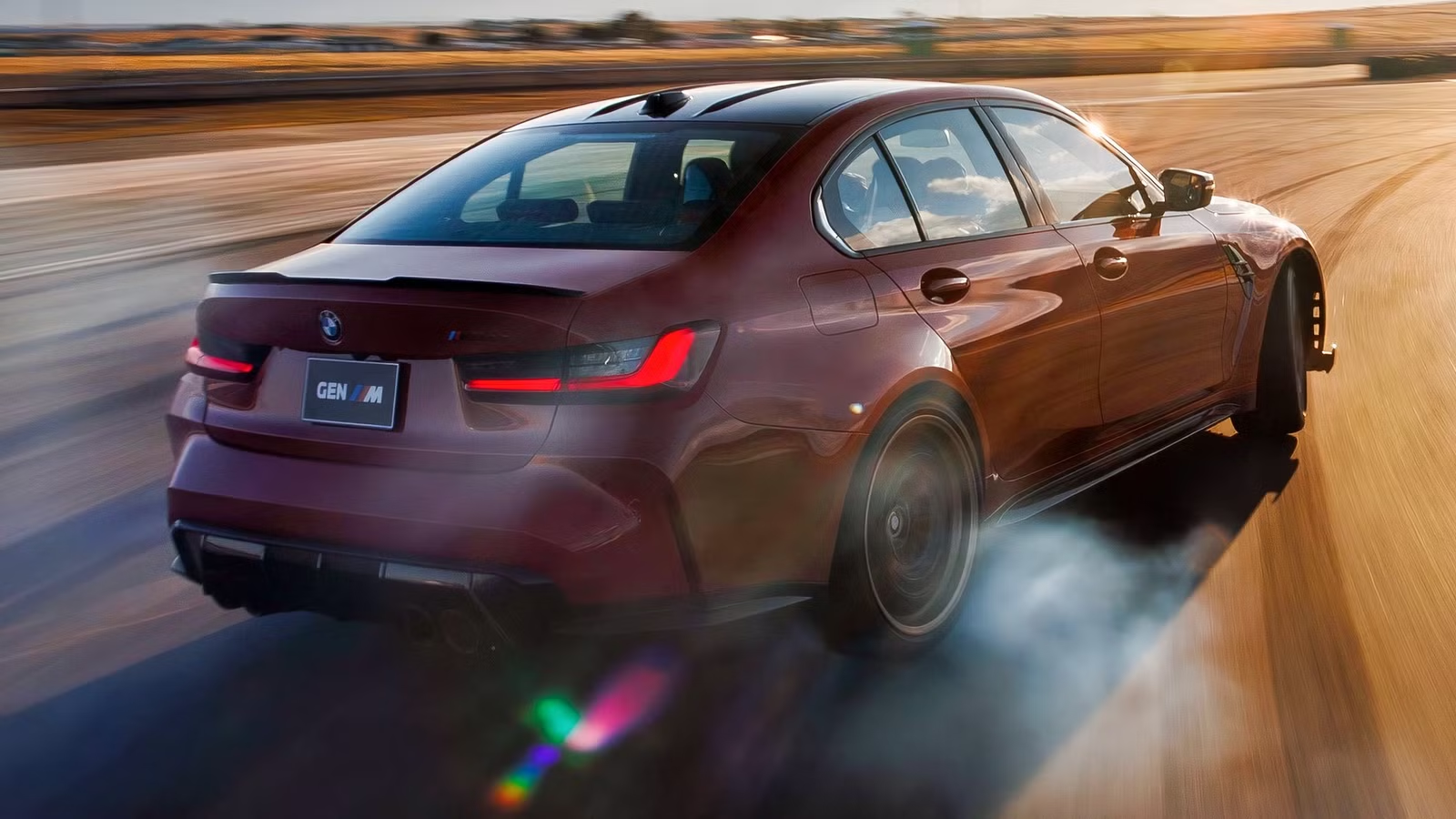
2026 BMW M2 CS. Drifting. Burning rubber. Power slide. Motion. Rear, three-quartersBMW
While the axing of the stick shift among BMW M cars is still very much speculative, whenever Munich stops making definitive statements, it seems like things begin to change quickly. So, it’s no wonder people are noticing.
Sources: BMW, BimmerPost.com, BimmerPost.com, BimmerPost.com, Motor1.com.
