

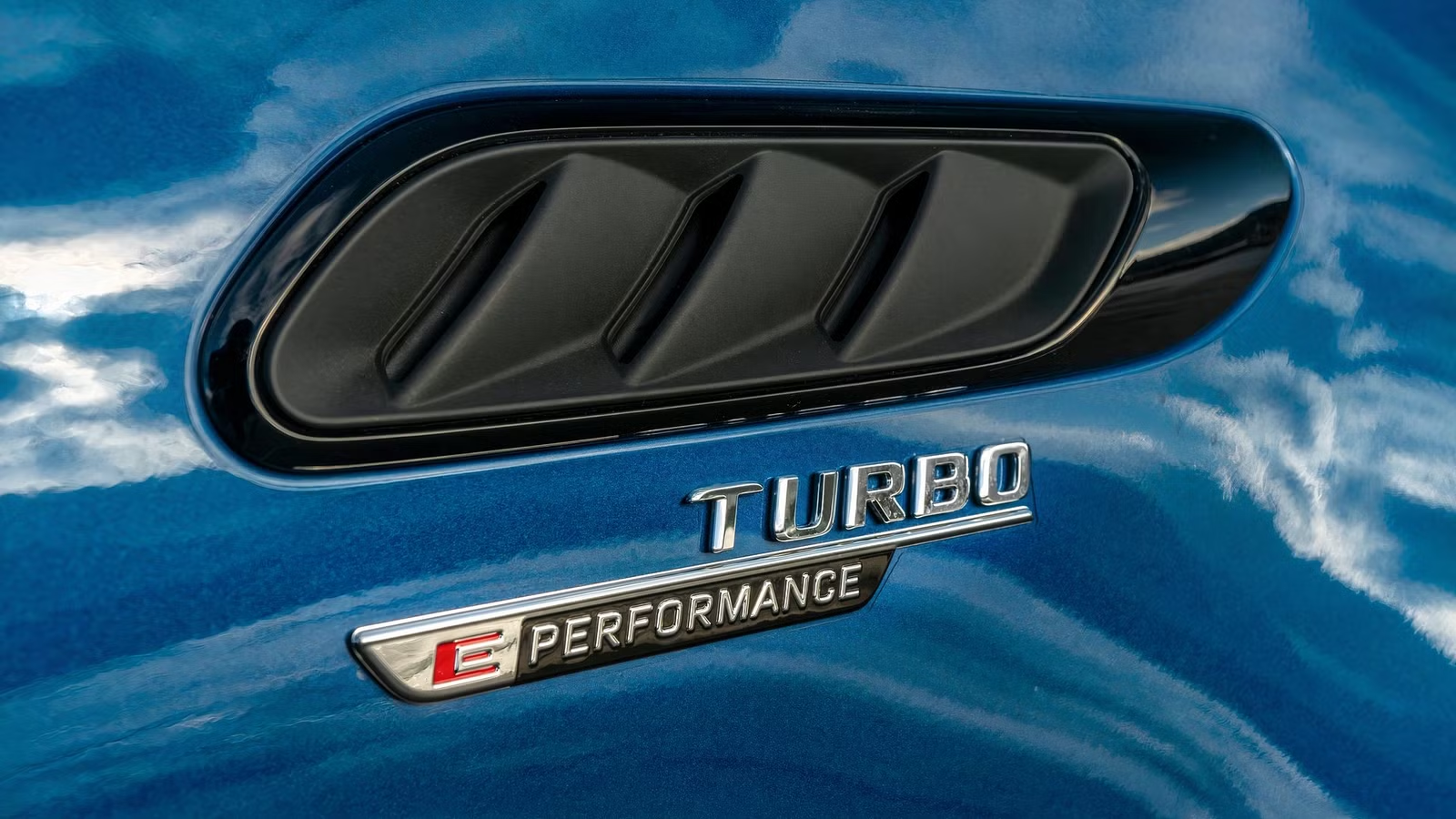
For decades, Mercedes-AMG has built its reputation on thunderous V8 engines that transformed ordinary Mercedes-Benz models into tire-smoking autobahn missiles. That’s a little ironic, though, because AMG has never been a V8-only brand. Over the years, it has offered everything from four-cylinder engines to V12s, and its first road car jointly developed with Mercedes-Benz, the C36 AMG, relied on a silky inline-six rather than a bent-eight to announce the partnership’s arrival.
The latest Mercedes-AMG C63 S E Performance is mad fast, but AMG customers missed the thunder a V8 brought to the party.Mercedes-Benz
More recently, AMG tried to rewrite its own playbook by replacing V8s in some of its core models with smaller, more complex hybridized powertrains in the name of efficiency. Fans never really bought into the idea, and now the Affalterbach tuner is rapidly reversing course. The clearest example is the latest C63 sedan, whose plug-in-hybrid powertrain centers around the world’s most powerful production four-cylinder engine: the M139. Despite shattering production-car records, the engine is set to be replaced shortly by a bigger unit, most likely when the current C-Class range undergoes a mid-cycle update for the 2027 model year.
AMG’s Four-Cylinder Gamble
Base Trim Engine
2L AMG I4 Hybrid
Base Trim Transmission
9-speed automatic
Base Trim Drivetrain
All-Wheel Drive
Base Trim Horsepower
469 HP @6750 RPM
Base Trim Torque
402 lb.-ft. @ 5000 RPM
Base Trim Fuel Economy (city/highway/combined)
19/22/20 MPG
Base Trim Battery Type
Lead acid battery
Infotainment & Features
8 /10
The M139 itself is an astonishing feat of engineering. The hand-assembled engine is a turbocharged 2.0-liter inline-four that cranks out a record-setting 469 horsepower and 402 pound-feet of torque on its own – numbers that rival what some modern V8s produce. In the C63, officially known as the C63 S E Performance, the engine teams with a plug-in-hybrid system to deliver a monstrous 671 horsepower and 752 pound-feet of torque. The tradeoff, however, is hard to ignore: the four-cylinder lacks the thunderous soundtrack that made the previous two generations of C63 so irresistible, while the hybrid hardware piles on roughly 780 pounds, pushing curb weight to a hefty 4,817 pounds.
Related
Mercedes Finally Admits 4-Cylinder Hybrid AMG Models Were A Failure
An inline-six will replace it, though a few AMGs will also get V8 power.
Straight-line performance is undeniably quicker, with the zero-to-60 time clocking in at 3.3 seconds (and sometimes quicker in real-world testing), but much of the C63’s character disappeared in the pursuit of bigger numbers, and buyers appear to have noticed. AMG hasn’t released model-specific sales figures, but the anecdotal evidence paints a bleak picture. Dealers reportedly struggled to move inventory, substantial discounts arrived far sooner than anyone expected for a once-popular nameplate, and AMG CEO Michael Schiebe has acknowledged the company lost customers who wanted a V8. More recently, Schiebe also admitted AMG overestimated how willing buyers would be to embrace a four-cylinder-powered C63.
The latest Mercedes-AMG C63 S E Performance is mad fast, but AMG customers missed the thunder a V8 brought to the party.Mercedes-Benz
Perhaps the clearest sign that the experiment failed is that AMG has already confirmed it’s moving on. In February, Schiebe revealed that the C63 will give way to a new model powered by a six-cylinder engine, with the plug-in-hybrid system expected to disappear in favor of a lighter mild-hybrid setup. Although AMG hasn’t announced a launch date, the new powertrain is widely expected to arrive alongside the C-Class’s mid-cycle refresh, likely with the car adopting the C53 badge. Schiebe cited increasingly stringent European emissions regulations as the main reason for abandoning the M139 in the C63, but it’s difficult to believe the car’s market reception didn’t also help seal the engine’s fate.
!!!MODEL TAG!!! Listing Carousel 2026 Mercedes-AMG C63 Sedan
/cars/mercedes-benz/amg-c63-sedan/2026/
M139: Engine Deep Dive
Mercedes-AMG M139 Turbocharged 2.0-liter Inline-Four EngineMercedes-Benz
The M139 actually made its debut in 2019 in AMG’s outgoing compact 45-series models, like the former CLA45, initially offering up to 416 horsepower—also a record for a production four-cylinder engine at the time. The engine came with a compression ratio of 9.0:1, a 7,200-rpm redline, combined direct and port injection, and Mercedes’ Nanoslide cylinder wall lining for lower friction and improved heat transfer compared to traditional cast linings. The original M139 featured a transverse design and a turbocharger spinning at up to 169,000 rpm and generating 30.5 psi of boost. The later longitudinal version introduced an electrically assisted turbocharger derived from Formula 1 technology to virtually eliminate lag.
Related
Mercedes Is Barely Updating Its Gas C-Class, But At Least It Still Exists
The stars are coming, and they’re getting closer than ever
The longitudinal version comes in two forms: a lower-output version found in AMG’s 43-series models, where it still delivers a maximum 416 hp, and a higher-output version found in the C63 S E Performance and its GLC63 S E Performance SUV counterpart. In the 63 models, the high-output version leverages a more powerful turbocharger, pushing specific output to roughly 235 hp per liter.
Mercedes-AMG C63 S E Performance M139 And Plug-In Hybrid SystemMercedes-Benz
The plug-in hybrid system in the 63-series models adds even more horsepower to take things up to supercar levels. The setup includes a rear-axle electric motor (up to 201 hp and 236 lb-ft) and a compact 6.1-kilowatt-hour battery. The battery enables a small electric range (around eight miles only), but more importantly, it features a complex cooling system once again leveraging technology straight out of F1. The battery’s 560 individual cells feature direct liquid cooling, allowing it to repeatedly deliver high power without overheating.
The hybrid system’s rear-axle electric motor also includes a two-speed transmission to aid efficiency at highway speeds, and runs on a 400-volt electric system. While the numbers are extraordinary, the extra components add a lot of weight, not to mention complexity, which could come back to bite owners in the long run.
Reliability Risks: High-Tech Powertrains vs. Proven Simplicity
2026 BMW M3 Sedan Front ViewBMW
The C63 S E Performance’s high-strung engine and complex plug-in hybrid gear raise legitimate long-term reliability concerns compared to simpler rivals. Having only arrived for the 2024 model year, reliability data is hard to come by. The car currently shows zero major complaints on CarComplaints and limited data on RepairPal. However, Mercedes as a brand typically ranks average in reliability (3.0/5.0 on RepairPal), with higher-than-average repair costs around $908 annually. The added layers of hybrid components, high-voltage architecture, and sophisticated cooling systems introduce more potential failure points than conventional setups—something that could translate into expensive repairs once warranties expire.
Related
Lexus V8 Engine Durability: The Engineering Secret Behind Its Longevity
How Two Japanese Titans Built One Of The World’s Best V8s
The rival BMW M3’s 503-horsepower twin-turbocharged 3.0-liter inline-six earns a below-average 2.0/5.0 reliability rating onRepairPal with annual repair costs around $1,161, often due to electronics, cooling, and occasional turbo-related issues. The Lexus IS 500 F Sport Performance’s 472-hp naturally aspirated 5.0-liter V8 stands out as the most straightforward and reliable option here, though it bowed out after the 2025 model year. Lexus consistently ranks near the top of reliability charts (4.0/5.0 on RepairPal), with low annual repair costs around $550. The proven 5.0-liter V8 architecture is also known for its robustness, with fewer potential failure points and simpler maintenance compared to the German offerings.
Toyota GR Yaris M Concept Disguised Rear View Trunk OpenToyota
Despite the potential long-term reliability challenges of extracting extreme performance from a downsized, highly stressed engine, Toyota appears poised to follow AMG’s lead. The automaker is already testing a new turbocharged 2.0-liter inline-four in a modified Yaris, where it is claimed to deliver 450 hp. Toyota engineers and executives have stated that more than 600 hp is easily achievable with a larger turbocharger, suggesting the engine was designed with significant headroom and aftermarket potential in mind. If it reaches production, this four-cylinder could become a modern performance legend in the same vein as the iconic 2JZ inline-six, assuming it can match the latter’s durability.
Engineering Brilliance, Commercial Misfire
Mercedes-Benz
The M139 engine and the models it powers are undoubtedly among the greatest engineering achievements in modern performance cars, proving just how much power can be extracted from a production four-cylinder. Yet remarkable specifications weren’t enough to win over traditional AMG fans enamored with V8 engines. As the M139-powered cars age, their highly stressed engines, sophisticated hybrid systems, and intricate electronics could also make maintenance and repairs prohibitively expensive, adding another layer of uncertainty to an already divisive powertrain.
Sources: Mercedes-Benz, RepairPal (1, 2, 3)
