

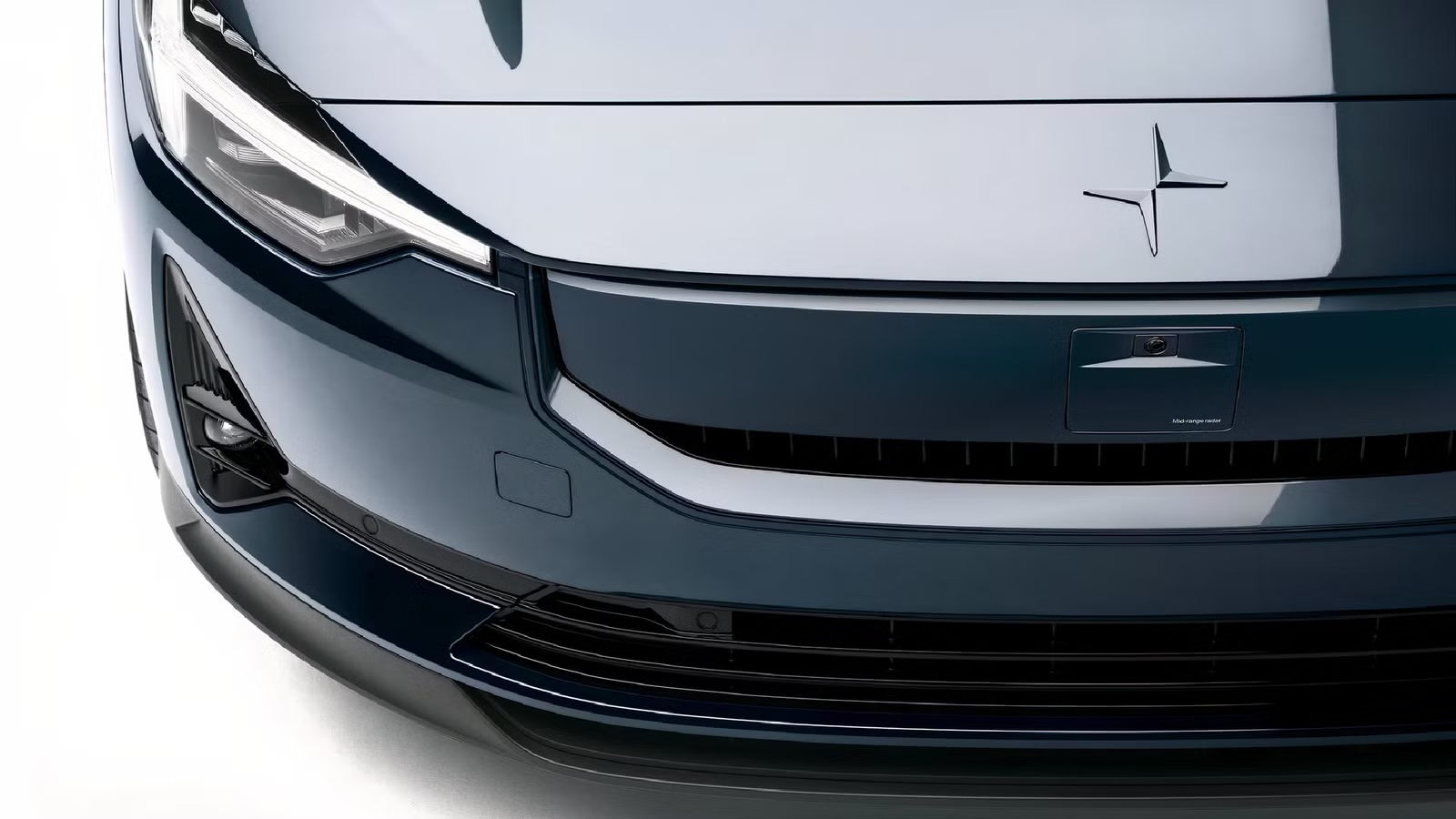
Although Polestar has built up a generally good reputation in the marketplace, its China links have proved to be its U.S. undoing. The government has denied authorization for the company to sell its vehicles from the 2027 model year onward under America’s Connected Vehicle rule.
Polestar will continue to sell its existing Polestar 3 and Polestar 4 models until they are cut off. And existing customers will continue to receive support, warranty coverage, and access to the service network as well. But for those U.S. customers sitting on a Polestar 2, the situation is a little bit more personal. Polestar’s Geely connection has now created some questions involving the car’s current value, what a dealer is likely to offer for it in 2027, and, crucially, who will be around to fix it in 2030.
The First Hit Comes At The Trade-In Desk
2024 Polestar 2 from the front three-quarter anglePolestar
2024 Polestar 2 Long Range Dual Motor Specifications
Motor
Dual electric motors
Transmission
Single-speed direct drive
Drivetrain
All-wheel drive
Power
421 hp
Torque
546 lb-ft
Although Polestar is not going through a dramatic collapse of any kind, the government’s ruling will create general market uncertainty. And that’s likely the first place for an existing Polestar 2 owner to encounter friction. A used car appraiser will be aware that Polestar does not have any new car future in the U.S. and will also know that buyers may exercise caution, and that may have a significant effect on their valuation.
Ordinarily, the Polestar 2 would be an attractive EV and, with its 2024 update, it became meaningfully better than before. It now had a more rear-biased dual-motor setup producing 421 hp and 546 lb-ft of torque. It offered up to 276 miles of EPA range as well, and could get to 60 mph in about 4.3 seconds. With the optional performance pack, output went up to 455 hp and cut that sprint time down to 4.1 seconds. This meant that the Polestar 2 had all the markings of a quick, modern, premium electric fastback, with enhanced hatchback practicality and Google connectivity built in.However, used shoppers who may be looking at a discounted Polestar 2 in 2027 may also want to know if they’ll be able to access the company’s nearest service point by 2029. They’ll want to know if software support will remain seamless and whether they’ll be able to sell their Polestar 2 when that time rolls around. These levels of uncertainty could quickly turn into a discount for used car appraisers, and it’s likely to sharpen their assessments.
Marketplace Data Already Shows The Depreciation Problem
Polestar 2 rear endPolestar
In 2024, the Polestar 2 Long Range Dual Motor version went on sale for $55,300 before destination. That already placed the vehicle into premium EV territory, but today, depreciation has already made its mark, with the CarBuzz Marketplace showing an average price of $25,900 for a 2024 Polestar 2. And that suggests that this vehicle has already moved from that premium EV territory to sub-$30K used car territory before the 2027 sales ban fully takes hold.
Another outlet suggests approximately 55% depreciation from new, and that is a number that ought to worry owners the most. They may find a certain amount of pushback when factors like buyer hesitation, dealer risk, or auction liquidity get priced in. Trade-in bids for a 2024 Polestar 2 could start to push into the low $20,000 range if dealers begin to price in orphan branding risk. By 2029, higher-mileage examples might plausibly settle into the mid to high-teens bracket unless good warranty support and strong service access help to keep confidence intact.
Why Polestar Isn’t Saab, Suzuki, Or Fisker As Yet
2024 Fisker Ocean front 3/4 parkedFisker
The orphan brand syndrome can be very problematic in the used car marketplace, and Saab, Suzuki, and Fisker carry some useful warnings. In the case of Saab, the Swedish company had very loyal owners, a genuine engineering character to lean on, and a strong identity. But once it had to declare bankruptcy at the end of 2011, the ownership equation suddenly changed. Without that factory-backed confidence, the value of its mainstream used cars started to wobble.
American Suzuki is another example of a manufacturer that had to shut its doors, filing for Chapter 11 protection in 2012. Suzuki did say that its existing service network would continue and that it would honor warranties and keep parts flowing. And that seems to be similar to Polestar’s current message when its new sales stop. But while American Suzukis didn’t become worthless overnight, the buyer pool clearly narrowed as the cars moved into the realm of a niche purchase.
Polestar owners may not really want to hear about the story of Fisker because it represents the modern EV nightmare. This company filed for U.S. bankruptcy protection in 2024 after struggling with suppliers and production problems, and that exposed specific modern car challenges. After all, today’s electric cars lean heavily on connected systems, proprietary software, diagnostics, and specialized support, and that places even more pressure on after-sales competence. It’s why Polestar’s continued operating status matters so much.
At the same time, it’s important to stress that Polestar is in no way bankrupt. Its official position says that service network access and warranties will continue, which may well temper the eventual outcome.
Service Support Will Decide The Value Floor
Polestar 4Polestar
Polestar has 32 US service centers and expectations suggest that they’ll remain open to provide service as they sell down their existing Polestar 3 and Polestar 4 stock. Warranties will remain in full effect according to their terms, and this usually means that the new car is covered for manufacturing defects for four years or 50,000 miles. The electric motors and batteries also get protection for eight years or 100,000 miles, but there’s clearly a question about long-term coverage.
Everything should be fine while dealers are selling down existing stock and those sales help justify showroom leases, diagnostic equipment, staff, and local marketing. But the business case may become thinner once a retail point pivots to an after-sales operation.
Related
Polestar No Longer Taking Orders For 2
There are still new ones available, but you can forget about 2026 models.
However, the Volvo connection may yet come into the picture. Strangely, even though Volvo is majority-owned by Geely, it can still sell its vehicles in the U.S. under the Connected Vehicle rule. But as Polestar is effectively a sister brand to Volvo, there’s a chance that Polestar owners could lean on the Volvo ecosystem. Those 32 Polestar service centers are housed within Volvo dealerships, after all. And that might help with parts, diagnostics, and technical knowledge so those crucial factors don’t slowly disappear into a black hole.
With time, Polestar may seek to clarify its position and provide reassurance to its existing owners. After all, the stronger the service story remains, the firmer the used Polestar 2 pricing floor is likely to be.
The Smart Owner Move Is To Manage Timing And Not Panic
2022 Polestar 2 cutawayCars & Bids
It is probably best for Polestar 2 owners to sit tight now rather than panic selling. After all, the Polestar 2 has already taken a major depreciation hit, and the marketplace is not necessarily the most welcoming for this car right now. If an owner has a Polestar 2 on lease, it’s probably best to let the leasing company absorb the residual value risk unless or until the buyout price becomes unusually attractive.
For those who own their car outright or may be financing it, their calculation will probably depend on location, mileage, warranty status, and service access. And for those who live near a stable Polestar service point and may have several years of battery warranty left, it’s probably best to keep the car and extract as much value as possible, based on the existing depreciation picture.
Related
Volvo And Polestar May Have Made A Mistake By Splitting Up
Just imagine what Volvo and Polestar could have been had they stuck together.
On the other side of the equation, people who are looking to buy a premium used EV may find a Polestar 2 quite attractive if they can find one in the low $20,000 range. In this situation, they could be getting a quick, stylish, well-built EV that comes with a battery warranty. While they will still need to answer questions about its long-term service path, such a purchase could make sense for someone who understands the risk.
Meanwhile, if Polestar keeps service levels good and predictable, with flowing access to parts and active software support, then the Polestar 2 should retain a defensible, niche value. The risk involves a potential slide into orphan brand discount territory if used car dealers become too wary, or if the Polestar network thins. Even though the car is still a good proposition, it will be down to the market to decide how uncertainty factors into the value equation.
Sources: Polestar, Kelley Blue Book, BIS.gov, Global Suzuki.
