

When considering a compact SUV nowadays, at least one of two names – RAV4 vs CR-V – automatically makes its way onto your list. There is a good reason for that. They are both bestsellers on the market and offer good practicality and comfort at a price that doesn’t break the bank.
So, what happens when you put both these compact titans against each other? We compare their engine, exterior, interior and finally, their price to find out which one is the better deal for you. There can only be one winner… right?
All information has been sourced from the manufacturer or test drive experience, where available. All prices listed are MSRP, which does not include any offers or additional fees. Automakers reserve the right to update pricing at their own discretion and without notice.
Toyota RAV4 vs Honda CR-V Engine Specs
The Kings Of Efficiency
2026 Toyota RAV4 PHEV GR Sport engineJared Rosenholtz/CarBuzz/Valnet
Model
2026 Toyota RAV4
2026 Honda CR-V
Engine
2.5L I4 Hybrid
2.5L I4 Plug-in Hybrid
1.5L I4 ICE
2.0L I4 Hybrid
Gearbox
CVT
CVT
CVT
e-CVT
Power
226 hp
324 hp
190 hp
204 hp
Torque
163 lb-ft (Engine only)
172 lb-ft (Engine only)
179 lb-ft
247 lb-ft
0–60 mph
7.16 secs
5.34 secs
~8.5 secs
7.5–7.9 secs
Best Fuel Economy (City/Highway/Combined)
47/40/43
43/36/40
28/33/30
43/36/40
Weight
3,640 lbs
4,435 lbs
3,472 lbs
3,752 lbs
The sixth and latest generation of the RAV4 doubles down on efficiency. It is available as a hybrid only from this year. However, you can choose how much involvement you desire from the electrical system. You have an option of a hybrid or a plug-in hybrid that gives you an EV-only range of up to 52 miles. This already makes it more convenient than the CR-V, which cannot run on electric power alone for extended periods of time. Not only that, the new RAV4 is also considerably faster than the CR-V, mainly due to its higher horsepower figures. The base RAV4 is also more efficient than the base CR-V, as the battery can handle city commutes through regenerative braking and not use any fuel at slow speeds. If you need to find faults in the new RAV4, the ride is quite stiff for its class and the wind noise at highway speeds may be a nuisance.
“The FWD model is the most frugal, and there is a slight drop-off depending on the trim level, but this is still among the most efficient compact crossovers on the market.”
– Jared Rosenholtz, Editor-At-Large, CarBuzz
The Honda may seem miles behind in terms of engine specs, but it makes up for it in terms of refinement. While you do get an option for an ICE-only model, the hybrid is superior in almost every metric. For 2026, the powertrains get a new traction-management system for the AWD models to aid maneuverability in low-speed, low-traction situations. While the CR-V is not known for its punchy performance or driving dynamics, its smooth and linear power delivery, especially at highway speeds, helps it stay in the fight. It is also praised for having a smoother ride than the RAV4.
Honda CR-V vs Toyota RAV4 Exterior Comparison
As Close As It Gets
Honda CR-V vs Toyota RAV4 Size & Dimensions
Model
CR-V
RAV4
Length
184.8 inches
181 inches
Width
73.5 inches
73 inches
Height
66.2 inches
67 inches
Wheelbase
106.3 inches
105.9 inches
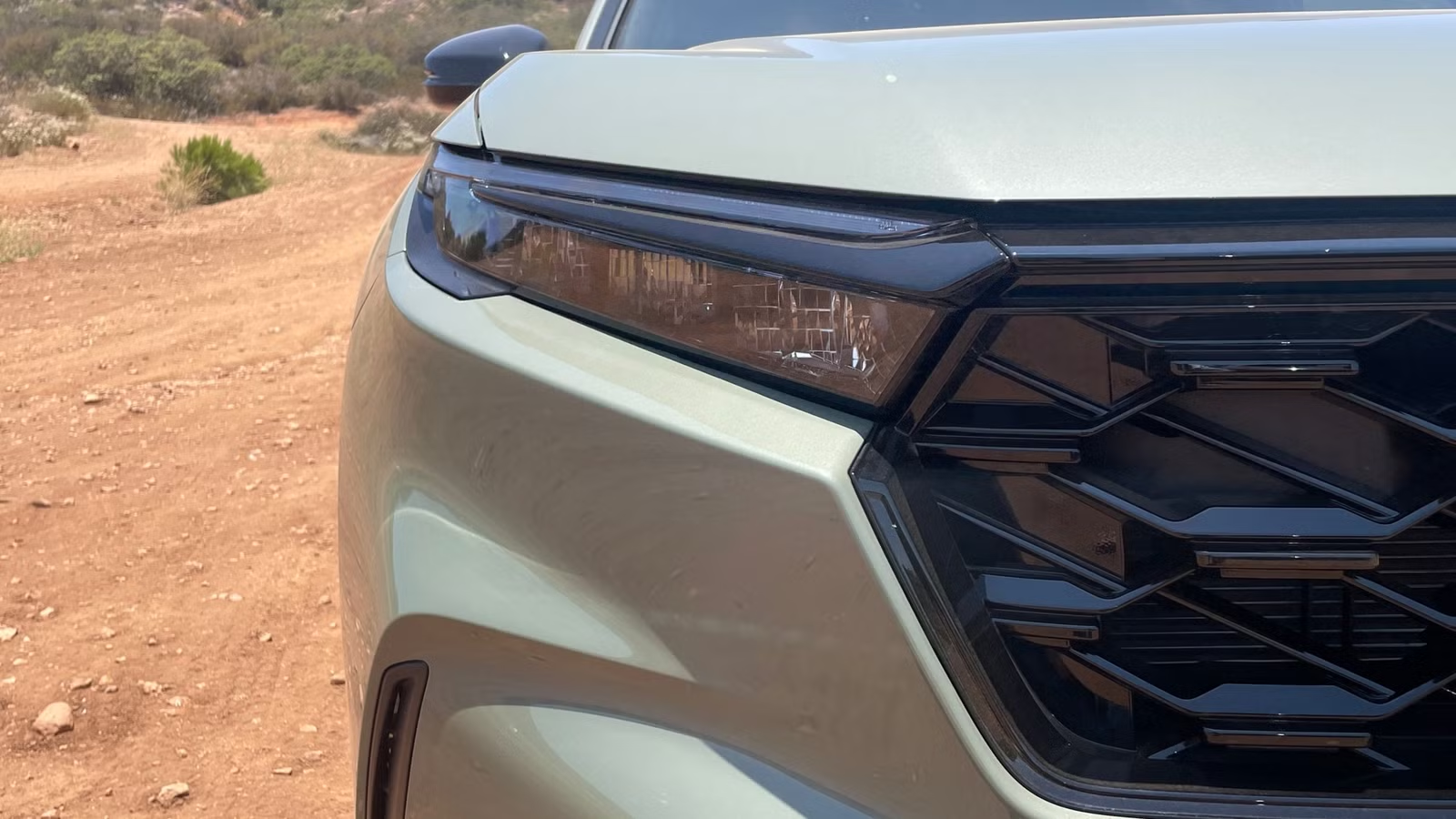
Both compact SUVs are almost identical in their exterior dimensions, with the CR-V being marginally bigger. The RAV4 gets a new design for this year. The new update brings it in line with the other models in its lineup. The main differentiator this year is the variety of trims that are available.
RAV4 Hybrid trims:
- LE: entry level trim with 17-in wheels, LED projector headlights and taillights, etc.
- SE: 18-in wheels with colored upper bumper, chrome rear bumper, piano black over fenders and lower front bumper, etc.
- XLE Premium: Digital Key capability, height adjustable power tailgate, etc.
- Woodland: Off-road focused trim with all-terrain tires, integrated fog lights, tow hitch, etc.
- XSE: 20-in wheels, power tilt/slide moon roof, vertical LED front bumper lights, etc.
- Limited: 18-in wheels, panoramic moon roof, 9-speaker JBL sound system, etc.
RAV4 Plug-in hybrid trims:
- SE: Same features as above, but more power, as well as higher price and towing capacity.
- Woodland: Same features as above, but more power, as well as higher price and towing capacity.
- XSE: Same features as above, but more power, as well as higher price and towing capacity.
- GR Sport: PHEV exclusive trim that is new for this year with 20-in high-performance summer tires, a rear splitter, wider stance, more aggressive front and rear bumpers and a stiffer and lower suspension and chassis tuning.
Related
How Honda’s Best-Selling SUV Stands Up Against The $4k Cheaper HR-V
There is a reason the CR-V compact SUV is so popular. Does the much cheaper HR-V challenge the practicality king?
The CR-V also has a plethora of trims to choose from.
Honda CR-V trims:
- LX: Entry level trim that is good for budget-conscious buyers.
- EX: Adds features such as heated front seats, dual-zone automatic climate control and a one-touch power moon roof.
- EX-L: Adds leather upholstery to the interior with a powered tailgate and parking sensors.
Honda CR-V Hybrid trims:
- Sport Hybrid: Cheapest trim with the hybrid powertrain and features 18-inch gloss-black alloy wheels.
- TrailSport Hybrid: The newest off-road focused trim with a rugged appearance package and all-terrain tires with unique TrailSport badges.
- Sport-L Hybrid: Adds leather upholstery to the Sport Hybrid trim.
- Sport Touring Hybrid: The flagship trim now gets larger 19-inch rims with a Bose sound system, hands-free power tailgate and Google built-in.
Toyota RAV4 vs Honda CR-V Interior Comparison
Superior Rear Space In The Honda
The Toyota RAV4 gets an updated interior as well for this year. It follows a theme of rugged and utilitarian rather than being overly modern or minimalistic. As standard, you get a 10.5-inch central screen with an optional 12.9-inch screen on higher trims. You also get a 12.3-inch digital driver’s display with a head-up display on the Limited and XSE trims. The dashboard is uncluttered and well-thought-out in terms of places to keep everyday belongings.
The second row is a bit more cramped than the CR-V, with lesser hip and legroom. However, it is far from the worst in its segment, and should be plenty for adults on relatively long trips. The cargo volume is also down when compared to the CR-V, which may be a deal-breaker for some.
Toyota RAV4 vs Honda CR-V Interior Comparison
Model
RAV4
CR-V
Rear Shoulder Room
56.4 inches
55.9 inches
Rear Hip Room
49.6 inches
52.6 inches
Rear Leg Room
37.8 inches
41 inches
Trunk Volume
37.8 cu-ft
39.3 cu-ft
If we compare the Honda CR-V to the Toyota RAV4 interior, the Honda seems like the more premium interior. While it is also not ultra minimalist and tech-forward, the material usage is better here. The fairly spartan dashboard is broken up with a central honeycomb-textured air vent grille. The central screen and digital driver displays are both smaller, at nine and 10.2-inches respectively. HVAC controls remain as physical buttons here, which is a welcome bonus.
The second row and cargo space are larger in the CR-V. Adults will have no problems in the back for long journeys, and you will also have enough space to carry all their luggage with you, with the CR-V’s best-in-class rear trunk volume. If you want maximum practicality, the CR-V is the better option here.
Related
2026 Toyota RAV4 First Drive Review: The Compact Crossover That Will Dominate America
Toyota took a bestseller, and just added more things customers wanted. Here’s why the new RAV4 will break even more sales records.
CR-V vs RAV4 Price Comparison
The Choice To Stick With Gas Or Go Hybrid
2026 Honda CR-VHonda
The 2026 Honda CR-V starts from $30,920 for the non-hybrid LX trim. The most expensive trim is the Sport Touring Hybrid, which starts at $42,550. For that price, you get a better and more practical cabin, in our opinion. You also get the option to ditch the electric powertrains and stick to conventional gas power, if that is something you are looking for.
One thing to note, the base hybrid trim of the CR-V starts at $35,630, which gives you the same economy as the PHEV RAV4, for around $5,000 cheaper. In terms of reliability, while both should not falter, the non-hybrid Honda should be easier to repair, should something go wrong, due to its less complicated internals. The CR-V is two-wheel drive as standard on all trims except for the TrailSport and Sport Touring, with an option to have AWD for $1,500.
2026 Toyota RAV4 PHEV GR Sport rear 3/4 angle in redJared Rosenholtz/CarBuzz/Valnet
The 2026 Toyota RAV4 Hybrid starts from $31,900 for the LE trim and goes all the way up to $49,475 for the GR Sport trim of the Plug-In Hybrid. While the Honda might be roomier inside, the RAV4 wins in the powertrain department. The RAV4 Hybrid is significantly more economical than the non-hybrid CR-V. Whereas, the RAV4 PHEV and CR-V Hybrid have the same efficiency score, despite the increase in performance of the RAV4. If you want the most economical among the two, the RAV4 Hybrid is the way to go, although you do get a smaller cabin and lesser trunk space. If you are looking for a performance version of a compact SUV, the RAV4 GR Sport should satisfy that need while sipping on fuel.
Which One Is The Better Deal in 2026?
Better Powertrain vs Better Practicality
If we compare sales figures over the last five years, the RAV4 wins every year. With the sixth generation RAV4, these numbers should remain strong for the next few years as well. Nevertheless, they are both the top two best-selling compact SUVs in America.
Toyota RAV4 vs Honda CR-V Sales Figures Over The Last 5 Years
Model
RAV4
CR-V
2021
407,739
361,200
2022
366,741
238,100
2023
434,943
361,400
2024
475,193
363,300
2025
479,288
403,700
The RAV4 also holds its value better than the CR-V, as highlighted by our price trends chart.
The Superior Compact SUV In 2026 Is…
2026_Toyota RAV4 PHEV_GR Sport_SupersonicRed_030Toyota
We wish we could declare the winner between these two as a sure-footed answer. However, Toyota and Honda are closer than ever this year. If you want better fuel efficiency, more performance and do not mind the slightly higher starting price, the RAV4 continues its run of form with this new generation. However, if you are adhering to a strict budget, the CR-V starts at a lower MSRP and offers more space inside and in the trunk, making it the practicality king. If you are willing to spend more, the CR-V Hybrid also matches the RAV4 PHEV’s efficiency for a considerably cheaper price and retains its space advantage over the Toyota.
Nevertheless, you really cannot go wrong with either of these choices. The list of priorities you demand from these compact SUVs will be the final factor while making this decision.
Sources: Honda, Toyota, EPA
