

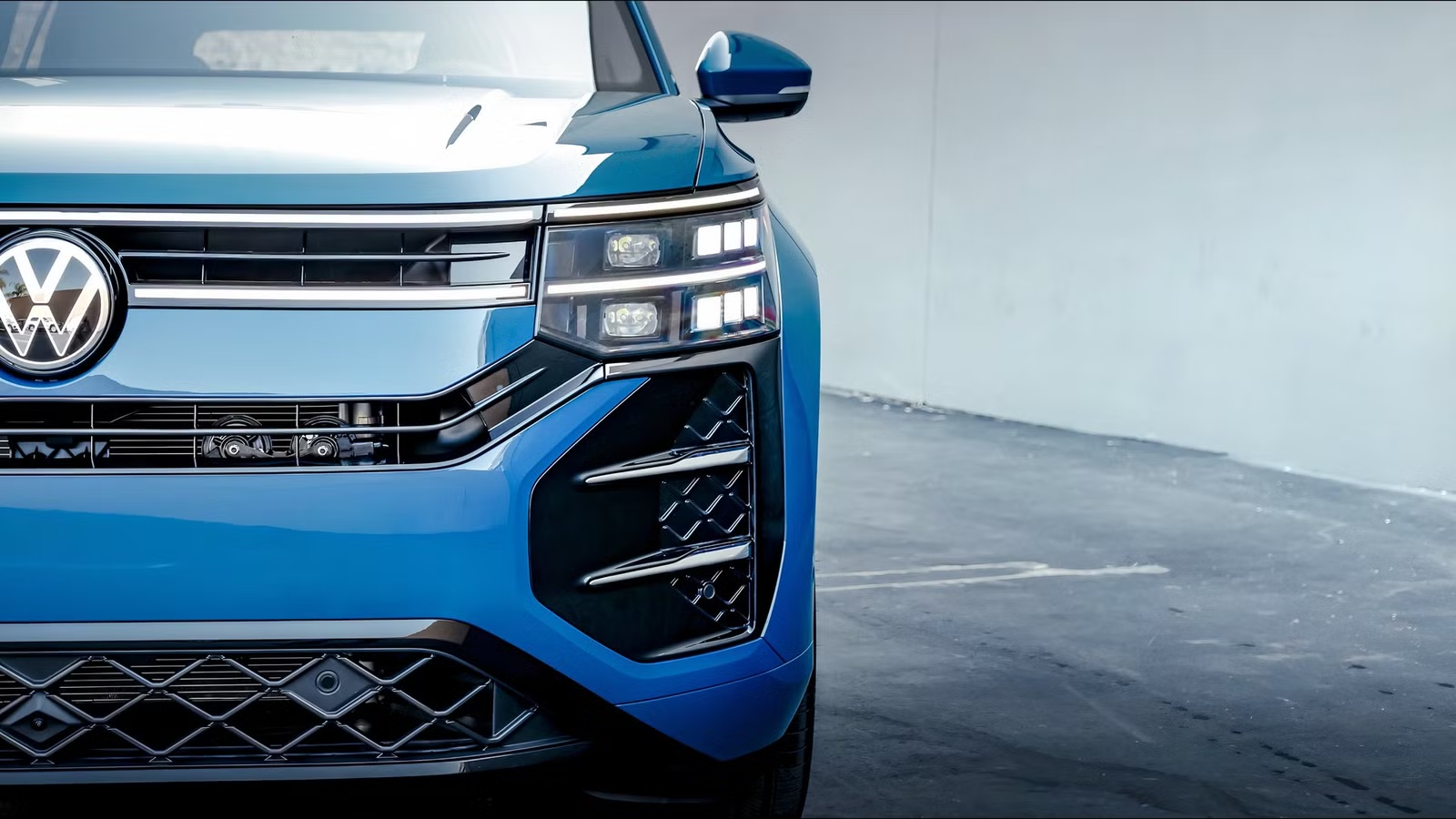
The Volkswagen Atlas is the German brand’s SUV with three rows of seating that’s designed specifically for the US market. Volkswagen is now looking to improve its success with a second generation model that has a brand new exterior design, the same level of roominess inside, more family-friendly features, more power, and better fuel economy. The new Atlas uses the next-gen four-cylinder turbo engine found in the previous model, with all-wheel-drive available and a rounded list of safety features.
Base Trim Engine
2.0-liter turbo Inline-4
Base Trim Transmission
8-speed automatic
Base Trim Drivetrain
All-Wheel Drive
Base Trim Horsepower
282 HP @5500 RPM
Base Trim Torque
258 lb.-ft. @ 1600 RPM
Base Trim Fuel Economy (city/highway/combined)
20/26/22 MPG
Segment
Midsize SUV
Pros & Cons
- Spacious and practical
- Big interior upgrade for a new generation
- Strong engine and transmission
When the Volkswagen Atlas debuted, it featured 17 cupholders – a sure sign it wasn’t going to go into the European market and was designed for the USA. It embraced the high-riding SUV format America loves along with an exceptionally roomy interior. For the 2027 model year, the designers have given the Atlas a complete makeover with even boxier styling, more sophisticated lines, and up-to-date lighting. Inside, Volkswagen has addressed criticism about its tech and lackluster design, and then put genuine thought into how people use the vehicle and tailoring it for them. Here’s what we found when we spent some time behind the wheel.
First Drive events provide our initial impressions of a vehicle in a restricted environment under certain time constraints. Keep an eye on CarBuzz for our comprehensive Test Drive review which will follow soon.
What’s Changed For This Model Year
As this is a second generation model, there’s a long list of differences over the outgoing model. The base trim comes with a 12.9-inch infotainment screen, while other trims come with a new 15-inch display. All trims include Volkswagen’s 10.25-inch Digital Cockpit Pro, and there’s dual magnetic wireless charging in the center console, so two phones can be charged at once.
There are new safety features as standard, and the next-generation engine is built to be stronger – it makes a little extra horsepower while improving fuel economy. The downside is that the Atlas increases in price for the 2027 model by $2,300, which Volkswagen says reflects the new features and improvements.
Design or Style or Exterior Looks: Embracing The Zeitgeist
Strengths
Weaknesses
- A bold new look
- LED lighting now standard
- Selectable welcome/leaving home animations
- Standard dynamic turn signals
- If you don’t like illuminated brand badges, that’s a negative here.
Volkswagen designers have gone nuts on the exterior design when you consider how conservative the previous generation is. Double-stacked headlights are the in thing, as is a pixelated design, illuminated badging on higher trims, and lighting across the full width of the rear end, and Volkswagen has embraced it all. The lines are more defined through the new bodywork, and a new spoiler deals with airflow over the tailgate, while at the front the Atlas gets a new grille.
The standard wheels are 20-inch items, increasing to 21 inches as you move up the trim levels. Three new colors are added for the 2027 model year – Blackberry Metallic, Sacramento Green Metallic, and Sandstone. However, despite all the changes and being on a new platform, the Atlas retains almost the same dimensions as before.
Interior: It’s About Time Things Got Nicer
Strengths
Weaknesses
- Plenty of interior space
- Generous cargo space
- New materials make the cabin welcoming
- Neat solutions for simplicity and usability
- A 15-inch screen could be considered overkill
- Piano black plastic trim won’t age well
The cabin for the new Atlas is a whole new deal, complete with a cohesive “bold loop” design blending the ends of the dashboard with the doors. A big change in approach is that the transmission shifter is now mounted on the steering column while simplified light controls are on the dashboard to the left of the steering wheel. We expected that to be a bit annoying, but out on the road and dealing with parking, it quickly became second nature. And, the lights are now set on automatic when the vehicle starts, which should be standard on all road vehicles now.
By moving the shifter to the steering column, a lot of space is freed up in the center console. Most importantly, it has made room for two magnetic MagSafe phone chargers that — and we can’t stress how unusual this is — hold the phones in place and on charge while driving around. Second-most importantly, the upgrade of interior materials, including soft-touch surfaces throughout, is palpable and makes the Atlas a more welcoming place to be.
The seats are an evolved version of the previous ones to improve adjustment and comfort, but what you’ll notice is the new volume knob on the center console. Not only is it pretty and useful for the passenger, but it can also be used to select the pre-programed ambient light settings. As for space, there’s plenty for the first and second row, while the third row seats are best reserved for school runs and emergencies. With the rear seats down, there’s a family’s worth of cargo space back there.
Infotainment: More Screen, Easier To Use
The base trim comes with a 12.9-inch infotainment screen, while other trims come with a new 15-inch display. We only got to experience the 15-inch touchscreen, but we doubt the 12.9-inch is too small – unless you’re using navigation, the 15-inch unit is overkill. Still, it’s an outstandingly crisp and responsive display and designers have clearly put time and effort into making the user interface intuitive to use.
Even the much maligned inclusion of environmental controls on the screen rather than physical buttons and dials is well implemented. Wireless Android Auto and Apple CarPlay are included, but if you want to pay Volkswagen money after buying the car, features like WiFi, Premium Speech, and generative AI are available through a subscription.
Powertrain & Driving: Middle Of The Road In A Good Way
Strengths
Weaknesses
- Smooth workhorse engine and transmission
- Excellent ride quality
- Unintrusive driving aids
- Looks sporty, but is not sporty.
The V6 option for the Volkswagen Atlas is gone, but the updated turbocharged 2.0-liter four-cylinder makes 282 horsepower with 258 lb-ft of torque and through an 8-speed auto. That’s good for pulling up to 5,000 pounds, and getting the Atlas around town briskly. The engine and transmission are nicely measured for the Atlas as a family vehicle in terms of power and smoothness. Off the line, it’s as brisk as you need, and there’s plenty for getting up to speed on the freeway.
2027 Volkswagen Atlas Engine Options
Engine
2.0-liter four-cylinder turbo
Transmission
Eight-speed automatic
Drivetrain
Front-wheel drive, all-wheel drive optional
Power
282 hp
Torque
258 lb-ft
Our test route with the Volkswagen Atlas took us up into the tight canyon roads above LA. The suspension system controls body roll so well that it was surprising how smooth the ride stayed when the road got rough. Again, the ride is measured just right without having to go to adaptive suspension for consistency. While the Atlas is a big SUV, despite technically being mid-size, the thin roads of Laurel Canyon weren’t a challenge, with the square hood telling us exactly where the front corners are.
2027 Volkswagen Atlas Fuel Economy
Drivetrain
City/Highway/Combined
Front-wheel-drive
22/29/25 mpg
All-wheel-drive
20/27/23 mpg
Visibility is excellent, the steering is light and accurate, and getting the right driving position didn’t take any thinking about. It’s just an easy vehicle to get in and drive. Nice touches include the door handles now being levers on the front end of the armrest, the simplified light controls on the dash, and side-window shades as standard in the rear. Even the extensive safety and driver assist suite (IQ.DRIVE) stays right out of the way until it’s actually needed.
Verdict & Pricing: Still Not As Expensive As You Expect
The 2027 model year Atlas starts at $41,610, excluding destination, which compares favorably to main competitors – the $45,195 2027 Honda Passport and $42,260 2026 Toyota Grand Highlander. The base trim won’t be the bestseller, though, and the more expensive SE trim starts at $45,610. The SEL R Line we drove starts at $52,110, and the new Atlas lineup tops out with the SEL Premium R-Line at $56,610.
The big criticism we have is that this is a new generation of Atlas, and it isn’t arriving with a hybrid drivetrain. Toyota’s Grand Highlander Hybrid LE trim starts at $45,610 and gets 36/32 mpg city/highway, making it the more efficient option. Honda hasn’t moved the Passport to hybrid yet, and is still using its well-proven but not very efficient 3.5-liter V6.
This generation of the Volkswagen Atlas appears to have been well measured by Volkswagen. Meaning, that the basics have been done right and the nice things to have are added tastefully, and without going over the top with anything – for example, ambient lighting or distracting graphics. It’s an SUV we can see being incredibly easy to live with, while still providing a lot of interior and cargo space.
