

Fifty-plus years on, the 1970s still cast a long shadow over car culture. Enthusiasts rightly celebrate the icons — the Lamborghini Countach, the BMW M1, the Mazda RX-7, the Ferrari 308, the Pontiac Trans Am, the Datsun 240Z, and the Porsche Carrera 2.7 RS. But for every legend that defined the decade, there were performance cars that quietly came and went, leaving barely a tire mark on automotive history.
Some seemed like brilliant ideas on paper but failed to capture enthusiasts’ imaginations — or their wallets. Others were hamstrung by quality problems, regulatory hurdles, or simply bad timing. Here are ten of those forgotten performance cars from the Seventies.
Fiat X1/9
Close
Engine
1.5-liter Inline-4
Horsepower
85 hp
Torque
87 lb-ft
0-60
10,7 seconds
Top speed
115 mph
The Autobianchi A112 Runabout made its debut at a motor show in 1969. The Bertone-designed sports car had a rear mid-mounted engine — a 1.3-liter SOHC unit borrowed from the Fiat 128 — delivering 75 hp. The small two-door attracted considerable attention, and Fiat decided to fast-track it for production.
The Fiat X1/9 went on sale in 1972, but was plagued by quality issues — most observers agree the compressed development cycle was to blame. Regular maintenance was a chore given the cramped engine compartment, so some owners skipped services, leading to chronic overheating problems.
For the US market, Fiat added larger safety bumpers and additional emission controls to meet local regulations. This only piled on more weight, further blunting the already modest performance. Eventually, Fiat enlarged the engine to 1.5 liters and lifted output to 85 hp. Performance improved, but never quite matched what the advertising implied.
The lack of punch spawned a lively X1/9 sub-culture, with owners swapping in more potent engines — a 2-liter Lancia unit was a popular choice. In stock form, the little Fiat never fully lived up to expectations, yet it soldiered on in production until 1990.
Bricklin SV-1
Close
Engine
5.9-liter V8
Horsepower
220 hp
Torque
315 lb-ft
0-60
9 seconds
Top speed
112 mph
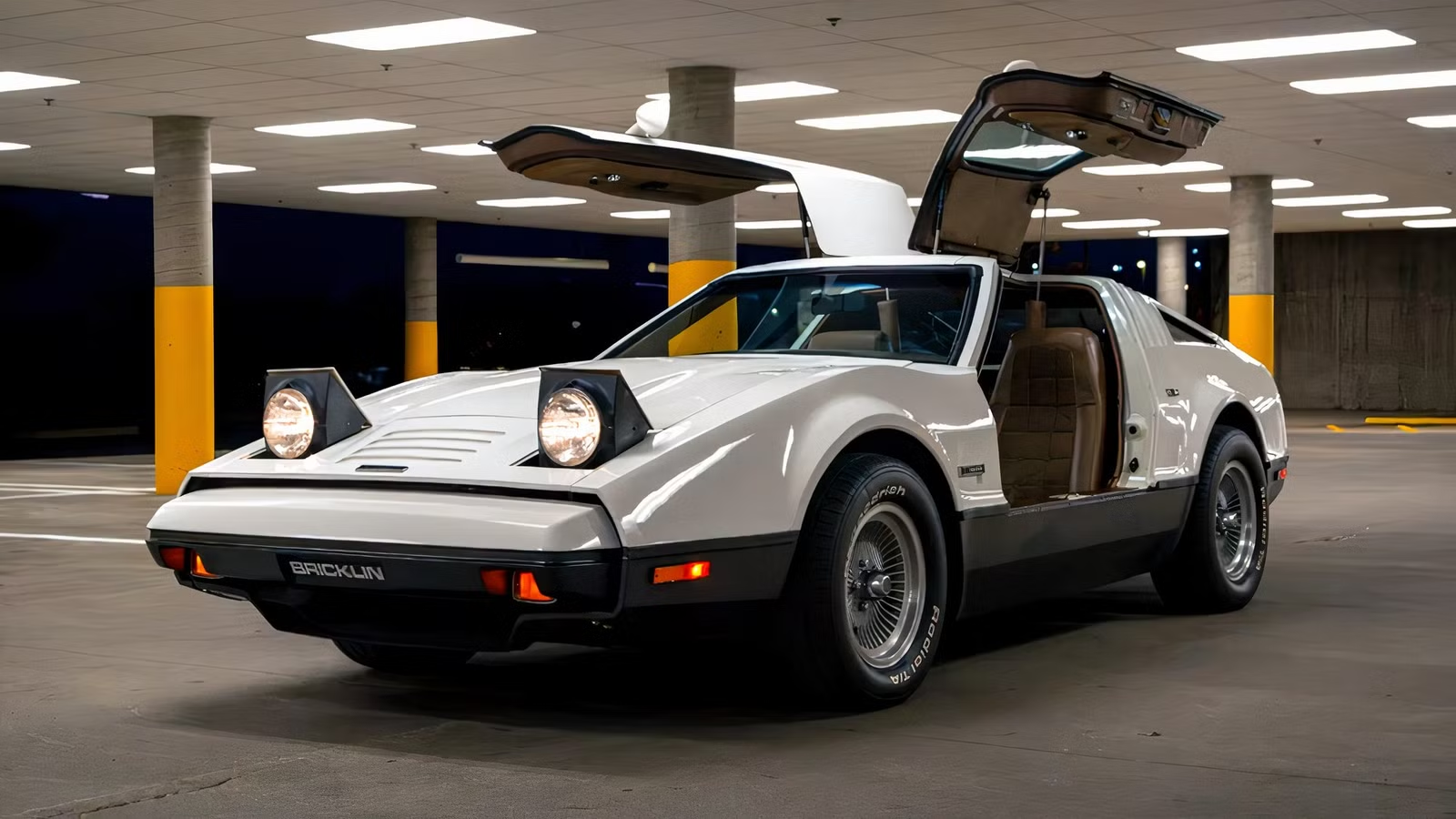
Canadian entrepreneur Malcolm Bricklin established Subaru of America in the late Sixties, then turned his attention to building his own car: the Bricklin Safety Vehicle 1, or SV-1. The concept had genuine ambition — a lightweight body fabricated from an acrylic and fiberglass composite, gull-wing doors, and a 4-cylinder Opel engine.
In 1972, the first prototype, nicknamed Grey Ghost, was completed. The composite body proved troublesome, the straight-six engine was sourced from a mixed-match parts bin spanning multiple manufacturers, and the whole project was handed to a new design and development team. By 1974, the first production Bricklin rolled off the line — completely redesigned and initially powered by an AMC 5.9-liter V8, later replaced by a Ford Windsor 5.8-liter V8.
Performance was reportedly adequate, but little else about the car impressed. Quality problems were severe, and when the price nearly doubled in under two years as the company tried to cover mounting losses, the end was inevitable — Bricklin went bankrupt with fewer than 2,000 cars produced.
Today the SV-1 is a genuine collector’s piece, with pristine, low-mileage examples commanding six-figure sums at auction.
Ferrari 365 GTC/4
Close
Engine
4.4-liter V12
Horsepower
335 hp
Torque
318 lb-ft
0-60
7.3 seconds
Top speed
162 mph
Here is a genuine unicorn: the 1972 Ferrari 365 GTC/4, which was on the market for just two years with only 500 units produced. The 365 didn’t carry a traditional Ferrari look — its styling sat somewhere between American muscle car proportions and conventional Ferrari design language.
It was no slouch, however, with a top speed of 162 mph. The 4.4-liter V12 was fitted with Weber side-draught carburetors and produced a healthy 335 hp, with a five-speed manual gearbox sending power to the rear wheels. US-spec cars received emission updates and a revised exhaust system, dropping output to 315 hp.
A steel body with aluminum doors and hood was mounted on a tubular spaceframe. Bodies were crafted by Pininfarina, and final assembly took place in Modena, Italy.
Thanks to its limited production run, the 365 GTC/4 has become highly collectible, with well-preserved examples regularly fetching around $200,000 or more.
Ligier JS2
Close
Engine
2.7-liter V6
Horsepower
170 hp
Torque
168 lb-ft
0-60
6 seconds
Top speed
150 mph
The French Ligier JS2 was built with one specific purpose: as a homologation special that would allow Ligier to compete in the European GT series.
The road-going JS2 was essentially still a racing car. Its chassis was constructed from layers of polyurethane sandwiched between steel sheets, all wrapped in a fiberglass body. Suspension was fully independent via wishbones and coil springs all around, with anti-roll bars front and rear, and disc brakes at all four corners. Minor components such as door handles and taillights were sourced from mainstream French manufacturers.
The JS2 was originally intended to use a 2.6-liter Ford V6, but Ford declined to supply the engine. Ligier switched to a Maserati C114 2.7-liter V6 producing 170 hp. By 1973, amid the international oil crisis, cash-strapped Citroën — which held a stake in Maserati — was forced into a merger with Peugeot, and the Ligier partnership became a casualty of the deal.
A total of 249 lightweight Ligier JS2s were built. They have since become rare collectors’ items, with values reflecting their scarcity.
Melkus RS 1000e
Close
Engine
1-liter Inline-3, 2-stroke
Horsepower
70 hp
Torque
87 lb-ft
0-60
12 seconds
Top speed
104 mph
Never heard of Melkus? That’s understandable — it hails from East Germany, and only 101 cars were built between 1969 and 1979.
The RS 1000e, with its gull-wing doors that were fashionable in the era, was essentially a racing car made street-legal. Power came from a mid-mounted 1-liter, 3-cylinder two-stroke engine producing 70 hp, with a five-speed manual gearbox driving the rear wheels. The fiberglass body’s standout attribute was its featherweight construction: just 1,500 lb on the scales.
Top speed was 104 mph, and handling was excellent. Finding one for sale today requires serious searching, and prices reflect the car’s extreme rarity.
AC Frua
Close
Engine
7-liter V8
Horsepower
350 hp
Torque
461 lb-ft
0-60
5.4 seconds
Top speed
140 mph
AC, creators of the legendary Cobra, developed the Frua 428 coupe as a successor to that iconic machine. The body was styled by Pietro Frua, who also penned the Ligier JS2 featured in this list. The AC 428 remained on sale until 1973.
Just 81 cars were produced, 51 of them coupes. Each was powered by Ford’s 428 cubic-inch V8 delivering 350 hp, with drive going to the rear wheels through either a 4-speed manual or 3-speed automatic gearbox.
The Frua featured a racing-derived independent suspension with coil springs, a top speed of 140 mph, and 0–60 mph acceleration quicker than an Aston Martin DB6.
Built on an extended AC Cobra chassis, the car’s complex production process was its undoing. The chassis was assembled in England, shipped to Italy for Frua to fit the body, then returned to England for the drivetrain to be installed. AC also lacked the capital to further develop and refine the design.
Priced at roughly double that of a Jaguar E-Type, the Frua was a remarkable car but an almost impossible sell. Its tiny production numbers have made it highly collectible, with examples selling for around $160,000.
Dome Zero
Close
Engine
2.8-liter Inline-6
Horsepower
170 hp
Torque
163 lb-ft
0-60
6 seconds
Top speed
130 mph
This Japanese concept made its world debut at the 1978 Geneva Motor Show. The Dome Zero was powered by a mid-mounted 2.8-liter Nissan straight-six producing 170 hp, with drive going to the rear wheels through a ZF 5-speed manual gearbox.
Creator Minoru Hayashi’s ambition was to develop the Zero into a Le Mans 24 Hours contender. When the car failed to comply with Japanese homologation rules, Hayashi built the Zero P2, aimed specifically at the US market. That updated prototype also failed to gain regulatory approval in either Japan or the US, so production never happened.
In 1979, Hayashi’s Zero RL — a full racing car powered by a Cosworth DFV V8 — made three attempts at Le Mans, each ending in retirement.
The Dome’s striking design generated a massive following in Japan, and model and radio-controlled car companies reportedly paid Hayashi millions for the commercial rights to the design. That makes it the one car on this list you can actually own — in miniature form, at least.
Monteverdi Hai 450 SS
Close
Engine
7-liter V8
Horsepower
350 hp
Torque
490 lb-ft
0-60
6.8 seconds
Top speed
168 mph
Only two examples of the Monteverdi Hai 450 SS were ever built. Swiss manufacturer Monteverdi wanted a halo model to sit above its High Speed range — a front-engined lineup of coupes, sedans, and convertibles.
Hai — German for shark — was fitted with a mid-mounted Chrysler 426 Hemi V8 producing 350 hp, giving the lightweight sports car a claimed top speed of 180 mph. Suspension was wishbone and coil spring up front, with a De Dion rear axle located by a Watts link and lower trailing arms.
The Hai never reached production. Of the planned run of 49 cars, only the two prototypes were completed. Monteverdi later used surplus Hai components and body panels to construct two non-running display cars, which now reside in the Monteverdi Museum in Switzerland.
In 2010, one of the original prototypes sold for $400,000.
Lamborghini Jarama
Close
Engine
4-liter V12
Horsepower
350 hp
Torque
302 lb-ft
0-60
5.5 seconds
Top speed
160 mph
The lesser-spotted Lamborghini Jarama went on sale in 1970, and over the following six years Lamborghini managed to find just 328 buyers.
The Jarama was powered by Lamborghini’s 4-liter V12 producing 350 hp, fed by six Weber carburetors, with drive going to the rear wheels via a five-speed manual gearbox. For a car weighing just over 3,000 lb, performance was genuinely brisk: a 160 mph top speed and a 0–60 mph sprint in 5.5 seconds.
The Jarama’s biggest problem, beyond its uninspiring styling, was the competition within its own showroom. The Miura — widely regarded as one of the most beautiful Lamborghinis ever made — used the same V12 engine and overshadowed it completely. When the Countach replaced the Miura in 1974, the Jarama never stood a chance against either classic. Despite the low production numbers, examples can still be found at relatively accessible prices for a Lamborghini, starting from around $70,000.
Four-Rotor Corvette
Close
Engine
3.4-liter 4-rotor
Horsepower
150 hp
Torque
125 lb-ft
0-60
N/A
Top speed
N/A
A Corvette with a rotary engine? Absolutely. In 1970, General Motors paid a reported $50 million for the rights to develop its own version of the Wankel rotary engine, and showcased the technology with the dramatic Four-Rotor Corvette concept in 1973.
Over the following years, GM’s engineers worked to develop a production-viable rotary that could meet emissions, reliability, fuel economy, and performance targets. The engine’s thirst, durability concerns, and difficulty satisfying emissions standards proved insurmountable. By September 1974, GM pulled the plug on the program after spending millions more in development costs.
With the rotary removed, engineers installed a small-block Chevrolet V8 in its place, and the stunning show car was renamed the Aerovette.
