

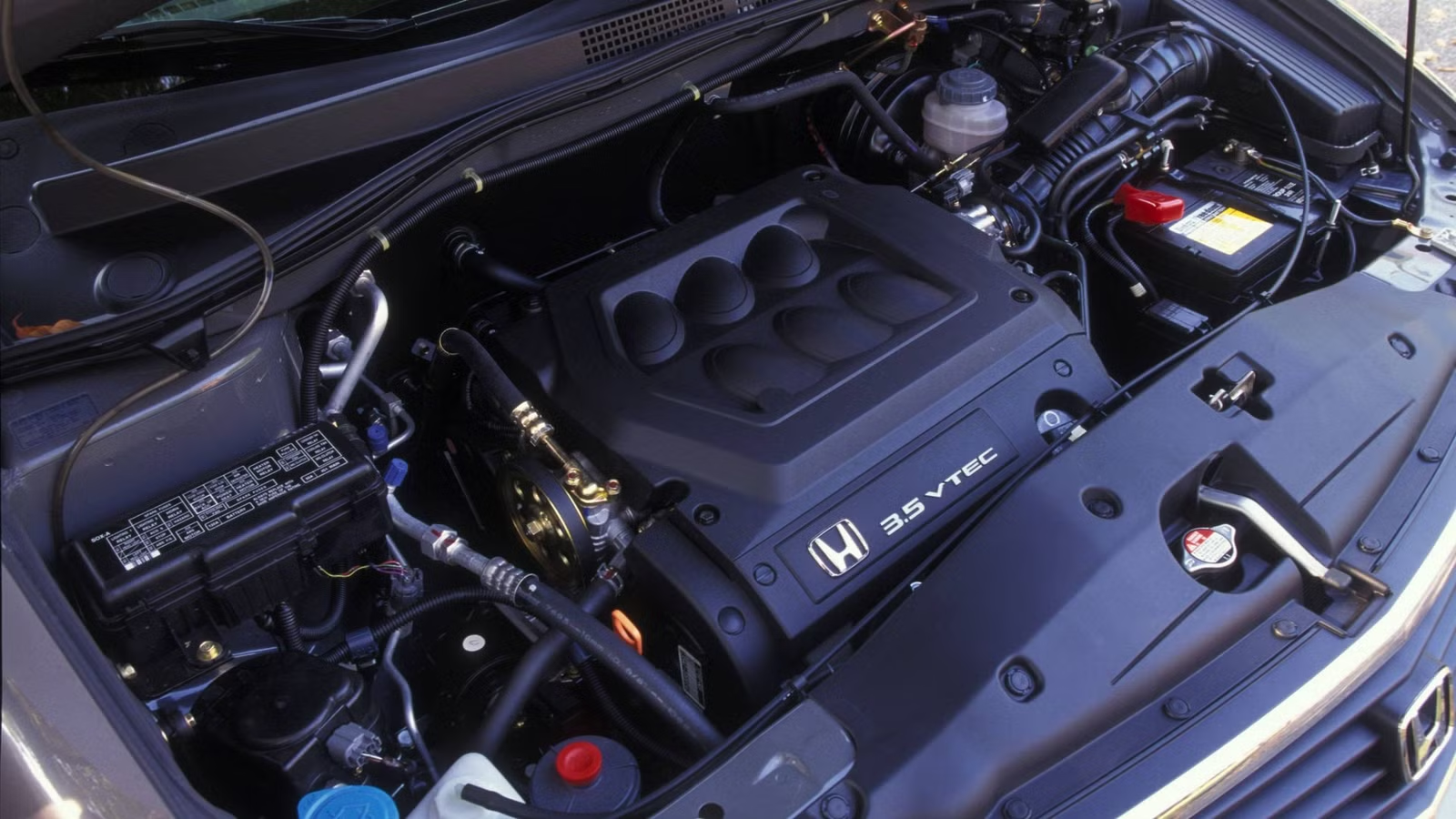
Engines that have demonstrated the longevity and breadth of application that the Honda V6 has managed are few and far between in the modern automotive era. Since it was introduced in the mid-1990s, the iconic engine has powered nigh-on everything, from family minivans and midsize SUVs to range-topping flagships and even a performance sedan that is still in production in 2026. Its reputation for mechanical refinement that punches above its displacement is well-earned, having accumulated multiple Ward’s 10 Best Engine awards with there even being at least one documented million-mile example. For an engine designed primarily for use in front-wheel-drive vehicles, mounted transversely, that really is quite the achievement.
And so, having underpinned Honda’s lineup in the US for nearly three decades, the J-Series motor is now in its twilight years. But rather than retiring the V6 altogether, Honda has been quietly developing an all-new V6 hybrid powertrain that has been engineered specifically for the use of the US market. While the J-Series chapter may be coming to a close, the next chapter might just be even more significant.
This article focuses specifically on Honda’s J-Series V6, maintenance costs and price of repairs as reported by owners and local authorities. Information is correct at the time of writing and your mileage may vary.
What Is The Honda V6 Engine?
2000 Honda Odyssey powered by a 3.5-liter Vtec V6Bring a Trailer
The Honda V6 engine that most motorists will be familiar with belongs to the J-Series family of engines – Honda’s fourth production V6 engine lineup that was introduced in 1996. Chief engineer Koichi Fukuo led the development of the J-Series V6, which began in 1993, with the main goal being the creation of a cost-effective engine to power price-competitive North America-bound Hondas. In order to do this, unified cylinder heads, simplified manufacturing, and entirely local parts sourcing were incorporated into Honda’s new lightweight, compact powerplant.
The end result was a 60-degree V6, the bank angle distinguishing it from the 90-degree C-Series V6 that it was replacing, built around an aluminum block, aluminum heads, single overhead camshaft setup and Honda’s VTEC variable valve timing. All J-Series engines are gas-powered, make use of four valves per cylinder and were designed to exclusively be mounted transversely. Honda’s Anna engine plant in Ohio and its facility in Lincoln, Alabama – both entirely US-based operations – are where production of these engines takes place.
The J30: Honda’s Iconic V6 And Its Remarkable Longevity
The 1996 Acura 3.0 CL debuted Honda’s J30 V6, effectively launching the J-Series family of V6s as the successor to the outgoing C-Series. Deliberately over-engineered for the segment in which it sits, it featured a die-cast aluminum alloy block with iron cylinder liners, single overhead cam heads with four valves per cylinder, a forged steel crankshaft, and a simplified cooling circuit specifically designed to reduce the potential of any leaks. J30’s can easily blast past the 200,000-mile mark with basic maintenance. A 2003 Honda Accord powered by a J30A4 has even been documented as having completed a million miles with nothing more than low compression and the occasional misfire having been reported as faults.
“Legendary V6 motors that have been pushing Hondas and Acuras along since 1999.”
The J-Series surpassed the number of years that Honda’s K-Series four-cylinder was in production by more than five years – the J30 family still being in production today – albeit in a significantly more modern form. The J30AC can be found under the hood of the Acura TLX Type S and the MDX Type S, adding a twin-scroll turbocharger, direct injection and direct overhead cams to produce 355 hp and 354 lb-ft. In both of these applications, this iconic motor is mated to a ten-speed automatic transmission and Super Handling All-Wheel Drive. What started out as a 200 hp motor in a front-wheel-drive coupe now powers Acura’s flagship.
The 3.5-liter V6: Honda’s Most Widely Used Engine
Of the J-Series family of engines, the J35 stands as the largest displacement naturally aspirated motor, designed for midsize SUVs, minivans, sedans and luxury vehicles that require smooth power delivery and variable valve timing. The second-generation Odyssey was the first Honda to feature this motor, which has subsequently become the most widely deployed engine in Honda’s history. The J35 has appeared in the Accord, Pilot, Passport, Ridgeline and a number of Acura models such as the MDX, RDX, RLX and TLX in varying states of tune. The Honda 3.5L V6 has evolved from a SOHC VTEC motor with outputs of 210 hp in its original form to a more modern DOHC setup with direct-injection, producing up to 310 hp in the Honda Legend in other markets.
Honda J35 Variants and Applications
Engine Code
Configuration
Output
Application
J35A1
SOHC VTEC
210 hp / 229 lb-ft
1999–2001 Odyssey
J35A4
SOHC VTEC
240 hp / 242 lb-ft
2002–2004 Odyssey / 2003–2004 Pilot
J35Y6
SOHC i-VTEC/VCM
280 hp / 262 lb-ft
2018–2022 Odyssey
J35Y6
SOHC i-VTEC/VCM
280 hp / 262 lb-ft
2019–2023 Passport
J35Y8
DOHC, no VTEC
285 hp / 262 lb-ft
2023–present Pilot
Variable Cylinder Management: Honda’s Efficiency Solution And Its Controversy
2012 Honda Crosstour V6 engine topHonda
Perhaps one of the J-Series’ more distinctive features is Honda’s Variable Cylinder Management System. VTEC and Variable Cylinder Management are both employed on Honda’s V6 i-VTEC engines, which essentially turns off one bank of cylinders under light loads, thus ostensibly turning the V6 into a straight-three. On some versions, this could even be taken a step further, deactivating a single cylinder on opposing banks and thus turning it into a four-cylinder motor under medium loads, the full V6 then only coming alive under hard acceleration. The thinking behind this is sound – simply put, a four-cylinder engine is more efficient than a V6 during cruising conditions – this clever system essentially allowed Honda to offer consumers V6 power without there being a significant sacrifice at the gas pump.
In the real world, however, this proved to be a little more complex. J35 engines equipped with Variable Cylinder Management developed a penchant for oil with elevated oil consumption due to the repeated cycling of cylinder deactivation, resulting in irregular oil film behavior on cylinder walls. This issue is well-documented and became prevalent enough that delete-kits for the Variable Cylinder Management system started to emerge on the aftermarket, owners paying as much as $300 to cancel out the system entirely and just run the engine as a conventional V6. The complications that consumers experienced with Variable Cylinder Management-equipped Hondas even led to the 2023 Pilot with the J35Y8 motor being the first V6-powered Honda since the original NSX to not feature VTEC at all.
Related
Honda’s First VTEC-less V6 Since The Original NSX
VTEC has been an integral part of most of Honda’s engines for three decades, but the brand decided to ditch it for its latest V6 engine.
Which Honda Models Currently Use a V6 Engine?
Gone are the days when the V6 was the default choice across Honda’s model lineup – the Accord has adopted turbocharged four-cylinders in place of the V6 and the CR-V now features hybrid powertrains. In 2026, Honda’s V6 is essentially limited to the brand’s SUV and truck offerings.
Honda/Acura Models That Use a V6 in 2026
Model
Engine
Output
Drive
Honda Pilot
J35Y8 3.5L V6
285 hp / 262 lb-ft
FWD/AWD
Honda Passport
J35Y8 3.5L V6
285 hp / 262 lb-ft
AWD
Honda Odyssey
J35Y6 3.5L V6
280 hp / 262 lb-ft
FWD
Honda Ridgeline
J35Y6 3.5L V6
280 hp / 262 lb-ft
AWD
Acura TLX Type S
J30AC 3.0L Turbo V6
355 hp / 354 lb-ft
SH-AWD
Acura MDX Type S
J30AC 3.0L Turbo V6
355 hp / 354 lb-ft
SH-AWD
Honda V6 Reliability: How Long Do They Last?
Gentleman with a diagnistics tool plugged into a Honda.Clinton Honda
J-Series engines have a reputation for being one of the most reliable engines out there, thanks in great part to Honda’s conservative engineering philosophy and the strength of the J-Series’ internal construction. Close attention should be paid to timing belt replacement intervals, 90,000 to 105,000 miles on the J30A and J32A which are belt-driven, which are non-negotiable considering the fact that all J-Series engines feature an interference design where engine valves and pistons share the same engine space at different times. Deferring this service item could result in catastrophic internal damage.
Maintenance on chain-driven variants such as the J35Y series is a little simpler, with timing-chain replacement often not necessary within a vehicle’s normal ownership cycle. On iridium-tipped spark plugs, they tend to run to around 100,000 miles and a change of transmission fluid is advised at 30,000 mile intervals. The only thing to pay close attention to in Variable Cylinder Management-equipped vehicles is oil consumption. It is recommended that buyers of pre-owned examples closely inspect the oil consumption history, as well as carry out a compression test prior to purchase.
Honda’s Next V6: An All-new Hybrid Powertrain Built For America
Honda’s new V6 hybrid system has been developed for towing and off-road purposes for the American audience.Honda
In November 2025, CarBuzz Managing Editor Roger Biermann visited Honda’s Tochigi R&D facility in Japan where he was offered a glimpse of Honda’s replacement for the J-Series V6 – an entirely new V6 hybrid powertrain. Based on an all-new design as opposed to being an evolution of the J-Series, the advanced new powertrain is earmarked for duty in the Pilot, Passport, Odyssey and Ridgeline from 2027 onward.
Related
Honda’s New V6 Hybrid Is Designed To Conquer America
Honda’s expanding its hybrid lineup, introducing a new V6 hybrid specifically aimed at towing and off-roading in large American SUVs and trucks.
The system comprises three electric motors, one of which sits on the rear axle, allowing for all-wheel-drive capability, improved power delivery when towing and traversing off-road, and a 30% increase in efficiency. The displacement of 3.0 liters remains and while four turbocharged cylinders were considered, this was ultimately rejected due to the fact that the V6’s characteristics are better suited to towing and off-roading, as explained by Honda’s engineers. In this application, the V6 has been specifically engineered as part of a hybrid setup and will not be seen as a standalone ICE engine and while it seems as though VTEC in its traditional, mechanical form is likely gone, engineers did hint to CarBuzz that electronic systems could mimic the effects of VTEC when necessary in order to maximize torque outputs.
Sources: NtheFastLane, Slashgear, Honda The Other Side, NHTSA, Car Community, Honda
