

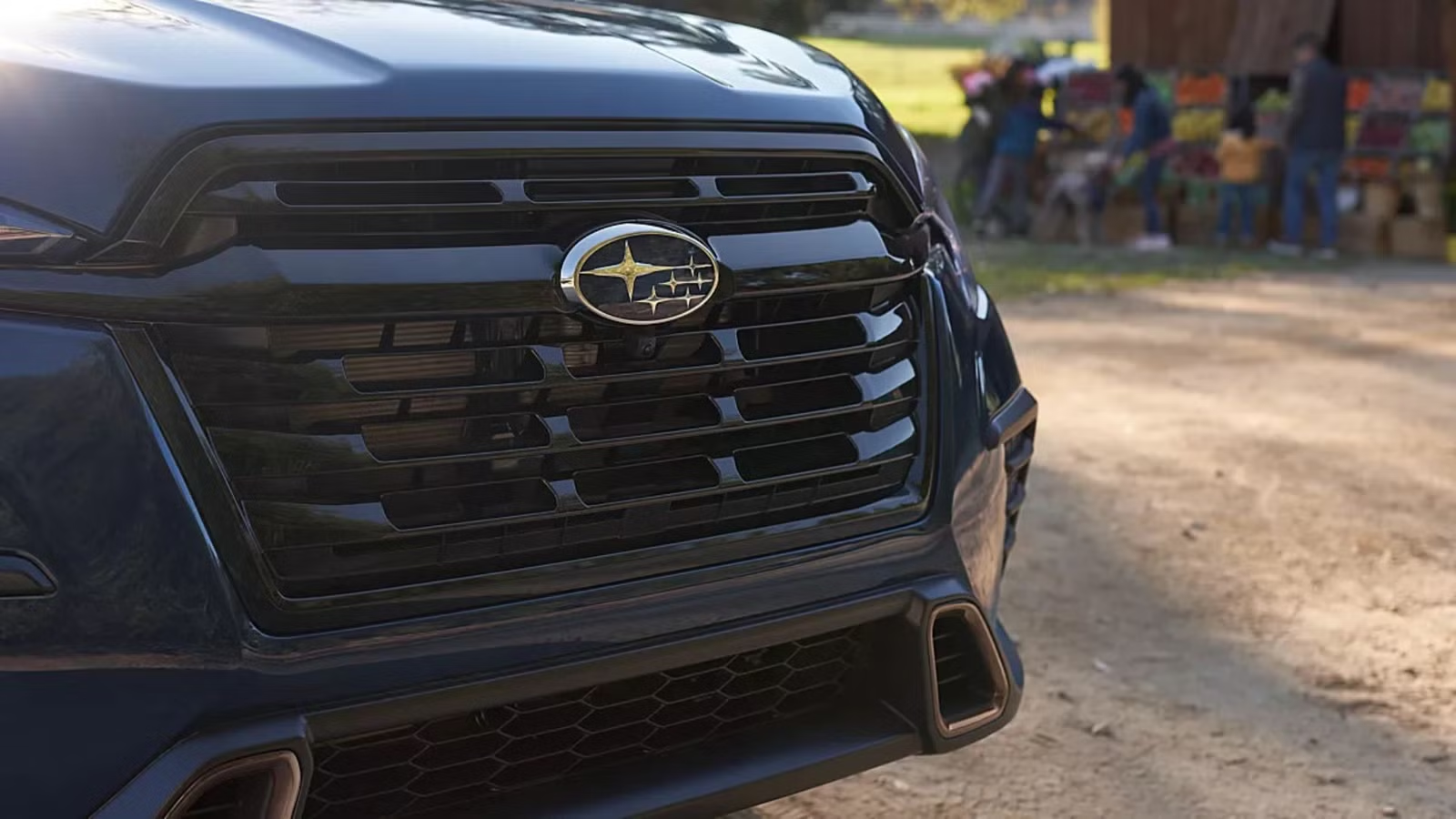
Sometimes, the most American things don’t come from America. Hot dogs are basically German frankfurters, denim was invented in France, and Robocop was actually directed by a Dutch guy. We all know Subarus are Japanese, but they seem to have been built specifically for American drivers who take on a lot of highway miles and the occasional backroad in all sorts of weather.
Case in point, some Subarus never even hit the market in their native country, like the Subaru Ascent, the Indiana-built midsize three-row that the brand has been considering selling in Japan. It’s sorta like how Ram and Ford make trucks for Latin America that we never get here in the US.
Subaru Is Considering Bringing The Ascent Back Home, But Nothing’s Confirmed Just Yet
2025 Subaru Ascent – front 3/4 angle in blue while drivingSubaru
Subaru issued a statement earlier this month reporting that the corporation is “considering the introduction of its US-built three-row SUV” to the Japanese market. Here’s what we know right now.
- Subaru is targeting a late-2026 Japanese launch.
- The Ascent has been sold primarily in the US since its 2018 launch, with some sales in other areas like Canada and Latin America. This would be its first time selling in Japan.
- The Subaru Ascent goes by the name Subaru Evoltis in other regions, and it would carry that name in Japan.
- The Japanese-market Subaru Evoltis would be built in Indiana and shipped back to Japan, leveraging Japan’s Ministry of Land, Infrastructure, Transport and Tourism’s (MILT) certification system, which was simplified under current Japan-US trade agreements and aims to balance imports and avoid tariffs.
- The Subaru Outback is currently the largest Subaru sold in Japan. This will no longer be the case if the Ascent makes the journey home.
We’ve covered Japanese kei cars and the road tax system employed overseas more than a couple of times here at CarBuzz. The long and short of it is that, to own a car in the city, you have to prove you have a place to park it, and you pay an annual tax based on engine displacement, and a once-every-two-years tax on vehicle weight.
“Midsize” Is Kinda Big In Japan
2025 Subaru Ascent – rear 3/4 angle in red while parkedSubaru
Cars that we consider midsize here in the US, and which we associate with typical middle-class families, might be regarded as more luxurious over in Japan, simply because they’re more expensive to own, even if only by a few hundred dollars a year. It’s like how, here in the US, you can buy a used BMW for cheap, but you’re still flexing the fact that you can afford to pay the maintenance bill.
Add in narrow city streets, and the fact that Japan has a high-speed railway for longer trips, and this all contributes to a very different car culture in Japan than the one we enjoy here in the US (which we’ve argued to be one of the best in the world for drivers, only missing an Autobahn to call our own).
How Will The Ascent Adapt To Japanese Roads?
2025 Subaru Ascent – rear 3/4 angle Subaru
As mentioned, Subarus seem custom-built for American drivers, but that goes double for the Ascent.
2026 Subaru Ascent Performance Specs
Engine
2.4-Liter Turbocharged 4-Cylinder
Power
260 hp
Torque
277 lb-ft
Transmission
8-Speed Lineatrtronic CVT
Drivetrain
All-Wheel Drive
At 2.4 liters, the Subaru Ascent’s turbocharged flat-four engine would fall into the 2,001-2,499 cc tax bracket, which West Coast Shipping, an automotive import/export website, puts at ¥45,000, annually, or around $281 in USD.
As for vehicle weight, a 4,449-lb SUV would fall into the 2,001-2,500 kg category, meaning you’re paying ¥15,000, or around $94, every couple of years.
2026 Subaru Ascent Physical Dimensions
Curb Weight
4,449 lbs.
Minimum Ground Clearance
8.7 Inches
Wheelbase
113.8 Inches
Front Width
76 Inches
Ultimately, the Ascent’s efficient engine displacement and midsize dimensions would keep it from being a total money pit for Japanese drivers. It’s a touch on the large size, but, at current rates, wouldn’t even have you paying an extra $400 a year to the government. Insurance and other-such bills would of course, be extra.
Japanese Drivers Don’t Need To Worry About Gas Prices (All That Much)
2025 Subaru Ascent – side profile in black while parkedSubaru
One might assume that gas prices keep Japanese cars small. After all, that’s a big part of why Europe is still driving station wagons instead of full-size SUVs, and Australia can’t get enough small trucks. But gas prices in Japan are comparable to gas prices in the US, at the moment, at a little over four bucks a gallon.
Japanese drivers enjoy generous government subsidies, paid directly to oil suppliers, in order to keep the prices low at the pump. Not only that, Japan is phasing out gasoline taxes for consumers by the end of the year.
The Ascent is a fairly fuel-efficient car for its size to begin with. It averages 22 mpg, combined, with FuelEconomy.gov estimating annual expenses of $2,850, assuming 15,000 miles driven each year, split 45/55, highway/city. But, it’s still way bigger than most cars you’ll see in Tokyo, where hatchbacks and minis are the norm. Apparently, though, gas prices don’t play as big a part as one might guess in Japan’s inclination towards smaller vehicles, at least not in 2026.
Related
Why Loyal Subaru Buyers Are Quietly Defecting To Toyota In 2026
Once Japan’s most loyal automotive following is quietly abandoning ship for a surprising competitor.
At present, we haven’t read or heard anything about Japan shaving the Ascent’s weight down or introducing a smaller engine. Based on what we know at the moment, the only things the brand plans to change are the name, and which side gets the steering wheel.
Building Japanese Cars For America, But For Japan?
2025 Subaru Ascent – front fasciaSubaru
The Japanese-market Subaru Evoltis wouldn’t be the first of its kind by a longshot. Back in the early 1990s, Toyota used to advertise the Toyota Scepter (Camry) wagon as “From the States.” It’s a Japanese car, for the Japanese market, but the commercials saw American families climbing in and out of the wagon in typical western suburbs.
Whether Subaru will lean into “Americana” branding for the Japanese version of the car, who can say, but the Scepter is proof enough that this isn’t really an unprecedented move.
Made In America For Japan Is The New Normal
2025 Toyota TundraToyota
The Evoltis won’t be the last of its kind, as Honda and Toyota have floated or confirmed similar plans recently. Toyota announced in April that US-made Toyota Tundras and Toyota Highlanders would be hitting Japanese car lots this year, and Honda will be reverse-importing the Acura Integra Type S, and the Honda Passport TrailSport Elite. And these aren’t rumors, this news comes directly from the Toyota and Honda newsroom websites.
Related
Where Are Subarus Actually Made?
Do all the AWD, boxer-powered wagons and SUVs come from Japan?
These decisions have all been made in light of the simplified certification system under Japan’s MLIT, which cuts “redundant” local testing and allows for digital approvals, streamlining the process by which American-made vehicles are approved for use in Japan.
The import of US-made Japanese cars may be, on some level, politically motivated, or at least politically opportunistic. But, we have to imagine that Subaru, Honda, and Toyota would have no interest in spending millions of dollars importing and advertising these cars in Japan were the market opportunity not there. That is, Japanese companies are bringing these cars back home in response to Japanese demand.
Reverse-Importing Makes Sense From A Fiscal Perspective
2025 Toyota Tundra Hybrid Rock CrawlingToyota
At a glance, the whole thing may appear to be unnecessarily complicated, but it must make sense to Subaru’s budget people. Ultimately, the automakers have determined that it costs less to build in America and reverse-import however many models you need for Japan, rather than set up a whole new plant in Japan in order to build a few thousand extra models for domestic buyers.
Retooling an existing facility is an expensive and time-consuming process, and it seems that someone must have crunched the numbers and decided it was cheaper to send a few by boat rather than try to save on import costs by building them at home. MLIT’s simplified certification process simply makes that feasible.
Sources: Subaru, Toyota, Honda, West Coast Shipping.
