

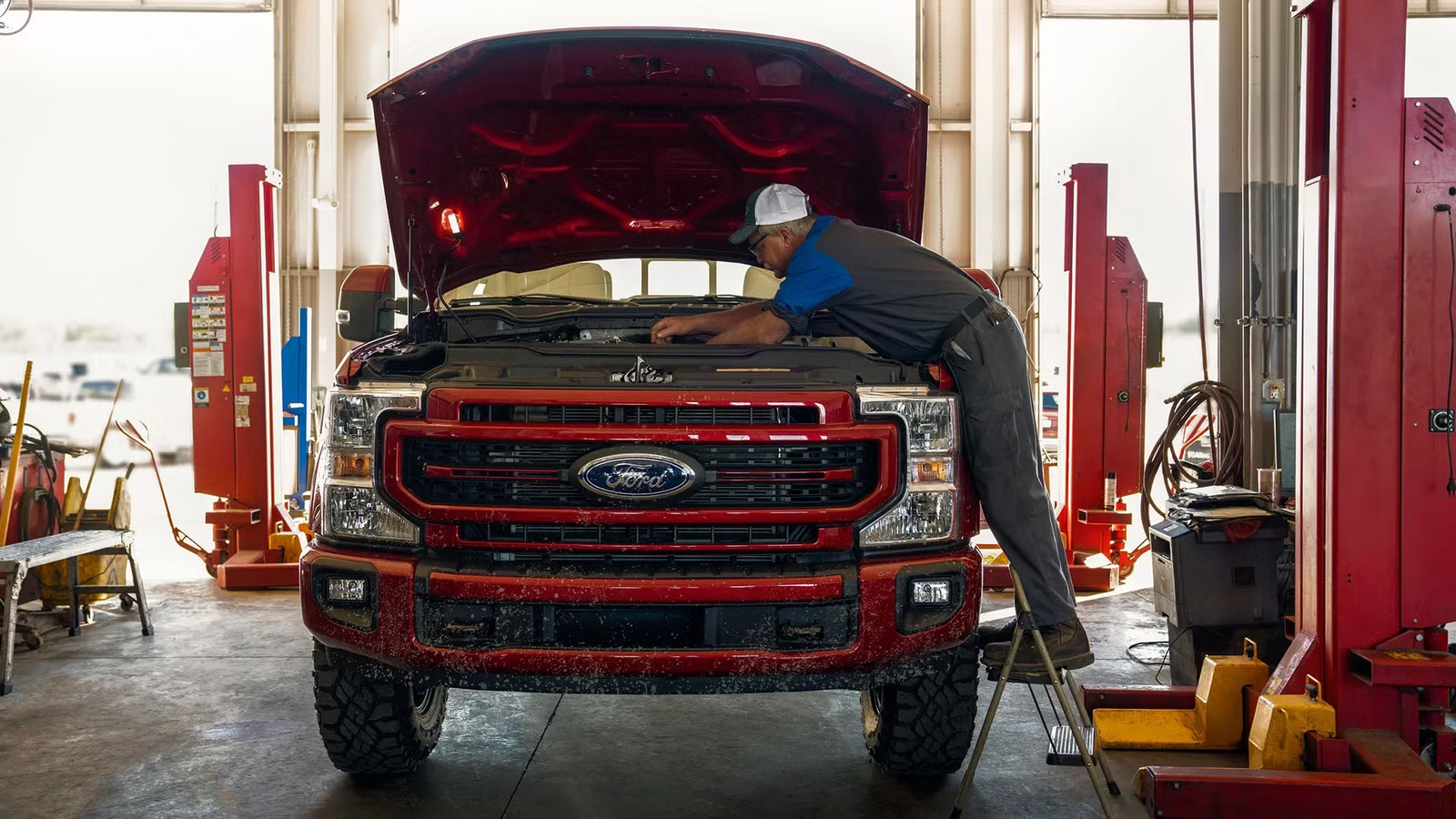
Earlier this month, executives from General Motors and Ford met with President Trump, along with auto dealer and race team legend Roger Penske. The result of what the President called a “great meeting” was almost certainly not what the automakers had in mind.
In short, the President told America that “they don’t want people to fix their car.” Of course, they represents automakers, notably GM and Ford in this case, since they were the ones on hand. It’s all in reference to the ongoing Right To Repair movement, which will likely get even more complicated as cars get even more tech.
CarBuzz reached out to both Ford and General Motors for a comment and clarification on all this. We are awaiting a reply, but Ford CEO Jim Farley has provided additional statements to the Detroit Free Press. More on that in a bit.
President Says Automakers Want Anti-DIY Legislation
Ford CEO Jim Farley. DearbornFord
“We had the auto industry in yesterday,” Trump said on June 4 (via The Detroit Free Press). “They don’t want people to fix their car. I said ‘that’s strange. I’d never heard of that.'” The President said that “Nobody’s allowed to fix their car, they gave a man seven years in jail actually because he fixed his own car. So I thought we’d do something about that. But we’ll get it all straightened away.”
Trump continued, saying “They want a bill that prohibits people from fixing … So if you’re mechanically inclined … You know, I grew up, I went to school with some guys, they were in some cases horrible students but they could fix an engine blindfolded. They could take a car apart blindfolded. But they weren’t too good at arithmetic and other things. But they were great and so there’s a move on to stop people from fixing their cars.”
“I didn’t understand it but we had a great meeting yesterday with the head of General Motors, and Roger Penske, the head of Ford,” Trump said. “We had a great meeting I think.”
Related
No, Trump Didn’t Legalize Cheap Microcars For America
We love the idea, but he didn’t actually do anything.
It’s not clear what case Trump was referring to when he said a man was sentenced for fixing his own car. The White House did not respond to the Free Press’s request for comment. Ford confirmed that Andrew Frick, President of Ford Blue and Model E was at the White House June 3 to discuss auto repair, but it’s not clear who from GM was in attendance.
Ford CEO Responds, And Makes Us Nervous
Ford CEO Jim Farley. KentuckyFord
Now, Ford CEO Jim Farley has clarified the company’s position to the Free Press. “Ford’s position is very reasonable, really,” he said. “We’re a big advocate for the ability to repair a vehicle, but it has to be done at a reasonable cost,” the CEO added.
When asked to clarify if this meant he didn’t want customers fixing their own vehicles, Farley said, “No, that’s fine, but not for warranty work, though. These are very complicated cars and we don’t think that’s safe for many of the repairs on our vehicles.”
Farley added, “Someone at home like myself could never do it. I mean, I have no problem working on a 1973 Bronco, but to work on a brand-new Bronco? I need all sorts of specialty tools. That’s something that would put people’s lives at risk.”
Related
Automakers Fail To Block Independent Shop’s Right To Repair In Massachusetts
This is a bigger deal than you think it is.
Right to Repair has been a big issue in the US in the last decade. It started with farmers forced to wait long periods for technicians to fix locked-down tractors, but has expanded to vehicles. A recent court settlement saw John Deere pay $99 million in a case where it was accused of conspiring with authorized dealers to force farmers into authorized repair services.
Generally, Right to Repair advocates push to limit locked-down computer systems, expanding access for independent and at-home mechanics. This doesn’t mean a wide-open ECU, necessarily, but does address sensors that need vehicle-specific programming using OE tools and similar issues.
CarBuzz Insight – Why This Matters:
Fixing your own car is as American as apple pie, and so is being able to go to any mechanic you want. It’s enshrined in law through legislation including the Magnusson-Moss Warranty Act of 1975. Automakers pushing to restrict that is a problem for anyone who owns a vehicle.
If automakers are able to lock down their vehicles and require you to use only original equipment parts, repair bills could skyrocket. Independent mechanics would be pushed out of business or forced to buy expensive computer systems and OEM parts, and owners would probably be locked out completely beyond the most simple maintenance.
Just like Farley said, warranty work is the domain of the dealer. Everything else should be open. If Ford, GM, and Penske were hoping for a law in their favor, it has clearly backfired. Right to Repair should be one issue both sides of the aisle can agree on.
Source: Detroit Free Press
