

In the grand scheme of things, Toyota has created some extremely popular engines in its time. You really don’t have to apply yourself for very long to come up with mills like the ultra-reliable 1UZ-FE V8, or the tuner’s dream 2JZ straight-six. Both of the aforementioned mills boast an excellent amount of durability, with the latter being praised for its penchant for power output and ability to happily take to even the most extensive modification.
At one point in time, Toyota needed to bring itself forth into the modern era of engine building, and leave behind the old-school ways of carburetion and cast iron. In order to facilitate this move, the Japanese automaker released one of its most famous four-cylinder engines: the ZZ. It was introduced in the late 1990s in order to replace a much older design, one that was showing its age and was in need of replacement. It just so happened that the ZZ engine would be well-known for things like reliability, performance, smoothness, and versatility. In other words, it’s the Jack of all Trades of the engine world.
The ZZ’s Rise To Power
Wikimedia Commons
Long before the ZZ engine got its start in 1997, Toyota began producing the mill it would end up replacing. It was called the A engine, and it first saw the light of day in 1978. Back then, Toyota was still very much involved in producing cast-iron motors with carburetors sitting on top, rather than the aluminum-alloy, fuel-injected machines we see today.
1ZZ
2ZZ
3ZZ
4ZZ
Displacement
1.8L
1.8L
1.6L
1.4L
Horsepower (NA)
120–130 hp
164–189 hp
109 hp
97 hp
Torque (NA)
122–126 lb-ft
104–170 lb-ft
111 lb-ft
96 lb-ft
Bore x Stroke
3.11 in x 3.60 in
3.23 x 3.35 in
3.11 in x 3.21 in
3.11 x 2.81 in
Compression Ratio
10.0:1
11.5:1
10.5:1
10.5:1
Production Timeframe
1997–2008
USDM Market Presence?
Yes
Yes
No
No
*Specs courtesy of Toyota & Engine-Specs.net
The most famous of the A engine family, the 4A, came about in 1980. Toyota fans will know of the 4A-GE and the supercharged 4A-GZE, both of which were produced across a few generations and saw use in iconic Toyota models, like the AE86 Corolla Levin/Sprinter Trueno and the ’84 through ’89 MR2. The 4A-GE was a well-sorted and celebrated engine, alongside the rest of the A engine family. But, by the mid 1990s, it was time for Toyota to start looking towards the future.
Enter the ZZ engine. It first hit the market as the “1ZZ-FE” under the hood of models like the eighth-gen Toyota Corolla, along with the Chevrolet Prism and even the Lotus Elise. This initial engine wasn’t exactly a fire breather, with just about 120–130 horsepower at its disposal in its stock form. Toyota sold a supercharger kit for the 1ZZ-FE, which increased power output by 40 ponies and 38 pound-feet of torque. The performance-oriented 2ZZ-GE was introduced at the same time as the 1ZZ, along with the 3ZZ and 4ZZ. However, the latter two were smaller, less powerful, and never offered in USDM-bound vehicles.
What Goes On Under The Block
2003 Pontiac Vibe Toyota ZZ I4 EnginePontiac
One of the largest aspects of the ZZ engine’s design was the pursuit of lightness. The older A engine it was slated to replace weighed about 287 lbs when fully dressed. Of course, this was a cast iron-blocked engine, meaning it was bound to be a bit heavy. However, the new ZZ engine and its all-aluminum construction shaved about 65 lbs off its overall hulk, weighing just around 220 lbs.
However, because its block was aluminum and performance was built into its design, Toyota had to get a little bit crafty with its design. For starters, the ZZ’s cylinder bores are lined with cast iron inserts that sport special, rough-edged outer walls that mate to the cylinder bores themselves for a stronger bond.
It also has a larger-than-average crankcase, allowing for the mill’s long piston stroke and the use of stronger main bearing caps, increasing bottom-end rigidity. It also used some forged internals, such as forged connecting rods in the 2ZZ-GE’s case. Following the 1999 model year, the ZZ engine traded in its fixed valve timing for variable valve timing.
It’s worth noting the 2ZZ-GE’s penchant for performance is particularly strong. As of today, it’s still considered one of the highest-power-to-liter-ratioed four-cylinder engines ever introduced in the US. In addition, it’s managed to win the International Engine of the Year award in 2002. It sports Yamaha-designed components, namely the cylinder head, and can rev all the way up to 8,600 rpm in some applications. Its main objective is to create as much power as possible at the top of the rev range, with its maximum horsepower being reached at a whopping 7,600 rpm.
Related
The Most Reliable Toyota Engine Of 2025 Might Not Be The One You Think
Those in the know will give reliability preference to a naturally aspirated engine, but Toyota flipped the script…
Drawbacks
However, there are one or two drawbacks to the ZZ’s design. Its block takes advantage of an “open-deck” design, meaning the point where the cylinder head mounts is not reinforced like a “closed-deck” block. Doing it this way meant Toyota could spend less time on the casting process, and allow for better cooling. But, the engine’s overall strength was weakened, which isn’t ideal for performance-oriented applications of the mill.
Toyota ZZ engine – MR2 W30, inside engine bayVia: Toyota
It also sported laser-clad valve seats, rather than the usual pressed-in sort. These help to cut down on valve seat overheating, but are nigh-impossible to overhaul, should things go wrong at any point. In addition, the cast-iron cylinder liners we just discussed are also extremely difficult to remove, and can cause catastrophic damage if not done properly. It seems that, in the pursuit of lightness and cutting-edge tech, Toyota’s ZZ engine was positioning itself as just a bit disposable.
There have also been numerous reported problems regarding the ZZ engine’s oil pump, particularly in the 2ZZ-GE mill. While no engine is designed to run over its rev limit, the 2ZZ’s pump seems to be keenly sensitive to incidents of over-revving, even for just a split-second. In addition, the 1ZZ engine is known to consume oil in large quantities, mainly due to piston rings that are undersized, along with pistons that lack proper oil drainage.
Related
10 Cars With 2JZ Engines You Probably Didn’t Know About
Of course, the Supra is on the list, but did you know the 2JZ powered nearly a dozen cars?
A Coupe Of Notable ZZ Users
2000–2005 Toyota Celica GT-S
A Front Three-Quater Shot Of A 2000 Toyota Celica GT-SToyota
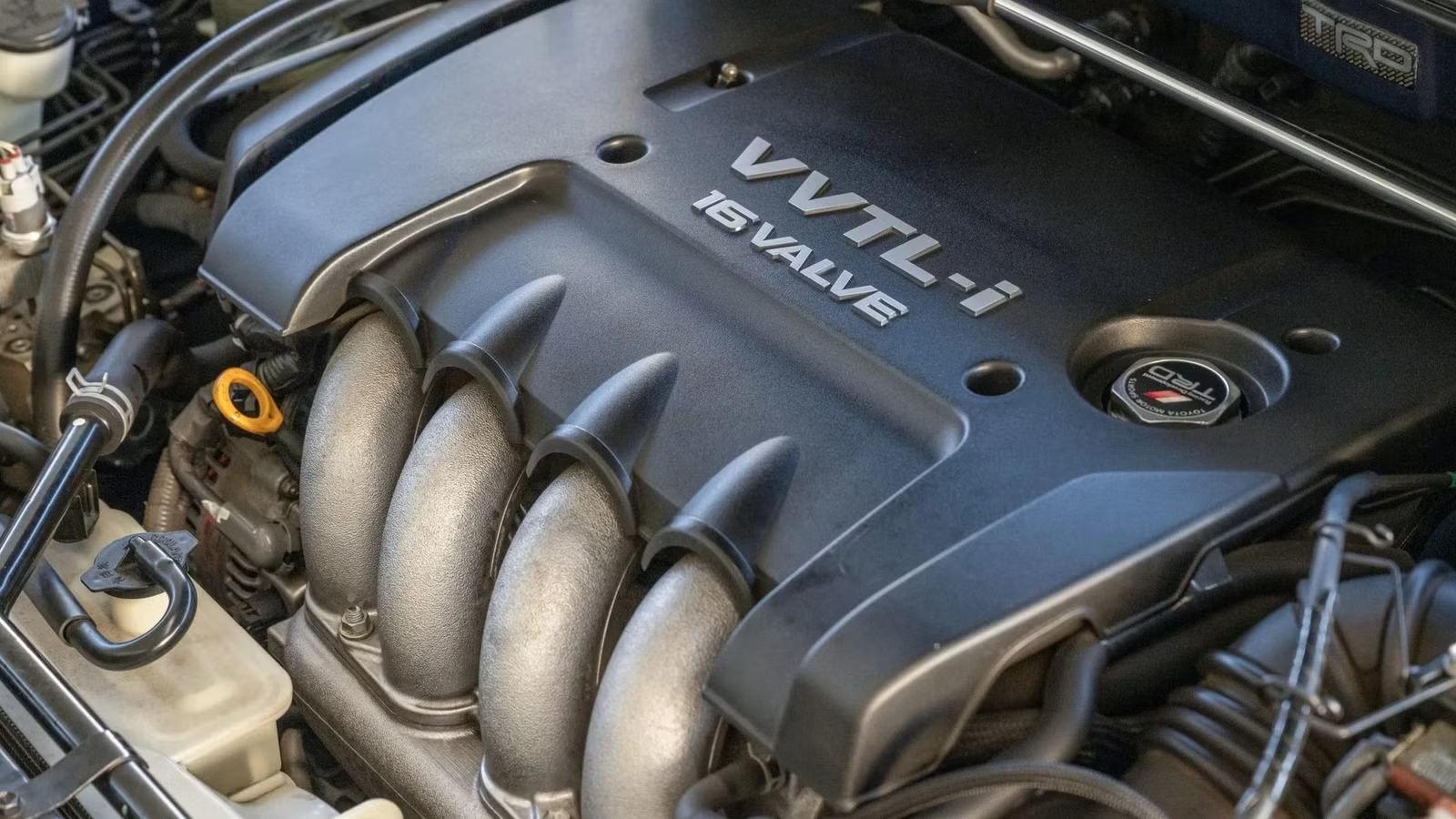
Arguably, the most famous USDM user of the Toyota ZZ engine came about in 2000, the Toyota Celica GT-S. It took advantage of the 2ZZ-GE, which boasted a cylinder head developed by Yamaha, along with Toyota’s Variable Valve Timing & Lift (VVTL-i) system. Using the mill, the 2000 to 2005 Celica GT-S could rev up to 8,200 rpm without issue. You could outfit it with either a four-speed automatic with button-shift capability or a six-speed manual transmission.
2000–2005 Toyota Celica GT-S
Engine Details
1.8L 2ZZ-GE NA inline-four
Power
180 hp
Torque
133 lb-ft
0-60 mph
6.6 seconds
Top Speed
150 mph (est)
*Specs courtesy of Toyota
2004–2011 Lotus Exige
2004 – 2006 Lotus Exige – front 3/4 angleLotus
In a strange twist, Lotus was a prominent user of the Toyota ZZ engine, particularly the 2ZZ-GE. In 2004, the British sports car producer introduced the Exige, a Lotus Elise-based car that was more stripped, tuned, and track-ready. Both a naturally aspirated and a supercharged “S” iteration were offered, with the latter powerplant being offered from 2006 onward.
Lotus tinkered with the 2ZZ-GE’s ECU slightly, and managed to bump its horsepower output by 10 ponies. Despite the ZZ engine being axed following the 2008 model year, Lotus continued to build the Exige with the mill until 2011 due to a surplus of engines being available.
2004–2011 Lotus Exige/Exige S
Engine Details
- Exige: 1.8L 2ZZ-GE NA inline-four
- Exige S: 1.8L 2ZZ-GE supercharged inline-four
Power
- Exige: 190 hp
- Exige S: 234 hp
Torque
- Exige: 138 lb-ft
- Exige S: 159 lb-ft
0-60 mph
- Exige: 4.7 seconds
- Exige S: 4.1 seconds
Top Speed
- Exige: 147 mph
- Exige S: 148 mph
*Specs courtesy of Lotus & Supercars.net
The ZZ’s Replacement
toyota 3zr-fae engine top viewWikimedia Commons: オーバードライブ83
Once production of the ZZ engine ended officially in 2008, Toyota had already been producing its replacement, the ZR engine. It’s loosely based on the previous 1ZZ and 2ZZ engines, and is still in production to this day. Most of its applications are seen outside the US, although USDM models like the Toyota Corolla, Matrix and C-HR have all employed the mill’s use at some point during their lives. It ranges in size from 1.6 to 2.0-liters, and boasts over 15 variations.
Sources: Toyota, Lotus, Engine-Specs.net, Supercars.net, Toyota-Club.net.
