

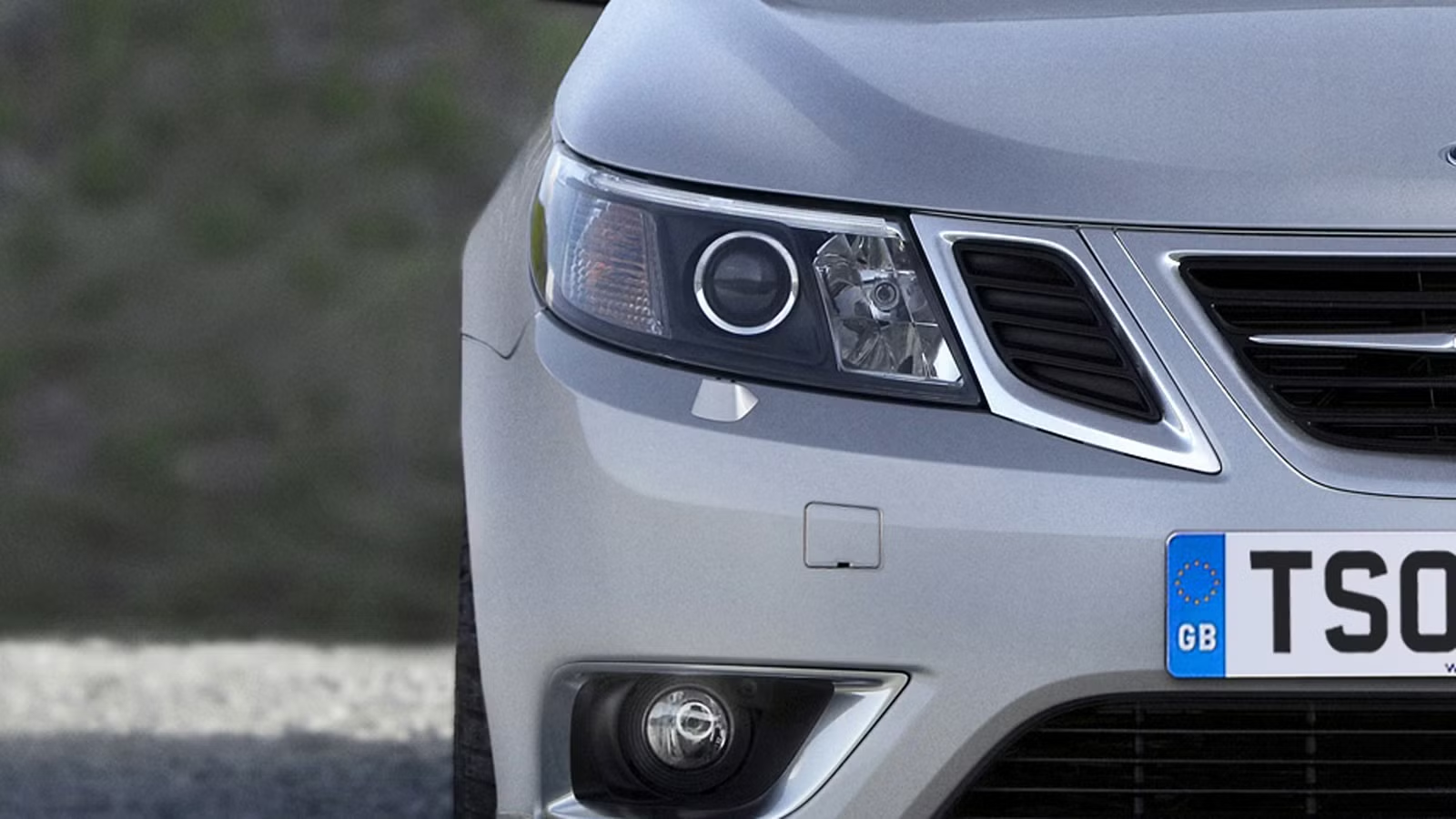
It’s been more than a decade since the final Saab left the production line at the Swedish marque’s historic Trollhättan plant, yet for enthusiasts, the sense of loss has never quite faded. This week brought news that will inevitably reopen old wounds: the last remaining Saab cars still housed at the factory are set to go under the hammer.
Once they’re gone, so too will be one of the final physical echoes of a brand that once stood for innovation, individuality, and distinctly Scandinavian engineering flair – bringing a definitive close to a chapter that many still struggle to see as truly finished.
The Last Saabs Are Leaving Trollhättan
Last Saab 9-3 Sedans At Trollhättan PlantKlaravik
Key Facts To Know
- Saab went bankrupt in 2011
- Saab’s final production models were the 9-3 Aero and 9-5
- A revival attempt by Chinese-backed NEVS ultimately failed
- Some of those last Saabs built by NEVS are now headed for auction
The ghosts of Saab aren’t done haunting Trollhättan just yet. A collection of vehicles – most of them pre-production prototypes – that were built and stored by the remnants of the once-proud Swedish automaker is now headed for an online auction hosted by Klaravik, scheduled to run from May 21-30.
Saab’s collapse ultimately became such a cautionary tale that three separate companies tried and ultimately failed to keep the dream alive, each eventually ending up in financial ruin themselves, though not necessarily because of Saab alone. The final attempt came from Chinese-backed startup National Electric Vehicle Sweden, better known as NEVS. The company was founded in the aftermath of Saab’s much-publicized bankruptcy at the end of 2011 specifically to acquire Saab’s remaining assets, which it managed in 2012. That haul included the modern Trollhättan factory, engineering resources, and the highly promising Phoenix platform, a next-generation architecture originally intended to underpin an entirely new era of Saabs before the company ran out of road.
Unlike the asset-stripping operations that often follow automotive collapses, NEVS appeared to have genuine ambitions to keep Saab production alive in both Sweden and China. The company even restarted production of the Saab 9-3 at Trollhättan in late 2013, briefly reviving activity at the dormant factory. But the brutal economics of mass-producing vehicles quickly caught up with the startup. By 2014, NEVS was effectively out of cash and forced to abandon its attempt to resurrect Saab as a car brand. To make matters worse, the company also lost the right to use the Saab name and griffin logo, trademarks for which are still controlled by the aerospace and defense firm Saab AB, from which the car company had originally been spun off in the mid-1940s.
NEVS itself managed to survive the failed Saab revival for several more years thanks to fresh investment from Chinese backers, including troubled property giant China Evergrande Group, which later launched its own EV brand, Hengchi. During that time, NEVS continued building updated versions of the old 9-3 in China wearing a NEVS badge, while also experimenting with electric variants and autonomous vehicle technology. But even that second life eventually fizzled out. In 2023, NEVS announced it would enter what it diplomatically described as “hibernation mode.” Now, with the company’s last remaining vehicles emerging from storage at Trollhättan for auction, the final remnants of Saab’s long and winding afterlife are about to be dispersed to the highest bidder.
What’s Crossing The Auction Block
2014 Saab 9-3 Pre-Production PrototypeKlaravik
A total of seven vehicles are headed to the auction block, though only three of them are actually Saabs. Even then, they aren’t technically the final Saabs ever built. All three are pre-production Saab 9-3 sedans assembled during NEVS’s brief attempt to restart operations in Trollhättan. Pre-production cars like these are typically used for final testing, certification, and registration work, while also giving factory employees a chance to iron out any last-minute assembly issues before full production begins. The actual final production Saab, a 2014 9-3 Aero, was already auctioned off by NEVS back in 2019, eventually fetching roughly $48,000 from a Saab enthusiast in Denmark.
NEVS Self-Driving Car PrototypeKlaravik
The trio of Saab-badged sedans headed for sale show anywhere from roughly 11,000 to 36,000 miles on the odometer, suggesting they saw meaningful testing duty rather than simply gathering dust in storage. Prospective buyers should be aware, however, that their pre-production status could make road registration difficult or even impossible depending on local regulations. Prototype vehicles often lack conventional VINs and, in many cases, are normally destroyed once testing programs conclude. That these cars survived at all feels unusual, almost like someone inside NEVS couldn’t quite bring themselves to send them to the crusher.
Related
Saab’s Last Ever Car Is A Turbocharged Bargain
A rare, turbocharged Swedish sedan with real character can be yours for very little money today, but it’s not without its risks.
The remaining four vehicles provide an even stranger glimpse into the alternate future NEVS envisioned after Saab’s collapse. One is a prototype for the NEVS-branded electric 9-3 that eventually entered limited production in China. The other three are development vehicles for projects that never reached production, including a self-driving vehicle, an EV equipped with in-wheel motors, and another electric model fitted with a range extender. The autonomous prototype was likely tied to NEVS’s ambitious robotaxi plans under its mobility division known as Pons. Back in 2020, the company even unveiled a six-seat autonomous shuttle called the Sango, intended for a pilot program in Stockholm that ultimately never materialized.
Perhaps the most intriguing machine of the lot is the in-wheel-motor prototype developed alongside British engineering firm Protean Electric, which NEVS acquired in 2019. There’s a good chance the vehicle served as an early engineering mule for a larger premium EV project that eventually surfaced in 2023 as the Emily GT. Developed largely by former Saab engineers, the sleek electric sedan was envisioned as a spiritual successor to Saab’s tradition of understated performance and unconventional engineering. One version would have delivered 653 horsepower from four individual in-wheel motors, had the Emily GT reached production.
The Engineering Obsession That Made – And Broke – Saab
NEVS EREV Prototype Based On The Saab 9-3Klaravik
Saab built its reputation by engineering cars the way aerospace companies build airplanes. That is, obsessively, expensively, and often without much regard for the accounting department. This resulted in Saab becoming famous for turbocharging ordinary road cars long before everyone else caught on, pioneering safety tech like active head restraints, and sweating details most rivals ignored. Even the dashboards felt different. Saab’s trademark Night Panel mode blacked out every gauge except the speedometer to reduce driver fatigue during nighttime driving, just another wonderfully weird feature only Saab engineers could justify.
2003 – 2007 Saab 9-3 SedanSaab
That mentality helps explain why Saab struggled financially for decades, and it was so deeply ingrained within the company’s culture that even General Motors couldn’t fully stamp it out despite years of trying to rein it in. GM, looking to expand its presence in Europe’s premium market, took a 50% stake in independent Saab in 1990, followed by full ownership in 2000. The thinking was that GM could turn Saab around by basing models on platforms shared with higher-volume brands such as Opel, and later Buick and Chevrolet. But Saab being Saab had to make some engineering changes which reduced the economies of scale.
Related
Saab Failed, And Robbed Us Of This Stunning BMW-Powered Creation
After GM unloaded Saab, there was an ambitious plan to save the Swedish brand, and it centered on this stunning concept.
For example, on the second-generation 9-3, based on GM’s Epsilon platform, Saab changed roughly 65% of the components, developing its own bespoke rear suspension setup, a unique air conditioning system, and extensive safety reinforcements rather than relying on parts used on the GM vehicles based on the platform.
Another clear case was the first-generation Saab 9-5, based on the GM2900 platform. Saab engineers modified the chassis and suspension tuning for improved handling dynamics, while also adapting powertrains such as GM’s 3.0-liter V6 to feature a single tiny turbocharger that used the exhaust of only half the cylinders, leaving the other half to be unrestricted. Known as the asymmetric V6, the idea was to retain the feel of a naturally aspirated V6 but with the strong low-end torque of a turbocharged engine.
2006 – 2009 Saab 9-5 SedanSaab
The result was a lineup of deeply distinctive cars adored by loyal owners, but developed and produced at costs the small automaker could rarely afford. As part of the fallout of the global financial crisis, which ultimately led to GM’s own bankruptcy in 2009, GM finally offloaded Saab by selling it to Spyker in 2010. The Dutch supercar manufacturer was fresh from a failed Formula 1 attempt and was only building a handful of cars per year. It was a recipe for disaster, and that’s exactly what happened. Under Spyker, Saab quickly ran out of funding and was forced into bankruptcy in 2011.
A shot of the 2008-2012 Saab 9-3 LogoSaab
Prior to the bankruptcy, Spyker had attempted to sell Saab and was courting a number of Chinese buyers, but these deals went nowhere. GM still retained significant sway over key intellectual property and, out of concern that the technology could be used to launch rivals to GM’s products in China, blocked the transfer of critical platforms and engines. This made the deals unviable for most potential buyers. Spyker even tried suing GM but failed. Once Saab was bankrupt, the bankruptcy administrators in Sweden then sold Saab’s assets to NEVS in 2012. Spyker would also go bankrupt just two years later (but has since returned), and as mentioned earlier in the article, NEVS would ultimately end up broke as well, albeit a full decade after its struggles with Saab.
Saab Has Finally Left The Building
1995 Saab 900 NG cutawayBring a Trailer
For many, Saab still resonates even after all these years. The cars were never perfect, rarely profitable, and often hopelessly overengineered, but they possessed a sense of originality that feels almost extinct in today’s auto industry. Once these final prototypes leave Trollhättan, Saab’s story won’t end for fans, but one of its last tangible links to the real world finally will.
Sources: Saab, Klaravik
