

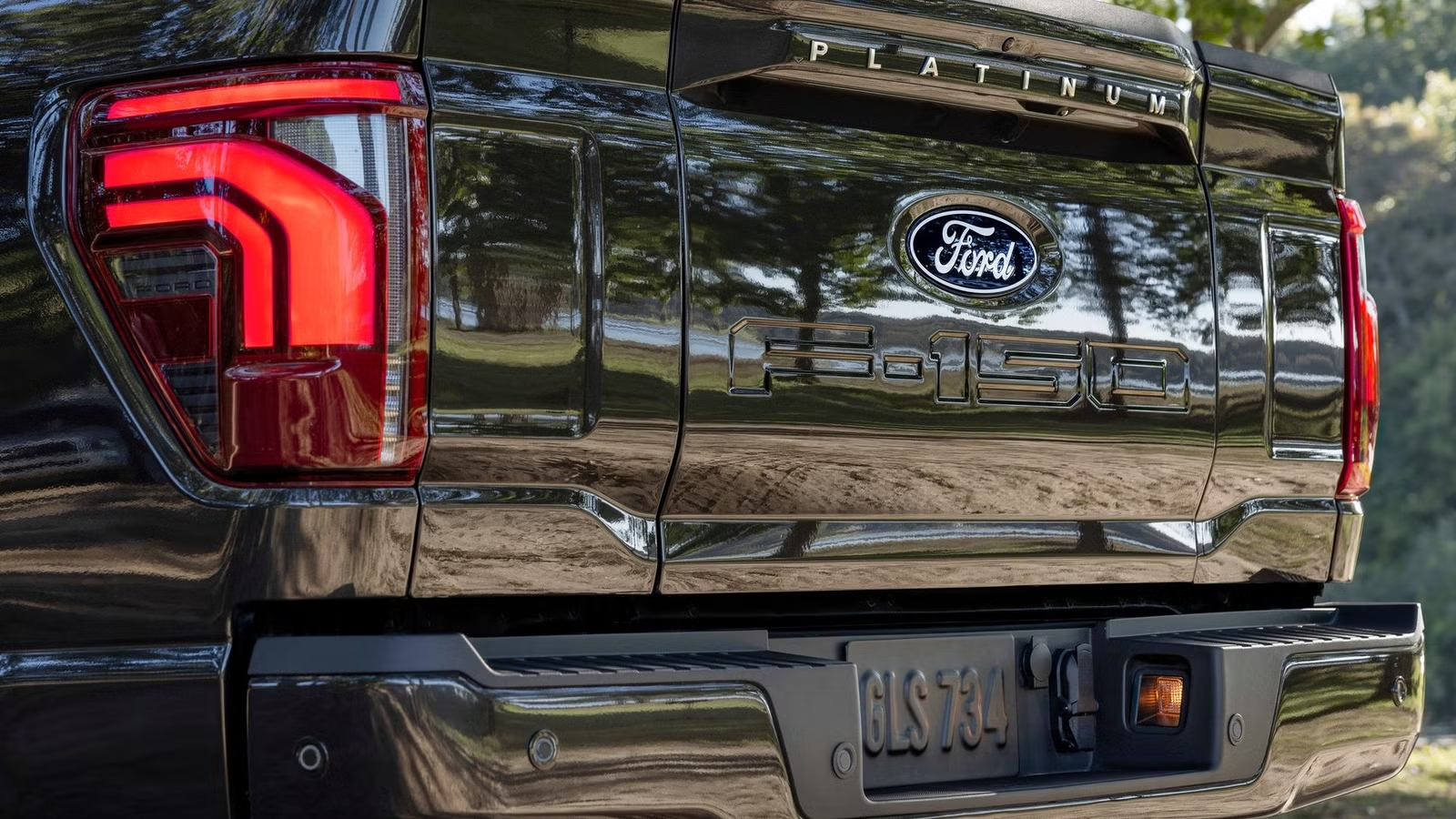
There is a reason Ford’s F-150 has been so popular in the USA for several decades now. According to many, its unmatched configurability, spaciousness, and towing capabilities make it the ideal truck for many families.
For the 2021 model year, Ford introduced a hybrid powertrain in the F-150 PowerBoost. Going hybrid seemed like a logical choice, especially as the Toyota Tundra also got a hybrid powertrain in 2022. So, now that a few years have passed, how does the F-150 hybrid compare to its gas powertrain options?
For this article, we are only comparing the least and most efficient gas engine options for the F-150 with its hybrid powertrain. Pricing and specifications are sourced from the manufacturer and are correct at the time of writing; automakers may change or update this at any time without notice.
2026 Ford F-150 Hybrid vs. F-150 Gas Engine Specs
2025 Ford F-150 5.0L Coyote V8 EngineFord
2026 Ford F-150 Engine Specs
Engines
2.7L EcoBoost V6
3.5L PowerBoost Hybrid V6
5.2L Supercharged V8
Horsepower
325 hp
430 hp
720 hp
Torque
410 lb-ft
570 lb-ft
640 lb-ft
Transmission
10-speed Automatic
10-speed Automatic
10-speed Automatic
Drive train
RWD/AWD
RWD/4WD
4WD
With six engines to choose from, deciding the best powertrain for your F-150 may get a bit confusing. Therefore, for the sake of legibility and clarity, we are only comparing the hybrid powertrain to the most and least efficient ICE-only offerings – the 2.7L EcoBoost V6 and the bonkers 5.2L Supercharged V8 in the Raptor R.
The EcoBoost V6 is the most efficient Ford F-150 gas engine as it also has the least displacement out of all of them. As this is the entry-level engine option, it is only available in the XL, STX and XLT trims. It provides solid performance with its twin turbochargers and aluminum block construction. With over 400 lb-ft of torque, it provides enough grunt for daily use.
The PowerBoost V6 is the perfect middle ground between these two engines in terms of performance. The V6 itself produces 383 hp and is mated to a 47 hp electric motor that brings the total power output to 430 hp. The motor is integrated into the 10-speed gearbox and helps with torque fill, regenerative braking and providing even more towing capabilities. At 570 lb-ft, it is almost as torquey as the all-out Raptor-R.
That is not all though, as the hybrid powertrain has another trick up its sleeve. The PowerBoost powertrain gives the truck the ability to become a generator for electronic devices up to 7.2 kW. This is enough to run power tools, camping gear or even emergency home backups, giving it a huge advantage over the other engine options.
The least efficient F-150 engine option is, to nobody’s surprise, the 5.2L ‘Carnivore’ V8. Derived from the same engine used in the Ford Mustang Shelby GT500, the supercharged V8 puts out a monumental 720 hp. The V8 makes very little sense in a pickup truck, but that is what many Raptor owners love about it. It may not have the highest fuel efficiency or the largest towing capacity, but it is the most powerful F-150 you can currently buy.
All three engines are paired to a 10-speed transmission. However, they are all configured differently to adapt to their use cases. The EcoBoost and PowerBoost are available with either rear-wheel drive or a 4WD system that intelligently sends power to the front wheels when needed or when there is loss of traction. The supercharged V8 is only available with an AWD system, with a two-speed transfer case that includes a 4-Low mode as well.
For budget-conscious buyers, the Ecoboost V6 makes perfect sense. For people who want the most technologically advanced powertrain and that generator feature, the hybrid is one of the only viable options.
F-150 Hybrid vs. F-150 Gas Efficiency
2025 Ford F-150 rear 3/4 view in red while parkedFord
2026 Ford F-150 EPA Estimates (city/highway/combined)
2.7L EcoBoost V6
19/25/21 mpg
3.5L PowerBoost Hybrid V6
22/24/23 mpg
5.2L Supercharged V8
10/15/12 mpg
There is another benefit to going hybrid other than superior performance when compared to the other V6 engine options. Fuel efficiency takes a positive turn for the PowerBoost F-150. When compared to the EcoBoost, the hybrid powertrain is better in the city as the electric motor helps the engine at low speeds. Regenerative braking also utilizes the energy that would be previously wasted on charging the battery, making sure it never runs out.
On the highway, the hybrid and Ecoboost are fairly similar, as the truck behaves as a normal ICE-powered vehicle once the battery runs out or is at constant speeds. The Ecoboost equipped trucks will be lighter than the hybrid trucks as well, which should help them match the hybrid’s fuel efficiency on the highway. The supercharged V8 is the worst out of all of them, as there is a severe price to pay for maximum performance.
Towing Capacity Comparison: F-150 Hybrid vs. Gas
2025 Ford F-150 towingFord
2026 Ford F-150 Maximum Towing Capacity
2.7L EcoBoost V6
8,400 lbs
3.5L PowerBoost Hybrid V6
11,600 lbs
5.2L Supercharged V8
8,700 lbs
Some would think that a hybrid powertrain may limit a truck’s towing capabilities. Usually, batteries and motors add weight to the truck and take away from the maxing towing performance a truck offers. However, this comparison is based more on the body styles these engines come with. As the EcoBoost is only available on the base three models, it is limited by the truck configuration. The hybrid powertrain is more widely available across trims, making this the winner in this category as well. Along with breaking past the 10,000-lb towing mark, the electric motor should also help with low-end torque at slow speeds. The performance-oriented V8, again, does not bode well here, with more than enough power, but with off-road suspension and high ride clearance that limit this number.
Related
Ford Will Turn To Hybrids To Keep V8 Raptors Alive
Think the V8 Raptor is on the way out? Think again.
2026 Ford F-150 Hybrid vs F-150 Gas Reliability
2025 Ford F-150. F-Series. AssemblyFord
As is the case with all engines, they are not always bulletproof. The EcoBoost suffers from the following issues:
- Fault intake valves: There was a recall for around 700,000 trucks with the 2.7L/3.0L EcoBoost engines in 2021 and 2022. This was due to the intake valves becoming brittle with excessive heat causing rough running or even engine failure.
- Carbon build-up: Carbon and oil from valve seals may build up over time on the exhaust valves and intakes. This caused rough idles, misfires, etc. It mostly affected the early years of the 2.7L engine.
- Oil pan leaks: The early 2.7L had leaking plastic oil pans. Owners reported smells of burning oil, oil leaks under the vehicle and the truck displaying low oil levels.
The PowerBoost hybrid also suffers from a few issues. They are as follows:
- Battery performance issues: The battery may not charge to its full capacity due to extreme weather or software malfunctions affecting energy management.
- Engine noise and vibrations: Owners reported unusual noise in the transition between electric and gas driving modes. This could be due to software glitches or mechanical wear on internal components.
- Turbocharger failure: Aggressive acceleration and deceleration could cause excessive wear and tear on the turbocharger.
The 5.2L V8 is prone to a few issues as well:
- Excessive supercharger wear: The supercharger may be prone to increased wear due to the high boost pressure the Raptor R runs.
- ABS recalls: The Electronic Brake Booster issues affect the 2025 and 2026 models and may await software fixes or module replacements.
While the 2.7L has not had the best track record for reliability, the hybrid seems to suffer from more technical glitches and snags than mechanical problems. The V8 is durable, but it is expensive to maintain and run.
Pricing Differences Between F-150 Hybrid And Gas
2025 Ford F-150 STX Super Cab Rapid Red Front Angled View – Ford ConfiguratorFord
2026 Ford F-150 Base Pricing
2.7L EcoBoost V6
$41,855
3.5L PowerBoost Hybrid V6
$52,015
5.2L Supercharged V8
$110,930
Pricing is a category that can make or break these three options. The base entry level 2.7L EcoBoost is the cheapest of the bunch, ranging from around $40,000 to $52,000 depending on trim level. The hybrid is the next step-up, starting from the XLT trim all the way to the Platinum trim that costs around $75,000. The Raptor R is the most expensive, at above $100,000, but it is tough to put a price on fun, right?
If you are looking at older versions of these trucks, avoid the early 2021 models as they suffer from the most issues. On the hybrid powertrains, make sure to look out for its battery health as it signifies how hard the truck has been driven.
Verdict: Should You Buy The Ford F-150 Hybrid?
2025 Ford F-150 Lobo exteriorFord
In one word – yes. However, there are several factors affecting this decision. If you are on a budget, the entry-level Ford F-150 gas engine gives you around 75% of everything that makes the hybrid so good for a few thousand dollars cheaper. For someone who wants the most economical and technologically advanced F-150, the PowerBoost is a no-brainer. It is more powerful, economical, can tow more, does not suffer from catastrophic engine issues and is priced well. For everybody else who wants to have fun in a truck with obnoxious power, the Raptor R will scratch that itch for many miles.
Related
Ford F-150 Generations: Everything You Need To Know In One Place
After 14 Ford F-150 generations, a lot has changed with one of America’s favorite trucks. Read all about it here.
Sources: Ford, EPA
