

For the vast majority of automotive history, cars, trucks, and SUVs alike have all sported steel bodies. Other than being easy to produce, steel has been, and still is, employed in a large majority of automobile manufacturing because it’s strong and readily available. Of course, one of the major downsides to steel is its affinity for rusting, especially if the steel-clad vehicles reside anywhere road salt is used in the winter months.
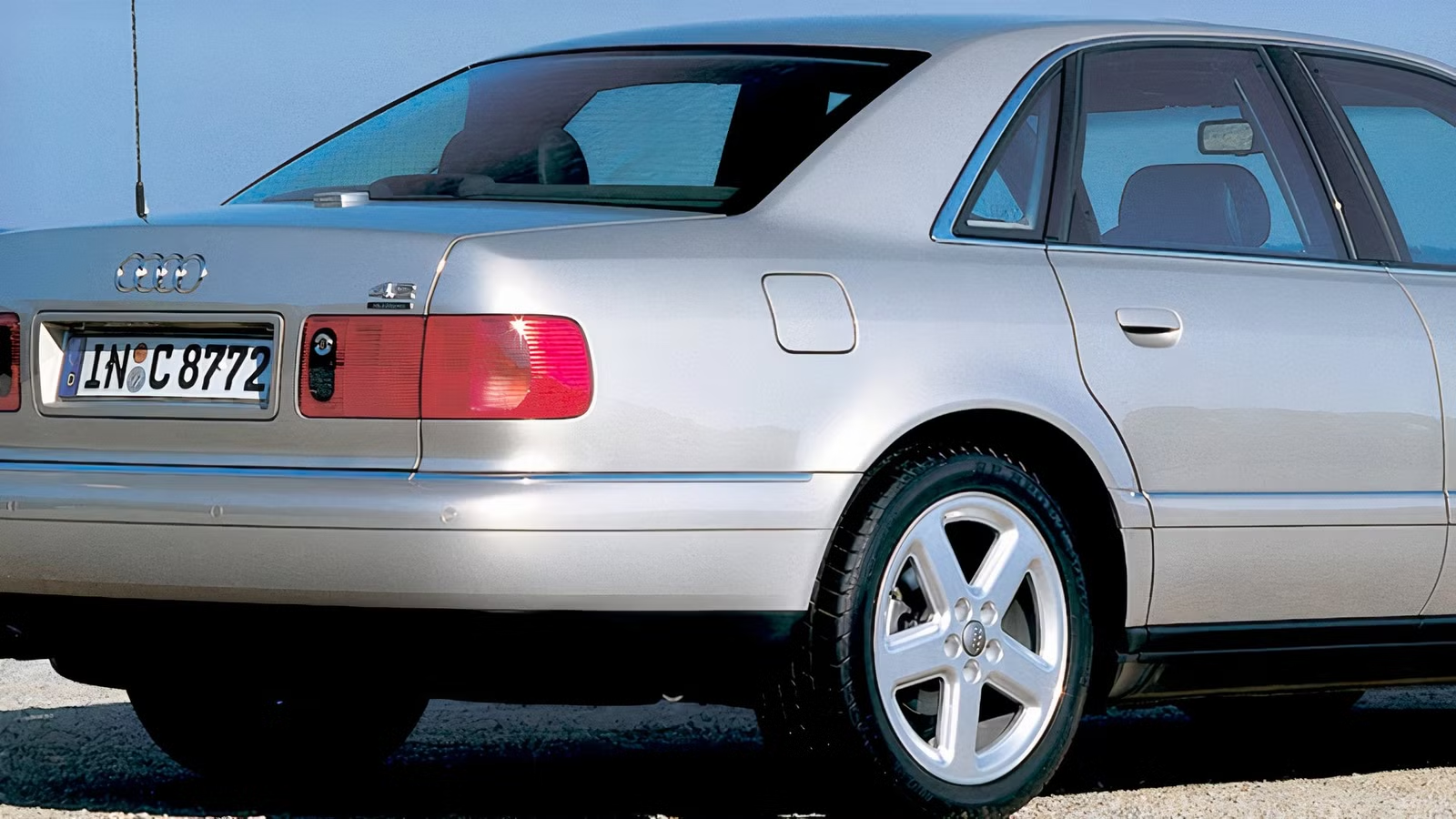
However, just over 30 years ago, Audi decided to break away from the hulking, steel body. Replacing it was a sculpted shell made from aluminum. Using the material for mass-market cars was relatively unheard of at the time, but Audi plowed on anyway. In the process, the German automaker produced the 1995 Audi A8, which hit the US market a couple of years later. It sported an all-aluminum body, a massive weight savings, and enough intrigue that Ford decided to copy Audi’s process to a “T.”
Audi’s Decision To Switch Over
Audi ASF conceptWikimedia Commons: L.Kenzel
In the late 1980s, Audi engineers realized an issue with the brand’s flagship model at the time, the V8. In essence, it was simply too heavy to be competitive with other models, like the BMW 7 Series and the Mercedes-Benz S-Class. The reason for the hulk was Audi’s Quattro all-wheel drive system, which added an extra 220 pounds to the car right off the bat. This meant the flagship Audi V8 was the heaviest of the big three German flagships.
1989 Audi V8 front 3/4 angle in brown while parkedAudi
Work began on trying to figure out how to reduce weight without compromising on build quality. The project was spearheaded by the legendary Ferdinand Piëch. He’d already approached an aluminum fabrication company by the name of Aluminum Company of America, or ALCOA for short. The deal remained stagnant until the aforementioned late ’80s period, when it was decided that aluminum would be used in place of steel for the Audi V8’s eventual successor.
By 1990, work had begun on the Audi V8’s successor in earnest, with conceptual drawings and clay models being mocked up, studied, and destroyed, until a final design was decided upon. Two designers, Chris Bird and Dirk van Braeckel, worked on the winning concept. Come 1993, Audi’s design team came up with a concept model, coined the Audi Space Frame (ASF) Concept, which was shown to the public at the 1993 Frankfurt Motor Show.
1998 Audi A8 finished front-quarter viewAudi
By 1994, the all-new, all-aluminum flagship Audi, now called the A8, was ready for production. It first debuted in February 1994 at the Frankfurt Auto Show, then entered full production in June that same year. European deliveries commenced shortly thereafter. When automotive publications finally got their hands on an A8 test car, it received heaps of praise for its unmatched agility for a full-size luxury car, owing, of course, to its lightweight nature.
1995 Audi A8 Specs
Horsepower
172–299 hp
Torque
184–295 lb-ft
0-60 MPH Time
6.9–8.7 seconds
Top Speed
147–155 mph
Curb Weight
3,329–3,858 lbs
Starting MSRP (1995)
~£65,000 (~$100,000)
Even with its all-wheel drive system — which received praise of its own — the 1995 Audi A8 was roughly 500 pounds lighter than the equivalent ’95 BMW 7 Series. The first-gen Audi A8 wouldn’t reach US shores until the 1997 model year.
Related
The Cutting-Edge ’80s Luxury Car That Stayed In Production For 23 Years
This little-talked-about Audi sedan was a technological marvel in its day, and outlived two generations of successors.
Ford Decided It Wanted Some Aluminum Action, Too
1993 Lincoln Town Car front 3/4Ford
While Ford didn’t adopt aluminum in a big way until 2015, it started dipping its toes around the mid 1990s. A handful of conceptual Mercury Sables and Ford Tauruses were built out of aluminum between 1992 and 1993, but they were never produced for the mass market. However, in 1995, the Lincoln Town Car began to sport an aluminum hood, a measure implemented to help get some of the land yacht’s weight down.
2005 Jaguar XJ Super V8 finished in black with black interiorCars & Bids
However, Ford’s largest contribution to the use of aluminum in car bodies came in 2003, when the Jaguar XJ X350 was released. At the time, Jag was owned by Ford, and the big cat was looking for ways to differentiate itself from other competitors, much like Audi did in the mid 1990s. It was decided that an all-aluminum body would be used. In total, the move saved about 400 pounds over the previous, X308-gen Jaguar XJ, even though the X350 gained things like a sophisticated air ride suspension, along with growing both wider and longer.
In 2005, Ford employed aluminum on select body panels for its GT supercar. Then came the all-aluminum F-150s, which were subjected to some serious scrutiny upon the model’s release. Many folks were unsure how an aluminum truck bed would withstand the same amount of use and abuse as a steel one. Ford thought of that, and employed the use of heat-treated, military-grade aluminum alloy instead of straight-up aluminum. The cargo bed’s floor also uses thicker aluminum than the rest of the truck.
Related
Ford Pumping Up F-Series Production Following Aluminum Fiasco
It’s going to make up for the shortages.
The Good & Bad Of Aluminum Bodies
1998 Audi A8 front shotAudi
The Good
The main upside to swapping out an old-school steel body for an aluminum one is weight savings. Being lighter on its feet means a car can be much nimbler than it would with a heavier steel body, an extremely desirable attribute for most vehicles on the road, especially in performance cars. Not to mention, having less overall weight to lug around means fuel economy is increased, as the motor needs to work less to produce the same amount of speed. Suspension components also receive a break.
Aluminum also shines bright when it comes to pickup trucks. Ford, for example, adopted a majority-aluminum body back in 2015. By using the material, and having its overall curb weight reduced, an immediate increase in towing and payload capacity was seen. Since that year, the Ford F-150 has regularly maintained a best-in-class maximum towing capacity among its full-size, light-duty pickup truck competition.
The front of the 2015 Ford F-150.Ford
Topping off the goodies that come with an aluminum body is the material’s innate ability to resist corrosion. In the Rust Belt, corrosion is a major issue for virtually all cars. Rust doesn’t just eat away at a vehicle’s body, either, as frames, suspension components, and various bolts and other bits become encumbered in rust over time. If you’ve ever tried to replace some rusty, old suspension struts, you’ll know how hard it can get if things are corroded. Aluminum is also extremely recyclable, making it one of the more environmentally-conscious materials to build a car body out of.
The Bad
Of course, there’s also some downsides to aluminum. One of the most glaring would be aluminum’s high production costs. On average, one pound of aluminum costs about $1.50 to $1.70 lbs. However, steel is much less per pound at roughly $0.45 to $0.60 per pound. When it comes to building an entire car, the price difference in raw material alone can equate to as much as $4,600.
1999 Ferrari 360 Modena Aluminum ChassisFerrari
On top of the expense of production, aluminum-bodied cars are also much more expensive to repair. It’s not as simple to repair aluminum as it is steel, as special welders and methods of repair are needed. In addition, some body shops refuse to work on aluminum as a whole, meaning those who do can get away with charging more for the job. Painting aluminum is also more involved than steel, and requires special preparation.
Related
Another Detroit Automaker Pauses Production Due To Aluminum Shortage
The problem has spread beyond Ford.
Audi’s Example Set The Stage
1998 Audi A8 rear-quarter shotAudi
Before Audi’s use of the material, aluminum was typically relegated to racing cars and prototypes. Most brands didn’t want to make the switch over to aluminum for reasons such as cost or labor intensity. However, once Audi managed to set the stage for the material’s use and other brands found out just how beneficial losing all of that weight was for a car, they slowly started to follow.
Of course, one of the main users of aluminum besides Audi was Ford. Today, loads of cars partially utilize aluminum in their body construction. General Motors and Tesla even employ its use. In short, it’s no wonder why Ford copied Audi’s use of aluminum. Who wouldn’t?
Sources: Audi, Ford, Car and Driver, Secat.net, Eagle-Aluminum.com
