

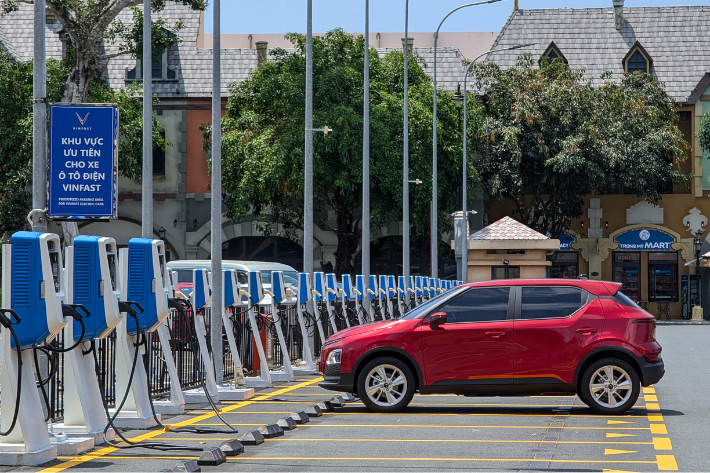
Electric vehicle sales have jumped in Southeast Asia with vehicle owners ditching their fuel-powered cars amid oil price spikes driven by the Iran war.
Asian nations have been particularly hard hit by the war due to a sharp fall in the crude shipments they rely on, and have few alternatives to.
And the energy crisis has been a windfall for Vietnam’s leading electric vehicle maker Vinfast as well as several Chinese manufacturers.
Also on AF: China Slams Ports Blockade, as Calls Rise For More US-Iran Talks
Vietnamese office worker Do Thi Lan explained the simple math of the cars’ appeal at a Vinfast showroom in Hanoi.
“We have to calculate our monthly expenses, as the money we spend on petroleum has been on the rise,” she said. Her family owns a car that runs on petrol but was considering buying an electric vehicle to save money, she said.
Dao Thi Hue, also at the showroom, was looking to go electric too.
“Driving an EV is so much better than driving a petroleum vehicle, in terms of costs and also in terms of saving fuel, queuing to fill up,” the school teacher said.
Fuel up 50%
Crude oil prices have soared by around 50% since the start of the Middle East war and again exceeded $100 per barrel on Monday, driving up costs at every pump.
Vinfast, listed on the Nasdaq, saw a 127% surge in annual sales in Vietnam in March, reaching 27,600 cars.
About 40% of cars sold in Vietnam in 2025 were electric, but the trend has been accelerating.
“At this point in time, clients consider fuel costs a lot when making a decision on which cars to buy,” Pham Minh Hai, deputy head of sales at a Vinfast showroom, said.
“In March we sold 300-400 cars,” he said, noting that the showroom normally sells between 200 and 250 cars a month.
Hai said more than 50% of his clients changed from petroleum to electric cars last month, while the number of customers at the showroom was up by around 30%.
He added that opening hours had been extended to deal with the rush.
China’s BYD gets a boost in SE Asia
Outside Vietnam, Chinese manufacturers specialising in electric vehicles, particularly Tesla’s main rival BYD, are booming.
At the Bangkok Auto Show earlier this month, BYD secured the most orders of any manufacturer, topping Japan’s Toyota for the first time.
“I drive a lot, nearly 100 kilometres (60 miles) a day… with the current fuel situation and no idea how long it will last, it’s become a major factor pushing me to make the switch,” Pleng Nawintham, a 36-year-old pharmacist from Thailand, said.
BYD was also seeing increased sales in the Philippines.
Mae Anne Clarisse Bacquiano, manager of a BYD showroom in the suburbs of Manila, said foot traffic at the dealership was “at another level”.
“It was all because of the rise in fuel prices,” she said. “Earlier today, I had a customer, a doctor who was ranting to me about how he is being punished by gas prices… He was in a hurry to go full electric. There’d be a huge difference in expenses.”
She added that all of her stock for the month had already been reserved by buyers.
“I don’t expect the gas (prices) to go back down over the next couple of months,” said Arlone Abello, an entrepreneur who was browsing BYD models at the showroom.
Sales spike across Asia
As BYD sales decline in China due to fierce local competition, the manufacturer hopes to gain international momentum.
The company told analysts it now expects to exceed 1.5 million exported vehicles in 2026, well above the 1.3 million target announced in January.
Exports of Chinese electric vehicles — for which Southeast Asia is a major market — doubled in March, compared to the same month last year across all manufacturers, according to the industry association CPCA.
Economic factors are at the forefront of the increased demand for greener vehicles.
“You have the individual consumer response to what they are seeing in terms of the price of petrol or diesel suddenly surge,” Euan Graham, an electricity and data analyst at energy think tank Ember, said.
The installation of charging stations in the region is also growing rapidly.
Jakarta promised last week to take “more serious steps to accelerate the development of a national electric vehicle ecosystem” to combat its “high level of energy consumption”.
Electric vehicles are also gaining momentum beyond Southeast Asia.
“There are signs that global demand has already picked up substantially,” Capital Economics said, adding that registrations of electric vehicles in Japan, South Korea, and New Zealand more than doubled in March, and rose by over 50% in India and Australia.
- AFP, with additional editing by Vishakha Saxena
Also read:
Energy Crisis From Iran War to Fuel Renewables Boom, IEA Says
Asia ‘Suffering The Most’ From Energy Crisis Due to Iran War
Another Two India-Bound LPG Tankers Cross Strait of Hormuz
India’s Poor Turn to Wood, Coal as Iran War Spikes Gas Prices
War in Iran Could Hit Some of Asia’s Biggest Economies Hard
India Races to Secure Supplies as New Attacks Risk ‘Energy War’
Asia Ramps Coal Power Use as Iran War Causes Gas Prices to Soar
Indian Refiners Snap Up Russian Oil as Iran War Trumps Sanctions
More Ship Strikes as Iran Threatens to ‘Destroy World Economy’
Get Ready for $200 a Barrel, Iran Says, as Three More Vessels Hit
Oil Crisis: US Allowing Iranian Tankers Through Strait of Hormuz
Asian Leaders Rush to Limit War Impacts as Oil Tops $100 a Barrel
Iran Mocks Trump Backdown on Strikes on Its Oil, Power Plants
Vishakha Saxena
Vishakha Saxena is the Multimedia and Social Media Editor at Asia Financial. She has worked as a digital journalist since 2013, and is an experienced writer and multimedia producer. As a trader and investor, she is keenly interested in new economy, emerging markets and the intersections of finance and society. You can write to her at [email protected]
