

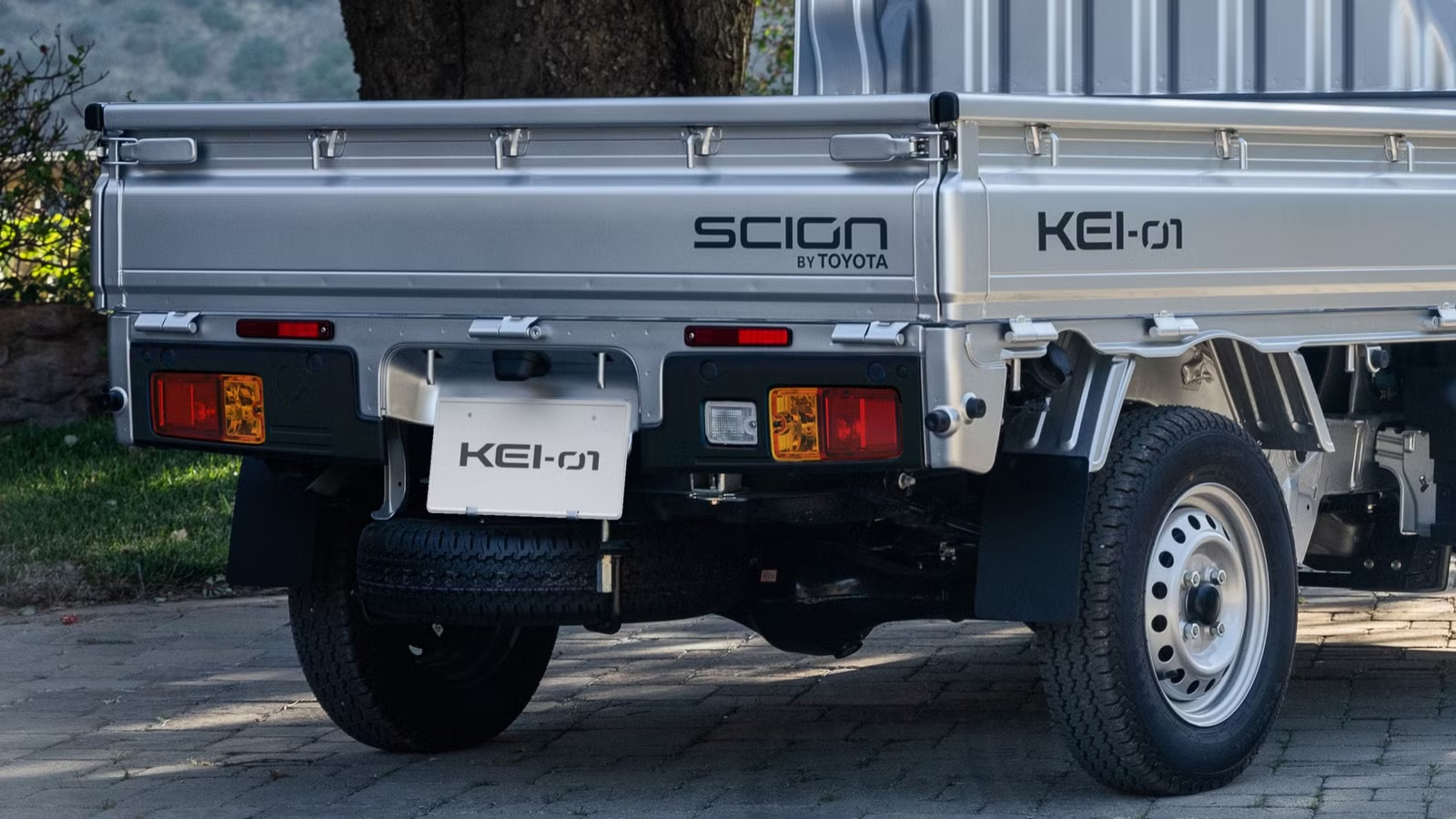
Pickup trucks are big business in the US, with the best-selling new models across the nation being made up of the things. They’re ultra-popular due to being very strong and dependable, practical, and versatile, with machines featuring a work-ready bed, but also car-like cabs that ensure they can double as family cars. The US is thus protective of the concept, with the country doing its best to ensure home-grown examples retain the advantage. That makes Toyota’s decision to start offering its Japanese kei truck in the US all the more surprising.
Selling Foreign-Built Trucks Is Impractical For The US Market
Volkswagen Amarok from the front three-quarter angleVolkswagen
For the most part, it makes no sense for foreign auto manufacturers to import and sell their truck models for the North American market. That’s due to the Chicken Tax, which came about in 1964. As a response to various European countries slapping high tariffs and import taxes on US-sourced poultry, which compromised profits and business opportunities for American farmers, the US government established the Chicken Tax. This put a hefty 25% tariff on all foreign-built light-duty trucks, which constituted a Gross Vehicle Weight Rating of less than 10,000 pounds.
This was done to protect the profit margins of manufacturers that produced their trucks in the US, though it made the business case for foreign brands unwilling to do so pretty hard to justify. This means that vehicles like Japanese kei trucks have never reached the US natively, since a 25% penalty makes the already-tight profit margins simply not worth the hassle for the various brands that offer them. Well, Toyota is now set to offer one of its models, set to be called the KEI-01, for sale in the US.
However, to do so, Toyota had to do some creative maneuvering to ensure the vehicle was eligible for sale, but without spending a fortune getting it prepared for the various strict mandates leveled at vehicles sold in the US.
Toyota Is Investing In A Special Low-Volume Production Line
2027 Toyota Scion KEI-01Toyota
Firstly, Toyota is pledging a healthy $34 million investment towards building a new low-volume production facility at its Indiana factory, which will also create a further 50 jobs. By doing this, Toyota can get around the costly Chicken Tax, which bolsters the profit margins of the trucks compared to what they would have been subject to if it had simply imported them from its Japanese homeland. This step is crucial in the process of offering such a vehicle, since Toyota is aiming to sell them at a ridiculously low price.
While the final MSRP hasn’t yet been announced by Toyota, its Japanese base price of 1.3 million yen is the equivalent of $9,000, so many are anticipating that it should come in under or at least around the $10,000 mark. For that, you’ll also get creature comforts like air conditioning and a touchscreen infotainment system, making it a usable little workhorse. To capitalize on its ultra-low entry price, Toyota is also resurrecting its budget Scion brand, which hasn’t been seen for a decade. Before you get excited about being able to drive a cute kei truck daily, though, there are some other things you need to know.
The General Public Won’t Be Able To Buy One
2027 Scion by Toyota KEI-01 ExteriorToyota
Sadly, unless you’re running a business, you won’t be able to get your hands on one. That’s because, in order to keep the production costs of the vehicle low enough to make the KEI-01 viable for the US market, it’s classed as a Low-Speed Vehicle. Essentially, the KEI-01’s safety standards aren’t up to the level needed for it to be classed as a normal road-going vehicle, so to avoid spending a fortune bringing it up to spec, Toyota classes it as an LSV, which isn’t subject to the same stringent standards. Plus, being classed as an LSV also allows Toyota to keep the KEI-01 right-hand drive, rather than have to invest heavily in converting them to left-hand drive for the American market.
This means its top speed is limited to just 25 MPH, making it practically unusable over longer distances that require highway driving due to its dangerously slow maximum speed. Aside from not having to conform to stricter safety standards, this also means the KEI-01’s 660 cc engine doesn’t have to meet the same emissions standards as conventional highway cars. Beyond that, the KEI-01 will also only be available as a fleet vehicle upon its expected 2027 release.
In what is becoming a theme, that means it doesn’t have to meet the same retail standards, which allows manufacturers to further cut production costs. Due to being fleet-only, Toyota is able to leave out particular safety systems or creature comforts, which ensures it can save a bit of money. With such a low base MSRP, Toyota is using every loophole it can to ensure it can keep the KEI-01’s production costs to a minimum. That’s how it has deemed the project commercially viable. In the end, that’s only a win for those who feel the KEI-01 could be their ideal little workhorse.
The KEI-01 Is Hard-Wearing, But Very Cheap To Run
2027 Scion by Toyota KEI-01 ExteriorToyota
Despite being the size of a pup, the KEI-01 is designed to be as tough as larger trucks like the Ford F-150. It is built upon a trusty ladder chassis, which will afford you the peace of mind that the truck will remain rock solid even if you constantly make use of the vehicle’s 600-pound load capacity. Speaking of its bed, loading is also made easy and practical due to the floor being completely flat, while the drop-down sides and tailgate ensure optimal access.
Plus, while details on the powertrain have not been confirmed as of yet, its home-market equivalent in Japan only makes 63 horsepower and 67 lb-ft of torque even in its most powerful turbocharged 660cc form, but at least the tiny powerplant only sips at its fuel. That makes it much cheaper to run than a larger gas or diesel truck, which can prove transformational for industries like delivery or farming. Speaking of farming, the KEI-01 also comes with four-wheel drive as standard, which ensures it has the traction needed to deal with deep mud or snow, even on the most extreme days. It even comes with a useful manually locking center differential, and with an estimated curb weight of just 1,600 pounds, it shouldn’t have much trouble pulling itself along.
Toyota is betting that the KEI-01 will be popular in rural settings, where enhancing fuel economy and minimizing general running costs are critical to keeping a business operating profitably. Beyond that, the lack of highways in such areas means the KEI-01 can be used to transport things around without having to worry about acting as the world’s smallest roadblock.
By constructing a new low-volume production facility at its Indiana plant, and by registering the KEI-01 as an LSV and offering it as a fleet-only machine for now, Toyota has been able to do what every other kei truck manufacturer has been unable to do: offer a kei truck for sale directly in the US from its own dealers. Should the KEI-01 prove popular, we wouldn’t be surprised to see other models start to crop up following the same recipe.
Sources: Scion/Toyota.
