

UPDATE: 2026/11/02 08:00 EST BY DAN CLOUGHER
Mazda Never Got Tired Of Producing Fun Concepts
We have included a section which looks at three other Mazda concepts, this time from the 21st century, to prove the automaker hasn’t lost its innovative and exciting edge.
In 1970, Mazda unveiled a concept car claiming a 15,000 rpm redline – a figure that would have embarrassed contemporary Formula 1 engines. That it was never built says everything about the gap between ambition and reality.
But Mazda should have been used to lofty goals and thinking outside the box. Before it became Mazda, the Toyo Cork Kogyo Corporation started in Hiroshima, Japan, in 1920 as a business making corks and machine tools. Mazda’s first combustion vehicle was a three-wheeled pickup that launched in 1931.
Amid Japan’s post-World War II reconstruction, the company remained in the commercial vehicle business until 1960 when it launched the R360 as the automaker’s first passenger vehicle. The company quickly evolved during the ’60s, including launching the Wankel rotary-engine-powered Cosmo in 1967. In 1970, Mazda introduced the RX-500 as a rotary-powered concept car wearing a radically different design language for the brand.
The Mid-Engine Concept Mazda Built To Imagine Life After The Cosmo
Close
The RX-500 concept debuted at the 1970 Tokyo Motor Show, but the idea behind the vehicle started in 1968 as the codename X810. The company wanted to evaluate how plastic body panels behaved at speeds of over 125 miles per hour. Part of the design process focused on crafting a shape with low aerodynamic drag.
The original plan behind the RX-500 was to imagine a successor to the Cosmo Sport. The production version of the Cosmo launched in 1967, but concepts existed as early as 1964, so it was time for a new performance flagship.
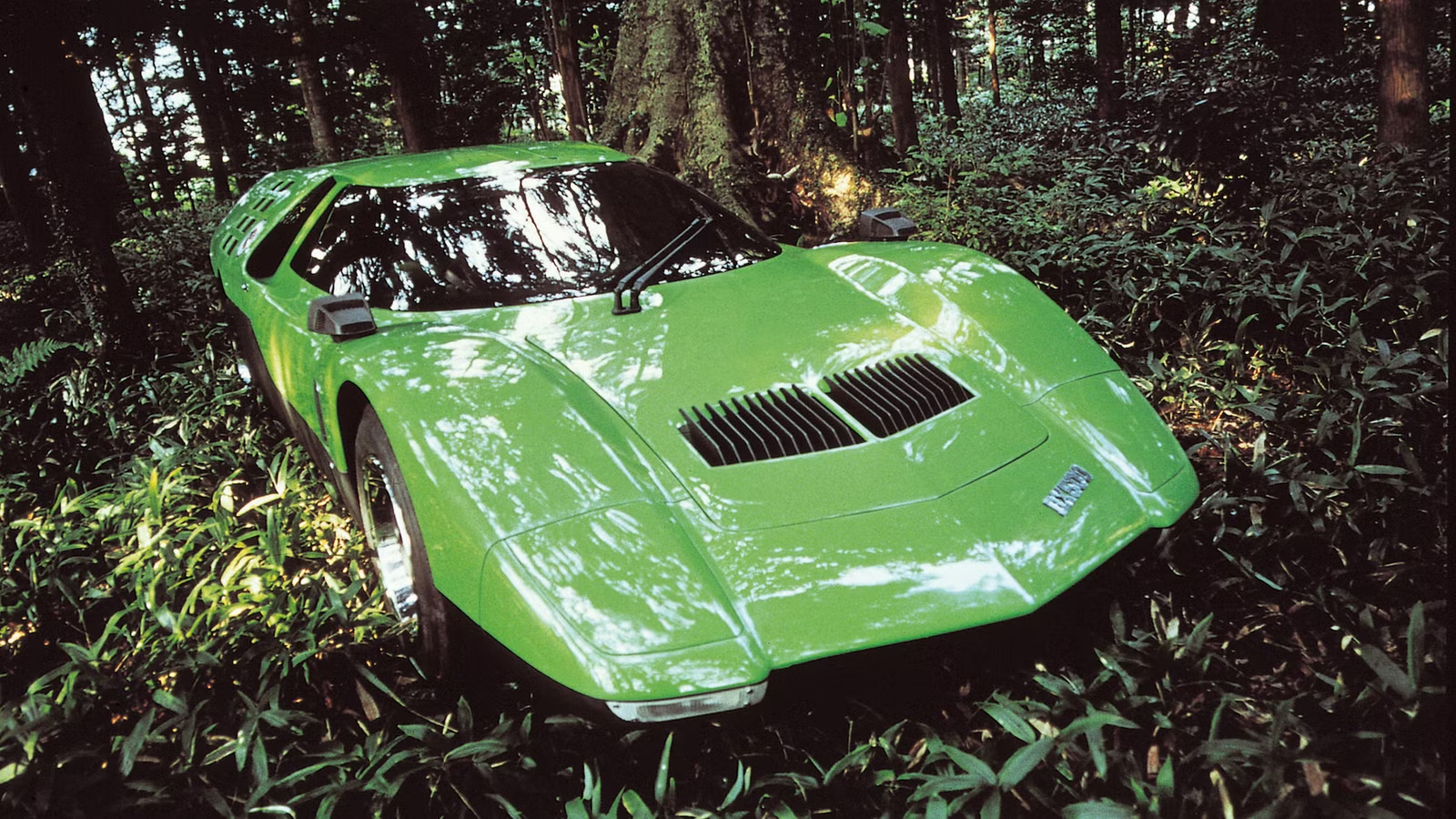
The RX-500 looked very different from the Cosmo. The concept car featured a mid-mounted engine behind the occupants. In front, there was a pointy nose and low hood. The roof featured a Kammback tail section somewhat reminiscent of the boxy rear of the Ferrari 250 GT SWB Breadvan. A central spine had a pair of hinged sections for accessing the powerplant.
One Car, Three Paint Schemes, And A Lighting System Decades Ahead Of Its Time
Close
Mazda built just one RX-500 concept, but the company tweaked its look for various events. The original prototype shown in promotional photos was green and had pop-up headlights. By the time it appeared at the Tokyo Motor Show, the concept received a yellow paint scheme. The mechanism for operating the headlights eventually broke, causing the team to adjust the nose with fixed headlights. A silver exterior was a final change while the car was on the show circuit.
The body was a mix of fiberglass and ABS plastic, so crafting new pieces wasn’t too complicated. Underneath the skin, there was a tubular steel space frame. Front-hinged butterfly doors created a dramatic opening into the modern-looking cabin. There was a double-wishbone suspension at each corner. The rotary mill was so compact that there was enough room for a full-size spare wheel in the engine bay.
The front panel also opened but only provided mechanical access; it wasn’t a frunk. The radiator was among the parts mounted there. At the back, there were lamps oriented in a vertical arc on each side. At least for the concept, the designers imagined the green lamps on top would illuminate during normal driving. There were also a pair of yellow lights for turn signals. Then three red brake lights on each side for different levels of stopping, and finally, white reverse lights at the bottom.
Below the bumper, with the message “Powered By Rotary,” there were a pair of rectangular exhaust pipes. An eye-catching, finned metal element was in the center.
Inside, the RX-500 featured a pair of futuristic-looking molded bucket seats. They had orange center sections with green outer sections. The driver gripped a four-spoke steering wheel with an orange center section to match the seats. There were three half-circular gauges with a tachometer displaying up to 15,000 revs behind the steering wheel, a speedometer in the middle, and the radio frequency display on the far left.
To put the vehicle into perspective, the RX-500 was fairly compact at 170.47 inches long. For comparison, a 2026 Mazda3 hatchback is longer at 175.6 inches, while a 2026 Miata is smaller at 154.1 inches. The RX-500 had a reported weight of 1,874 lbs.
Mazda Claimed 15,000 RPM – Here’s Why That Was Nearly Impossible
Close
Unlike many concepts, the RX-500 had a functional drivetrain. Mazda announced it would use the company’s 12A engine with two rotors and displacing a total of 1,146cc. At some point during the original display period, the car received a 10A powerplant with two rotors and 982cc. The engine connected to a four-speed manual driving the rear wheels.
The intended power for the production version of the RX-500 was a rotary engine making 247 hp or more and revving to a sky-high 15,000 rpm. However, these numbers were possibly lofty ambitions for the concept rather than being realistic figures for a road-going vehicle at the time. For example, in 1970, a tuned 10A engine powered a Chevron B16 sports car raced at Le Mans, and even in competition tune, it made around 200 hp at 8,000 rpm. Hitting 15,000 revs and being street legal would have been tough.
To fit the car’s performance intentions, the concept had disc brakes at each corner, with four-piston calipers. When static, the RX-500 sat on a set of special aluminum wheels. A crew had to swap it to stronger 15-inch steel wheels when the concept needed to go driving.
Mass-Produced Immortality For A One-Off Concept
While Mazda made only a single RX-500 concept, the vehicle had a mass-produced second life as a Matchbox toy car. The company reportedly picked it because the futuristic shape would appeal to kids. The toy arrived in 1971 called the MB66, and the company re-released it as the Streaker in 1975. Other color schemes arrived in re-issues between 1978 and 1985.
Restored, Running, And Still Turning Heads 55 Years Later
The RX-500 never received a production version, and the oil crisis in 1973 killed any chances for it. However, Mazda gave the RX-500 a sympathetic restoration in 2008. Over the years, the doors had broken at their base, and the original urethane foam and upholstery had rotted. The steering wheel also needed restitching. The company wanted to keep the car as original as possible while still making it driveable again.
For historical context, Mazda Motor of America launched in 1970 to bring the automaker’s vehicles into the country. Its first rotary-powered model in the country was the RX-2, arriving in 1971.
Today, the RX-500 is on public display at the Hiroshima City Transportation Museum. It remains in running order, with the museum taking the car for a low-speed run around a parking lot in October 2026. It’s rare to see a concept from this era still in good condition today, let alone still have a running powertrain. The RX-500 stands as a testament to Mazda’s rapid evolution as an automaker, having debuted just 10 years after the company’s first passenger car.
Mazda Never Got Tired Of Producing Fun Concepts
mazda iconic sp frontMazda
The RX-500 may have gone down in history as one of Mazda’s more iconic concepts, no doubt aided by the Matchbox toy car and indeed appearances in the Gran Turismo franchise, however, it’s far from the only adventurous sporting concept the automaker has churned out. Here are a few post-2000 favorites which demonstrate that Mazda still knows how to steal headlines with bold designs and adventurous powertrains:
Mazda Furai: Mazda first peeled the cover off of its Furai in late 2007. It was built upon the chassis of a Le Mans Prototype racer, and powered by a 2.0-liter 3-rotor wankel rotary engine, which ran on E100 pure ethanal and kicked out 450 horsepower. It was sadly destroyed during high-speed testing, although Mazda kept it a secret for five years, before revealing the charred carbon-fiber remains in 2013.
Mazda RX-Vision: A revival of the RX series is all many Mazda enthusiasts want, and so when the RX-Vision was unveiled in 2015, there was naturally a healthy buzz surrounding it. Under its sleek hood sat a Skyactiv-R rotary engine, which catapulted rotary designs into the 21st century. While the sports car never made it into production, the MX-30 e-Skyactiv R-EV did, sporting a hybridized powertrain, in which the single-rotor engine powered a generator, which in turn supplied electricity to the battery and electric motor.
Mazda Iconic SP: This sleek two-door coupe debuted in 2023, and proved that Mazda still has not given up on a rotary-powered sports car release. The powertrain is similar to that of the aforementioned MX-30, although just with more power – up to 365 hp, to be precise. It’s designed to run on a variety of carbon-neutral fuels, such as e-fuels and biodiesel, and its low-slung silhouette is remarkably similar to that of the FD-gen RX-7.
Source: AZ-1 Chiappa, Auto Messe, Hiroshima City Transportation Museum, [2] Mazda, [2]
