

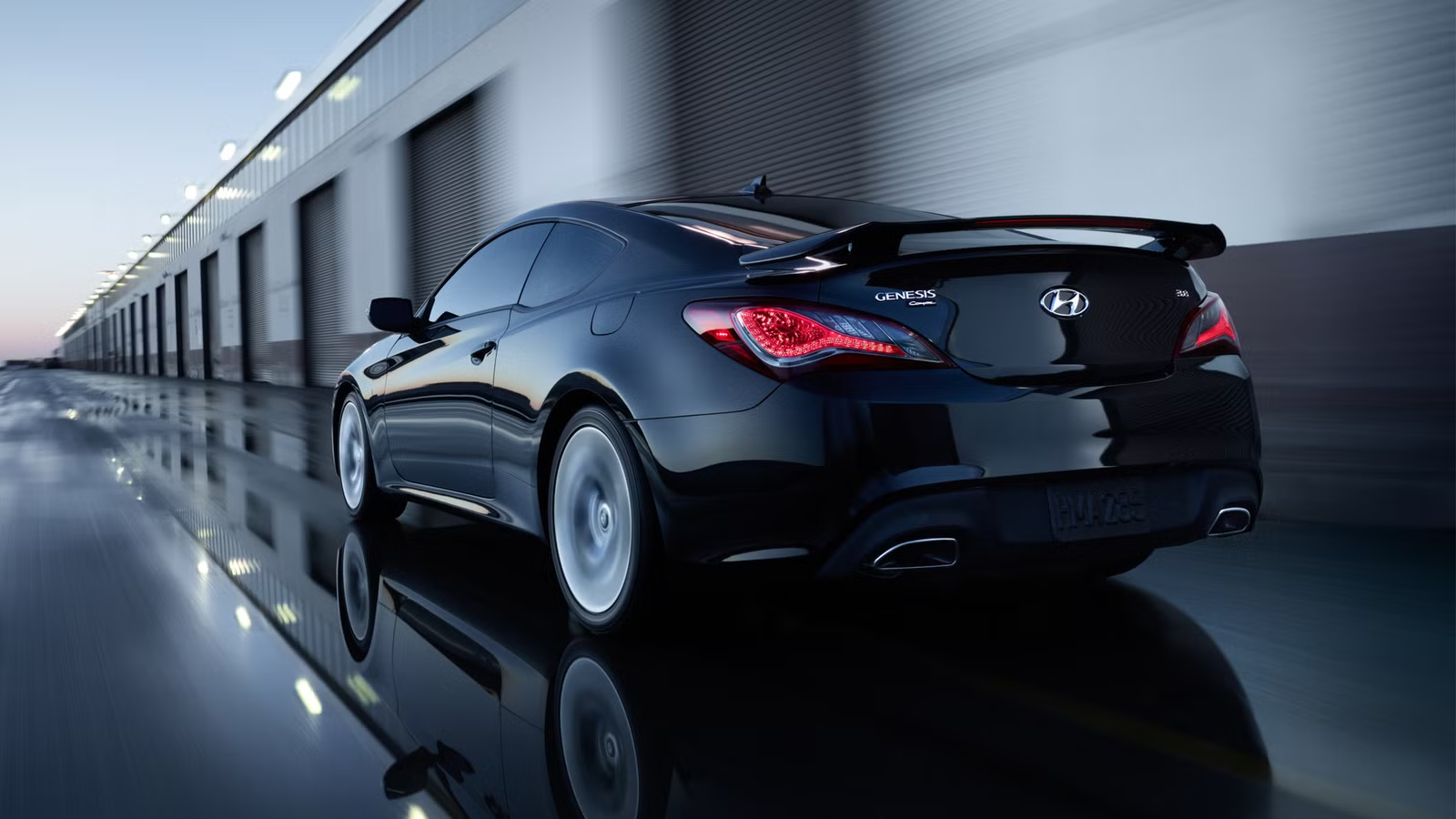
Few used sports cars offer this much for so little. The Hyundai Genesis Coupe — the car that proved Hyundai could build a genuine rear-drive performance machine — has quietly become one of the best-value buys on the used market. It never got a successor, and it never quite shed the budget-brand stigma that followed Hyundai into the late 2000s. But those two facts are precisely why you can pick one up today for less than the price of a new economy sedan, and drive away with factory Brembo brakes, a limited-slip differential, and up to 348 horsepower. The Genesis Coupe’s story is worth knowing — because understanding where it came from makes the bargain even harder to ignore.
A Hyundai Unlike Any Other
2007 Hyundai Genesis Coupe Concept from the front three-quarter angleHyundai
It’s important to keep in mind what Hyundai was like in 2007. The sportiest thing it had ever released in its 40-year history was the final-generation Tiburon, a front-drive sporty coupe that made, at most, 172 horsepower. It had released a few exciting concepts, but they didn’t mean much in showrooms beyond spawning a bunch of practical family cars. Customers weren’t going to Hyundai for something exciting in 2007. So it was all the more shocking when Hyundai revealed the Genesis Coupe Concept (pictured above and below) at the 2007 Los Angeles Auto Show.
2007 Hyundai Genesis Coupe Concept from the rear three-quarter angleHyundai
The car followed hot on the heels of the Genesis Sedan Concept. While Hyundai said the Coupe would be related to the sedan, the two cars looked dramatically different. The swoopy two-door wore a vivid orange paint scheme to show off its deep lower intakes, mischievous grin from the shape of the main grille and headlights, and fat rear fenders. The hood even featured bare carbon fiber and huge vents that would look at home in the pages of a tuner magazine of the era. This wasn’t a luxury cruiser; this was a real sports car.
The preliminary specifications backed up the boisterous body. Most noteworthy was that power would go to the rear wheels under those bulging back fenders — yes, Hyundai was finally leaving its front-drive sports coupe history behind to take on more prestigious performance machines.
The brand’s chief designer specifically called out the Infiniti G37 and Mitsubishi Eclipse. However, it was clear the model aimed to take on the Ford Mustang and Chevrolet Camaro, among others. Hyundai also revealed the coupe would be backed by a V6 making more than 300 horsepower, with an available six-speed manual, limited-slip differential, and beefy brakes. On top of that, the automaker indicated the machine wasn’t just a concept — it was headed for production for 2009.
It Had A Solid Start
True to its word, Hyundai revealed the production Genesis Coupe in October 2008, in time for it to go on sale in 2009. The design was essentially identical to the concept, though with slightly toned-down bumpers and a metal hood without air vents. Inside, the cabin was sporty but not gimmicky, with a flowing center stack featuring aluminum-look finishes and a pair of rear seats for a modicum of practicality.
Of course, the important part of the Coupe was what it had under the skin. As promised, the Coupe was available with a V6 and rear-wheel drive. It was a twin-cam, naturally aspirated 3.8-liter unit that made 306 horsepower and 266 pound-feet of torque, and it could be paired with either a six-speed manual or six-speed automatic transmission.
The base model came with a turbocharged 2.0-liter four-cylinder that made 210 hp and 223 lb-ft of torque. It also could come with a six-speed manual transmission, but the automatic had just five speeds.
2.0-liter turbocharged engine in the Hyundai Genesis CoupeHyundai
Those power numbers were laser-focused on the competition. The contemporary Ford Mustang, with its V6 and V8 options, made 210 and 300 hp, respectively, and both came with five-speed transmissions. The outgoing Nissan 350Z had exactly the same amount of power as the V6 Genesis Coupe, though the follow-up 370Z had jumped to 332 hp.
Hyundai didn’t stop with the powertrains, though. Every Genesis Coupe came with MacPherson strut front suspension and five-link independent rear suspension — a step up in sophistication over the solid rear axle on the Mustang. The Coupe also came with four-wheel disc brakes that were at least a foot in diameter at all four corners.
The Track and R-Spec trims were the enthusiast-focused versions. They featured larger wheels with stickier tires, thicker anti-roll bars, stiffer springs and shocks, plus upgraded Brembo brakes. All four corners had fixed four-piston calipers with 13.4-inch rotors up front and 13-inch rotors at the rear. Finally, and potentially most importantly, these grades received a Torsen limited-slip differential rather than the stock open unit.
The Refresh Is The Version To Get
The Genesis Coupe was basically unchanged save for minor tweaks to trim and feature availability such as navigation. In that time, the competition had improved, particularly the Mustang. Ford replaced all the engines in the famed pony car for 2012, so the base model was now making 305 hp — the same as the top-level Genesis Coupe. For 2013, Hyundai gave the Genesis Coupe its sole refresh.
Introduced at the 2012 North American International Auto Show in Detroit, the 2013 Genesis Coupe’s big attractions were the updated engines. It still offered a turbocharged 2.0-liter four-cylinder for the base model and a naturally aspirated 3.8-liter V6, but both made considerably more power. Hyundai fitted a twin-scroll turbocharger and upgraded intercooler to the four-cylinder, bringing output up to 274 hp and 275 lb-ft of torque. That didn’t quite match the V6 Mustang in peak power, but it nearly matched it in torque, and the twin-scroll setup built boost faster, making the four-cylinder more responsive than before.
As for the V6, Hyundai added direct fuel injection, lifting output to 348 hp and 295 lb-ft of torque. That let it beat the Nissan 370Z and made it one of the most potent naturally aspirated V6s available in a sports car at the time. Still, it lagged behind the Mustang GT, which had just received the 5.0-liter, 412-hp Coyote V8.
Hyundai made other changes to the Genesis Coupe for 2013, too. The front fascia got a major update, with a large black plastic grille in the bumper to give it a more imposing look and tie it into other contemporary Hyundai designs. The hood gained a pair of decorative nostrils to complement the menacing face. Both engines also received new eight-speed automatic transmissions, making the powertrain a more competitive package overall. The interior was largely carried over, but Hyundai added auxiliary gauges to the center stack for extra sporting flair, and the steering wheel gained telescopic adjustment in addition to tilt.
2013 Hyundai Genesis Coupe InteriorHyundai
Aside from those changes, the Genesis Coupe was largely unchanged. That meant the Track and R-Spec models remained the ideal choice for performance enthusiasts, with upgraded Brembo brakes and a limited-slip differential. Those models did gain adjustable front camber plates with the new model year, allowing owners to dial in a more aggressive alignment for track use.
This refreshed Genesis Coupe stuck around through the 2016 model year, with most subsequent changes centered on feature availability. For 2014, Hyundai added rev-matching on the automatic transmission, upgraded synchros in the manual, made fog lights and cruise control standard, and gave the R-Spec better-bolstered seats. The Track and Grand Touring trims disappeared in favor of the Ultimate trim, which combined all the Track performance hardware with the full comfort and convenience features from the Grand Touring.
Hyundai dropped the four-cylinder engine for 2015 and introduced push-button start and automatic climate control on the R-Spec. For its final year in 2016, the Genesis Coupe got a full-color information display nestled between the main gauges.
The Bang For Your Buck Is Excellent
Exterior view of a Hyundai Genesis Coupe
Hyundai
With far less name recognition than other rear-drive sports and muscle cars, you can find used Genesis Coupes for not much money. Unsurprisingly, the CarBuzz Marketplace price trend tool shows that later V6 models are the most expensive. They’re more likely to have lower miles and be in better condition, and they carry the most powerful engine and generally the most equipment. Specific averages shift as inventory turns over, so check the tool for current figures — but expect a widespread depending on condition, mileage, and trim.
Four-cylinder models are naturally more affordable across the board. The highest-priced examples tend to be 2014 cars, which benefit from the higher-output engine and are typically newer and in better shape. The lowest prices belong to pre-refresh models with the less powerful four-cylinder. As with the V6, the relatively small number of Genesis Coupes on the market at any given time means condition and equipment can swing averages significantly.
2015 Hyundai Genesis CoupeHyundai
We recommend any R-Spec, Track, or Ultimate Genesis Coupe, ideally a post-refresh model. Whether you want the four-cylinder or V6 will depend on your ultimate goals. If you like to modify and upgrade your car, the four-cylinder might be the better route, since adding power to a turbocharged engine is relatively affordable. If you don’t plan on touching the engine, the V6 is the way to go. Either way, a sports car in good shape with as much as 274 or 348 horsepower, factory Brembo brakes, sporty suspension, and a limited-slip differential — all for under $20,000 — is an incredible bargain and well worth a look for someone willing to try something a little different. That’s less than the cost of a brand-new Corolla.
Here’s Why It Still Gets Overlooked
2015 Hyundai Genesis Coupe wheelHyundai
Hyundai, and the Hyundai Motor Group, makes some genuinely exciting cars these days. We rate the Ioniq 5 N very highly, and it’s getting increasingly difficult to find a bad word to say about the Elantra N, too — but things haven’t always been this way. Back in the mid-to-late ’00s, Hyundai was still very much a budget brand, and no amount of rakish lines or 300-horsepower V6 engines were going to rid Hyundai of that image overnight.
Furthermore, while the Genesis Coupe certainly delivered the core ingredients — that powerful six-cylinder and six-speed manual transmission — much of the interior plastics were cheap and uninspiring, feeling sub-par compared to Japanese rivals, let alone more upmarket American and European sports coupes. The six-speed manual was also criticized for a notchy, rubbery shift action that drove many enthusiasts away.
All that said, current prices are so low that the Genesis Coupe is still very much worth considering, especially for buyers who accept that bang-for-buck often comes with a little compromise.
Source: Hyundai
