

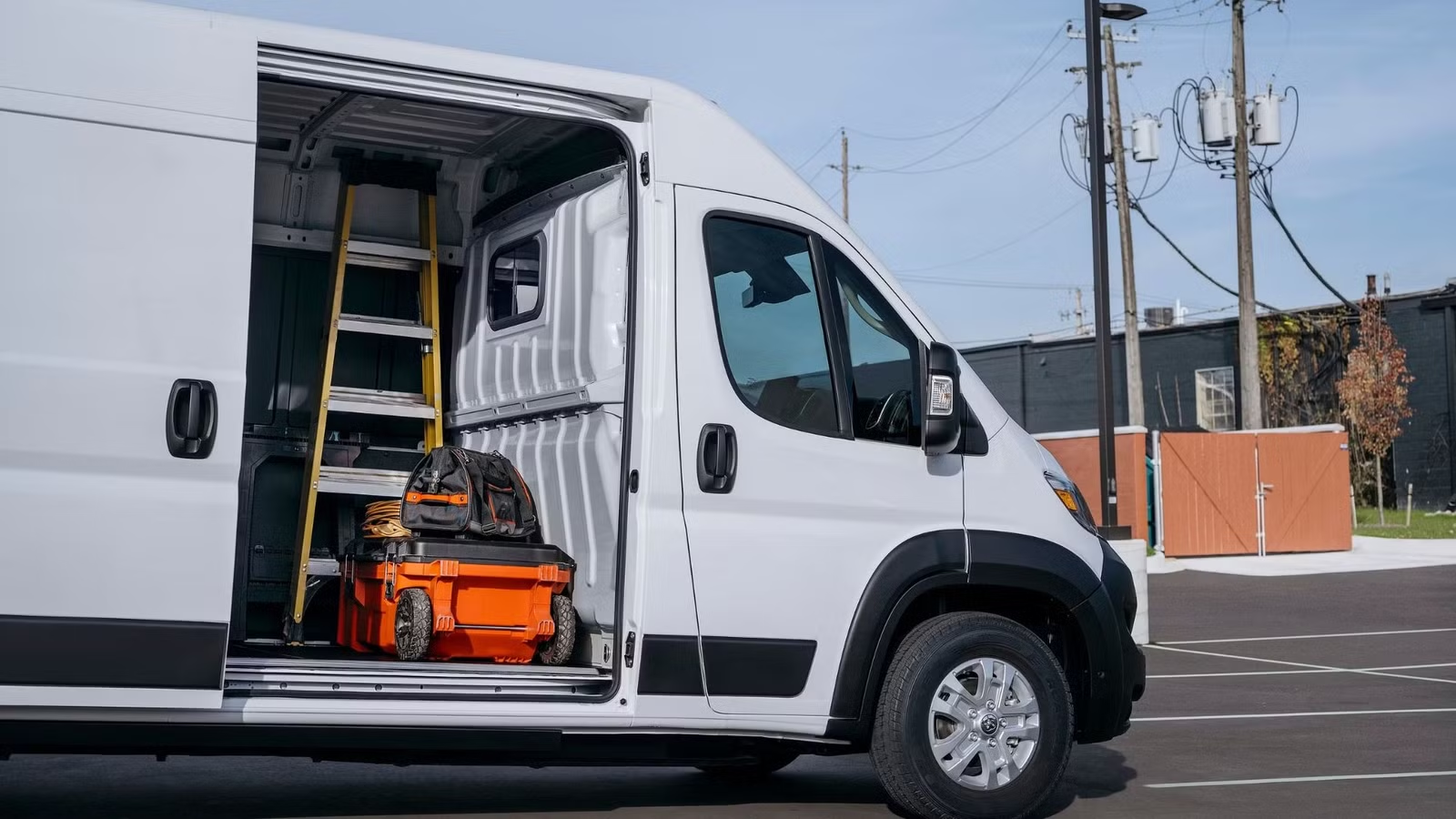
When you’re window shopping for your next work van, it’s easy to get distracted by all the pretty headline figures that you read in the brochure – payload and seating capacity, comparing their dimensions, or looking at how much you can haul or tow at a time. You might even look at which dealer is willing to strike you the best deal on that new Ford Transit or Ram ProMaster, but many business owners and fleet operators tend to overlook long-term reliability. Thankfully, the most reliable vans in 2026 settle this conundrum.
Any tradesperson worth their salt needs the most reliable work van for their trade, and don’t forget that building your businesses on the back of an unreliable van means more breakdowns and problems. Of course, this will require more visits to the workshop, and this ultimately results in less time spent working. Whether you’re a plumber, a carpenter, or an electrician, time is money, so let’s check out the most reliable vans to buy in 2026 that guarantee minimal downtime, less stress and headaches, and more profits.
This is an analysis and comparison of the most reliable vans to buy new in the US for 2026, with reliability, maintenance, repair, ownership cost, recall, and depreciation data sourced from the NHTSA and CarEdge. All the statistics, ratings, price, and information mentioned below are accurate as of publishing. Automakers reserve the right to update this at any time and without notice.
8
Ford E-Transit
Slightly Compromised Versatility, But At Least It’s Affordable To Maintain
Powertrain
Single Motor / 266 hp / 317 lb-ft
89-kWh Battery / 211–249 Miles of Range
Weight Class
–
Body Style
Cargo Van
Roof Height
Low / Medium / High
Wheelbase
148 in.
Max Payload Capacity
3,320 lbs
Max Cargo Volume
487.2 cu-ft
Max Towing Capacity
–
Max GCWR
–
Max GVWR
9,500 lbs
5-year Ownership Cost
(incl. Depreciation, Fuel, Insurance, Interest, & Maintenance)
$62,394
Annual Maintenance Cost
(incl. Routine Servicing and Scheduled Wear and Tear Items)
$453
5-year Maintenance Cost
$2,265
Complementing the gas-powered Ford Transit, if you prefer something all-electric, you can instead buy the aptly named Ford E-Transit. You’re really not losing out a ton when it comes to the work van-related practicality, usability, and flexibility you need to do actual work with, despite the fact that it isn’t properly rated for towing. If you’re okay with that, the best thing about buying an electric work van is its low running costs. With fewer moving parts than a combustion-powered van, the Ford E-Transit costs less in maintenance and repairs.
That said, like most other electric vehicles, the Ford E-Transit depreciates heavily, which is why CarEdge has bestowed it with an unimpressive value rating of D. CarEdge found that over a five-year period, it’ll depreciate by an eye-watering 56%, though the pretty affordable maintenance and repair costs over that period might help to offset the hefty depreciation. Otherwise, the NHTSA did recall the Ford E-Transit once for high-voltage battery fire risks due to electrical arcing (26V062000), including a loss of drive power.
7
Ram ProMaster
A Below-Average Pentastar V6 Engine & Plagued With Worrying Recalls
Powertrain
3.6-liter V6 / 276 hp / 250 lb-ft / 9-speed Automatic
Weight Class
1500 / 2500 / 3500
Body Style
Cargo Van / Crew Van / Passenger Van
Roof Height
Standard / High / Super High
Wheelbase
118 in. / 136 in. / 159 in.
Max Payload Capacity
4,750 lbs
Max Cargo Volume
524 cu-ft
Max Towing Capacity
6,910 lbs
Max GCWR
9,350 lbs
Max GVWR
12,000 lbs
5-year Ownership Cost
(incl. Depreciation, Fuel, Insurance, Interest, & Maintenance)
$62,866 (1500) / $67,213 (2500) / $68,977 (3500)
Annual Maintenance Cost
(incl. Routine Servicing and Scheduled Wear and Tear Items)
$1,327 (1500) / $1,337 (2500) / $1,342 (3500)
5-year Maintenance Cost
$6,633 (1500) / $6,683 (2500) / $6,710 (3500)
Moving from electrification to good ol’ combustion, we now have the Ram ProMaster, as it offers a way higher payload capacity, GCWR, and GVWR, and unlike the all-electric Ford E-Transit, you can actually tow a decent amount of stuff. However, it will cost you, since the Ram ProMaster trades versatility and van-like capability for reliability, as CarEdge’s metrics show that it costs more than rival cargo and passenger vans for its regular maintenance and repairs. Some of that can be blamed on the Pentastar V6.
Overall, though, CarEdge gave the ProMaster a poor C- value rating for the 1500 and 2500 models, while the ProMaster 3500 settled for an even worse D+. If that isn’t bad enough, it was recalled five times by the NHTSA. This includes recalls for a sudden loss of power steering (26V621000), a radiator fan circuit that may overheat (25V720000), wheelchair seat belts that might not restrain you (26V357000), a rearview camera that might fail to display (26V531000), and rear benches missing seat legs (26V280000).
6
Ram ProMaster EV
Electrification Ups The ProMaster’s Reliability & Lowers Maintenance Costs
Powertrain
Single Motor / 268 hp / 302 lb-ft
110-kWh Battery / 164 Miles of Range
Weight Class
–
Body Style
Cargo Van
Roof Height
High / Super High
Wheelbase
159 in.
Max Payload Capacity
3,170 lbs
Max Cargo Volume
463 cu-ft
Max Towing Capacity
–
Max GCWR
12,000 lbs
Max GVWR
9,350 lbs
5-year Ownership Cost
(incl. Depreciation, Fuel, Insurance, Interest, & Maintenance)
$61,601
Annual Maintenance Cost
(incl. Routine Servicing and Scheduled Wear and Tear Items)
$742
5-year Maintenance Cost
$3,708
Proof that going all-electric can improve certain vehicles, one of the most reliable cargo van options today is the Ram ProMaster EV. You do have to compromise a smidge when it comes to its payload capacity and total cargo volume compared to the gas-powered ProMaster, but otherwise, you get near-perfect feature parity between them, and with even fewer downsides than you might expect. You still get Ram’s generous selection of cabin tech and driver assists, yet the ProMaster EV is generally a lot more dependable, too.
CarEdge’s data show that the ProMaster EV is more affordable to own and cheaper to maintain, whether new or across a five-year period. This explains the higher CarEdge value rating of C, and to make the jump to electrification even more attractive still, the ProMaster EV doesn’t depreciate as heavily as you might expect for an electric van. One of the most reliable work van choices you can buy today has been recalled twice by the NHTSA, though, overlapping with the standard ProMaster: 26V621000 and 26V531000.
5
Ford Transit
The Quintessential Work Van Offers Good Longevity & Solid Dependability
Powertrain
3.5-liter V6 / 275 hp / 260 lb-ft / 10-speed Automatic
3.5-liter V6 / 300 hp / 400 lb-ft / 10-speed Automatic
Weight Class
–
Body Style
Cargo Van / Passenger Van
Roof Height
Low / Medium / High
Wheelbase
130 in. / 148 in.
Max Payload Capacity
5,103 lbs
Max Cargo Volume
487.3 cu-ft
Max Towing Capacity
6,900 lbs
Max GCWR
12,600 lbs
Max GVWR
11,000 lbs
5-year Ownership Cost
(incl. Depreciation, Fuel, Insurance, Interest, & Maintenance)
–
Annual Maintenance Cost
(incl. Routine Servicing and Scheduled Wear and Tear Items)
–
5-year Maintenance Cost
–
Unsurprisingly, if you’re window shopping around for the most reliable cargo van or the most reliable passenger van ever made, the Ford Transit is inevitable. It is based on a tried-and-tested and long-proven underpinning, and Ford has had a lot of time to iron out most of the kinks and issues since it first came out all the way back in 2015. Plus, when you pop open the hood, you will find one of two durable, long-lasting V6s, including an EcoBoost V6, good for 300,000+ mostly problem-free miles with proper maintenance.
The NHTSA did recall the current model year Ford Transit once, however, specifically for a wireless seat belt reminder system that’ll fail to alert you if the seat belt is unfastened (26V579000). Other than that, you can’t go wrong with a Transit, now upgraded with an up-to-date SYNC 4 12-inch infotainment system, complete with wireless Apple CarPlay and Android Auto. As standard, you also gain Ford Co-Pilot 360, which gives you all the driver assists you need, from a 360-degree camera to automatic emergency braking.
4
Chevrolet Express
If It Ain’t Broke, Don’t Fix It, With Fewer Repairs & Cheaper Servicing Costs
Powertrain
4.3-liter V6 / 276 hp / 298 lb-ft / 8-speed Automatic
6.6-liter V8 / 401 hp / 464 lb-ft / 8-speed Automatic
Weight Class
2500 / 3500
Body Style
Cargo Van / Passenger Van
Roof Height
Low
Wheelbase
135 in. / 155 in.
Max Payload Capacity
4,280 lbs
Max Cargo Volume
283.6 cu-ft
Max Towing Capacity
10,000 lbs
Max GCWR
16,000 lbs
Max GVWR
9,900 lbs
5-year Ownership Cost
(incl. Depreciation, Fuel, Insurance, Interest, & Maintenance)
$65,461 (Cargo) / $65,461 (Passenger)
Annual Maintenance Cost
(incl. Routine Servicing and Scheduled Wear and Tear Items)
$766 (Cargo) / $773 (Passenger)
5-year Maintenance Cost
$3,828 (Cargo) / $3,864 (Passenger)
Believe it or not, the Chevrolet Express that you can buy brand-new today has been on the market since 1996, with its most recent facelift being in 2003. In other words, you’re essentially buying new-old stock, but that’s not necessarily a bad thing, as this has given Chevrolet plenty of time to continually refine the Express, making this dinosaur one of the most reliable cargo van models you can find. If, of course, you can deal with the fact that it only has one (low) roof option, and its cargo volume isn’t as large as other vans.
It does at least make up for its limited expandability compared to the other most reliable work vans by offering a fantastic towing capacity, a high GCWR for hauling heavy loads, along with the option of a proper V8 engine, with loads of power and torque. When put next to the other vans here, the Express is cheaper to maintain and upkeep, but be wary that the NHTSA has recalled it thrice: a loose steering gear assembly nut (26V399000), a gear shifter with a mind of its own (26V345000), and tire sidewall damage (26V127000).
3
GMC Savana
The Chevy Express’s Twin Is Actually More Reliable & Affordable To Maintain
2025 GMC Savana front 3/4 angle in white while parkedGMC
Powertrain
4.3-liter V6 / 276 hp / 298 lb-ft / 8-speed Automatic
6.6-liter V8 / 401 hp / 464 lb-ft / 8-speed Automatic
Weight Class
2500 / 3500
Body Style
Cargo Van / Passenger Van
Roof Height
Low
Wheelbase
135 in. / 155 in.
Max Payload Capacity
4,280 lbs
Max Cargo Volume
283.6 cu-ft
Max Towing Capacity
10,000 lbs
Max GCWR
16,000 lbs
Max GVWR
9,900 lbs
5-year Ownership Cost
(incl. Depreciation, Fuel, Insurance, Interest, & Maintenance)
$63,469 (Cargo) / $64,245 (Passenger)
Annual Maintenance Cost
(incl. Routine Servicing and Scheduled Wear and Tear Items)
$682 (Cargo) / $689 (Passenger)
5-year Maintenance Cost
$3,409 (Cargo) / $3,446 (Passenger)
For all intents and purposes, since the GMC Savana is twinned with the Chevrolet Express, most of its specs are identical. This means you’re buying a new van that can feel old when you’re sitting inside, due to the lack of updates, but GM did give it some creature comforts. This includes a Tow/Haul Mode to improve control and stability when you’re towing heavier loads, StabiliTrak, Hill Start Assist to make inclines easier to manage, and an automatic locking rear differential for extra traction. You even get OnStar and remote keyless entry, too.
Yet, the GMC Savana is actually more reliable than the Express, with CarEdge boosting its value rating score from C to C+. It’s a smidge more affordable than the Express to own, with lower depreciation and cheaper servicing. For context, it’s $3,296 cheaper to maintain over a five-year period than an average full-size van, according to CarEdge. Plus, according to the data, the probability of a major repair after five years is lower: 14.62%, which is 7.43% lower than full-size van average, and versus 16.7% on the Express.
2
Mercedes-Benz Sprinter
Impressive Performance, Costly Maintenance, But Strong Resale Values
Powertrain
2.0-liter I4 Diesel / 170 hp / 295 lb-ft / 9-Speed Automatic
2.0-liter I4 Diesel / 211 hp / 332 lb-ft / 9-Speed Automatic
Weight Class
2500 / 3500 / 4500
Body Style
Cargo Van / Crew Van / Passenger Van
Roof Height
Standard / High
Wheelbase
144 in. / 170 in.
Max Payload Capacity
6,812 lbs
Max Cargo Volume
533 cu-ft
Max Towing Capacity
7,500 lbs
Max GCWR
15,250 lbs
Max GVWR
12,125 lbs
5-year Ownership Cost
(incl. Depreciation, Fuel, Insurance, Interest, & Maintenance)
$64,915 (2500) / $66,059 (3500) / $70,065 (4500)
Annual Maintenance Cost
(incl. Routine Servicing and Scheduled Wear and Tear Items)
$1,238 (2500) / $1,232 (3500) / $1,243 (4500)
5-year Maintenance Cost
$6,192 (2500) / $6,161 (3500) / $6,215 (4500)
You might expect a Mercedes commercial van to offer a different ownership experience than a Mercedes luxury sedan or sporty SUV, but no, it turns out they’re two sides of the same coin. The Mercedes-Benz Sprinter costs more than most other vans here when it comes to scheduled maintenance and repairs, and its overall cost of ownership can be quite hefty. Yet, there’s a really good reason why CarEdge has given the Sprinter a generous value rating of B+, as it holds its resale value exceptionally well, depreciating only 36% in five years.
Moreover, the Sprinter hasn’t been recalled by the NHTSA, with no major problems or owner complaints to note, which also makes the new Sprinter one of the most reliable used van models to buy if you’re shopping around the second-hand market. With lots of payload capacity and cargo volume to work with, the Sprinter offers you ample flexibility and tech, complete with a 10.25-inch MBUX infotainment unit, a 360-degree camera, and tons of driver aids, making it one of the best, most reliable cargo van alternatives out there.
1
Mercedes-Benz eSprinter
Electrifying The Sprinter Makes It Cheaper To Own, With Minimal Downside
Powertrain
100 kW Standard Output / 136 hp / 295 lb-ft
150 kW High Output / 204 hp / 295 lb-ft
81-kWh Battery / 150 Miles of Range
113-kWh Battery / 206 Miles of Range
Weight Class
–
Body Style
Cargo Van
Roof Height
Standard / High
Wheelbase
144 in. / 170 in.
Max Payload Capacity
3,516 lbs
Max Cargo Volume
488 cu-ft
Max Towing Capacity
4,100 lbs
Max GCWR
11,023 lbs
Max GVWR
9,370 lbs
5-year Ownership Cost
(incl. Depreciation, Fuel, Insurance, Interest, & Maintenance)
$56,757
Annual Maintenance Cost
(incl. Routine Servicing and Scheduled Wear and Tear Items)
$691
5-year Maintenance Cost
$3,454
Alas, while the Sprinter comes close, if you’re looking for the most reliable work van and the most reliable cargo van you can buy today, it’s actually beaten by its own all-electric twin, the Mercedes-Benz eSprinter. Unlike the Ford E-Transit or the Ram ProMaster EV, though, the eSprinter isn’t plagued with substantial depreciation, and while it isn’t massive, you can even tow stuff with it. In fact, it holds onto its resale value better than most other vans here, with cost-effective maintenance costs, and few reliability quirks.
Nonetheless, you have to trade in cheaper servicing costs with downgraded capability, as the eSprinter’s payload capacity and cargo volume are slightly compromised. On the flip side, you can get upwards of 206 miles of range with the bigger 113-kWh battery, in addition to DC fast-charging up to 110 kW, letting you recharge from 10% to 80% in as little as 32 minutes. You also get a nice cabin, with wireless Apple CarPlay and Android Auto, a wireless charger, and you can even pre-condition the cabin using a mobile app.
Sources: NHTSA, CarEdge
