

For the vast majority of drivers, your engine oil isn’t thought of until the little maintenance reminder light pops up on your dash. Once it does, you pull into some sort of quick-lube shop, get the job done, and move on with your life. Now, the previous “forget it until you can’t” mindset surrounding engine oil is no longer viable. That’s because a severe shortage of Group III base oils, heavily used in modern synthetic lubes, has pushed prices sky-high.
Kirkland’s 10-quart synthetic two-pack now costs about $57.99. Originally, that price sat around $30. To boot, you can only buy two packages per Costco membership every seven days. The issue extends outside Costco, too, as those Group III base oils now fetch a price of roughly $12.45 per gallon. That’s approximately four times higher than this past February’s average price.
Problems in the Middle East, and the fact that about a third of all passenger vehicles on US roadways use low-viscosity 0W-20 oil, have both contributed to the supply issue at hand, and the average driver is paying the price.
The Issue Doesn’t Lie With Crude, Rather The Base Oil Inside Your Jug
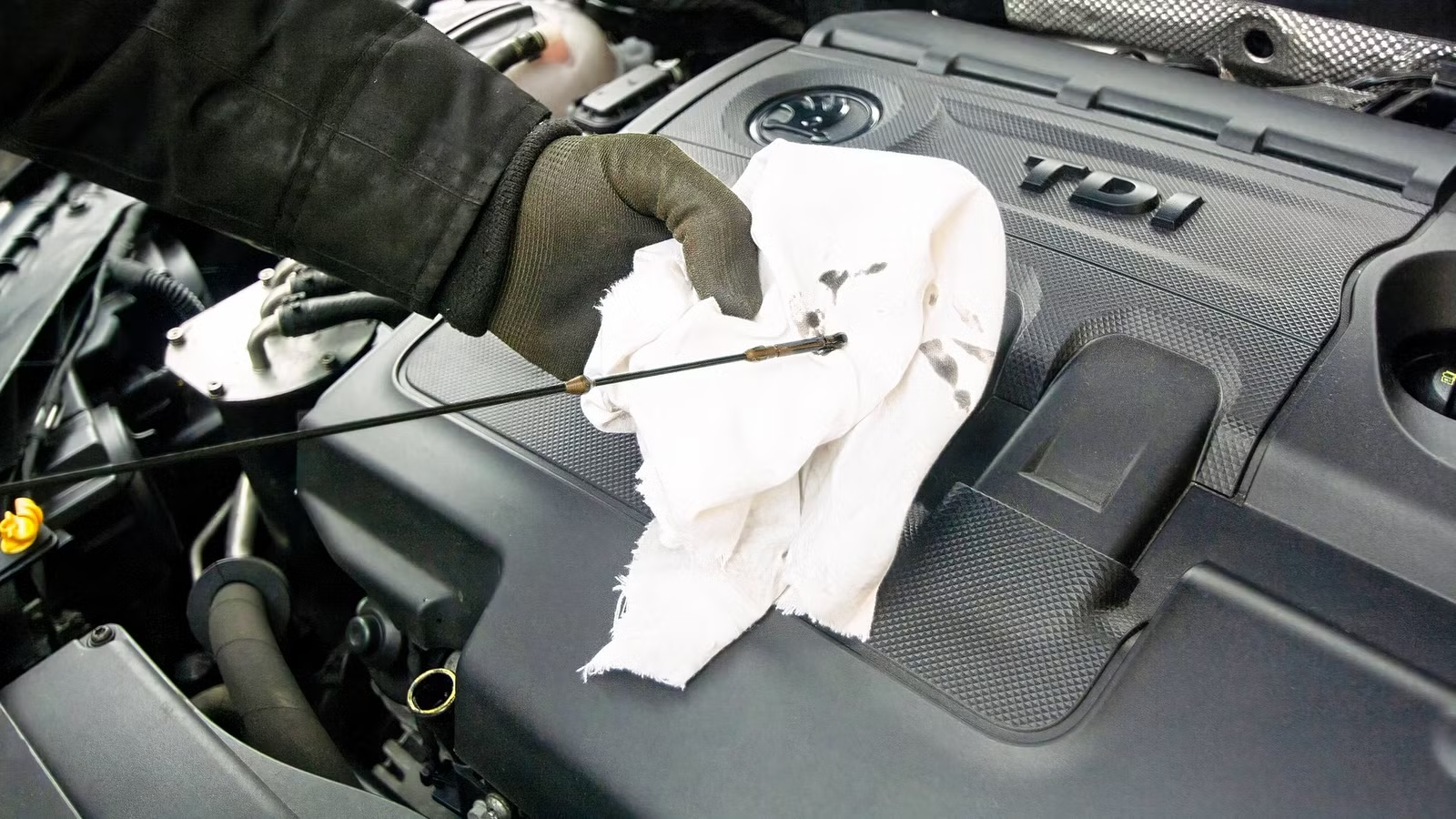
Close-up detail shot of an engine oil dipstickCarBuzz/Valnet
The current motor oil supply upset is separate from the world’s crude oil supply. Of course, they’re both related, but not interchangeable by any stretch. When you get a quart of oil from your local retailer, the product found within is much different from the black goo that comes out of the ground. Finished motor oil combines a slew of base oils mixed with additive packages, which are designed to act as detergents, provide anti-wear protection, and control viscosity degradation.
Today, full-synthetic motor oil relies heavily on what’s called Group III base oils. These are extremely refined mineral base stocks, so they do come from the ground, but a significant amount of work goes into transforming them into motor oil. As a country, we have become heavily dependent on imports of these specific oil types, and much of our stock comes directly from the currently troubled Persian Gulf region.
Shell’s Pearl GTL facility in Qatar is particularly important for our Group III base oil supply. The facility utilizes natural gas, which is then converted into highly refined liquid materials. Unfortunately, conflict-related damage has rendered the facility virtually unusable for the time being; it was shut down in March of this year following an attack.
Prior to the current Middle Eastern conflict starting, roughly 44% of US Group III base oil imports came from Persian Gulf suppliers, namely Shell’s Pearl GTL refinery. Compounding the issue of base oil shortages, refiners have an unbalanced incentive to prioritize the production of other products, such as jet fuel and diesel. This occurs when fuel prices get high, and supply dwindles.
Oil StorageErik McLean/Pexels
It’s enough to make your head hurt, but the gist is this: just because there’s enough crude oil going around doesn’t mean the issue would be instantly solved. Refining capacity is the true bottleneck – and if you happen to drive a Toyota, Honda, Nissan, or Subaru built in the last decade, the shortage hits you harder than most.
0W-20 Users Are Especially Exposed
2007 Million Mile Nissan Frontier with its owner checking the oilNissan
About a third of all cars on the road in this country use 0W-20 oil, and it’s the most popular type used in modern cars built within the last decade or so. It’s a lightweight lubricant, and it’s also relatively low-viscosity compared to heavier motor oils like 5W-30 or 10W-30. As modern automotive engineering pursued much lower internal friction inside engines, better cold-start performance, and small fuel economy gains, the lightweight oil became the darling of the industry.
Find any Toyota, Honda, Nissan, or Subaru model on the road that was built relatively recently, and you’re likely to find a “0W-20” stamp somewhere on its engine oil fill cap. However, some models use even lighter oil than that. 0W-16 has entered the market, too. There’s even a 0W-8 type, found in models like the current Toyota Crown and the Toyota Grand Highlander Hybrid.
2025 Toyota Grand HighlanderToyota
You typically can’t just pick what sort of oil you want to use, either. Engines are specifically designed with a certain type of oil in mind. Try to put 5W-30 in an engine that calls for 0W-20, then see what your service writer says about your warranty claim once the truth comes out. Manufacturers can deny warrantied service if your use of the wrong oil contributed to the car’s issues in any way. However, some manufacturers do permit using different oil weights under certain circumstances, such as extreme heat or extreme cold.
The issue of 0W-20 shortages hasn’t just hit Costco, either. It’s been reported that certain Nissan dealers are being forced to confront the issue head-on, reducing its synthetic oil allocation by about 45% compared to 2025 levels. Toyota has instructed its service centers to use permitted alternative oil weights whenever possible to try to save as much 0W-20 as possible for the cars that truly need it.So how much is this actually going to cost you at your next oil change – and is the panic warranted?
The Annual Cost Actually Isn’t All Too Bad
Adding Oil To An EngineHalfords YouTube channel
If you shopped for Costco’s 10-quart bargain bundle eight months ago, you’d have found it for anywhere between $30 and $36, on average. Now, it’s roughly $22–$28 more expensive across the board. If you take that $30 on the low end, the new $57.99 price equates to a 93% increase. However, oil itself isn’t something like eggs, milk, or toilet paper.
Buying oil isn’t really an annual operating cost. Let’s do some math. Say your Toyota takes exactly five quarts of 0W-20, and you fancy some Costco-brand full-synthetic. Before, you’d spend about $15 per five quarts. Now, that price comes to about $29 for the same amount of oil. That means a typical DIY oil change, excluding the filter, only costs about $14 more than it did previously.
The average driver only travels about 13,500 miles per year, and the standard recommended oil change interval now falls anywhere between 7,500 and 10,000 miles. With that in mind, the average driver will change oil twice a year, incurring a $28 increase in oil expenditure compared to before. Change your oil three times annually, and the price only increases by $42 per year.
A professional lube job costs more than it used to, as well. Shops usually buy oil in much larger quantities, and some businesses have reported a 55-gallon drum of full synthetic oil jumping from $400 per unit to $1,000 per unit. To offset the increase in product costs, most shops have raised their prices anywhere between 20% and 30% on average. Some shops have chosen a different approach, electing to absorb most of the oil price increase themselves.
The Real Warning Is How Dependent Modern ICE Engines Have Become On Specialized Oils
Car Maintenance; Mechanic Checking Mini’s Oil In Workshop
No, you can’t get around oil pricing if you buy a hybrid. Hybrids still have regular combustion engines that need regular combustion-engine maintenance, such as consistent oil changes. Many newer hybrids, as evidenced above, use the very same sort of specialized lubricants that we’re currently short of. Buying a brand-new Toyota Camry won’t make you immune from fluctuating base-oil prices, either.
In theory, you can free yourself from the regular oil change by buying an EV. But why would anyone spend all that money on an electric car to avoid an annual expenditure that’s currently less than $58 (excluding the filter), on average, if you do it yourself? There are better ways to spend your money if that’s your only reason to get into an EV.
Detail shot of a person filling an engine with oilWikimedia Commons: Sigaus
The current shortage shows us that there’s more to this than meets the eye. Fuel is only one petroleum-based product on which a car relies, and it’s arguably the most important in terms of price. However, modern engine oils become more and more complex as time goes on, and need more and more refined base oils than ever before. Manufacturers can diversify sources to offset disruptions like the Shell Pearl plant shutdown, but motor oil is a regulated commodity and must undergo validation processes.
No, 0W-20 motor oil hasn’t disappeared. You can still head down to Costco and buy 20 quarts of it a week if you want; it’s just more expensive. Most projections foresee an uptick in base oil production in 2027, so relief may very well be around the corner, too. So don’t sell your ICE car in a panic, and don’t try to use used cooking oil as a substitute for motor oil in an attempt to cut costs. Just expect the next few oil changes to cost more.
Sources: CNN, DuckerCarlisle.com, MPR News, New York Post, WashingtonExaminer.com, CNBC, Reuters.
