

The last couple of decades have seen some impressive and important engines debut. Powerplants such as the 1,064-horsepower, twin-turbocharged, 5.5-liter flat-plane crank V8 sitting behind the driver in the Chevrolet Corvette ZR1, BMW’s reliable yet powerful S58, and Lexus’ screaming 4.9-liter V10 show there’s still life in the internal combustion engine.
The technology in engines like these overshadows what was done in the 20th century. However, without those earlier efforts that challenged how automakers approached motivating their models, we wouldn’t have the technological masterpieces we all love and celebrate today.
In 2000, Wards Auto selected its top 10 engines of the 20th century. While they might not have been the most powerful or enthusiast-focused units, each helped push engine design forward in one way or another. Here, we once again celebrate those same 10 engines, more than a quarter-century deeper into their everlasting legacies.
Ford Model T Inline-Four
Ford reckons it might have another Model T moment on its hands, but in reality, we’re unlikely ever to see anything remotely as significant as the Model T’s achievement in the early 20th century. Henry Ford revolutionized transportation by placing his Model T into the hands of the mass market, by employing a moving assembly line, and reducing prices while simultaneously raising workers’ wages.
In comparison to a modern car, the Model T is notoriously challenging to pilot. However, with more than 15 million sold, this clearly wasn’t an issue 100+ years ago. Motivating Ford’s marvelous creation was a 2.9-liter inline-four, which churned out just 20 horsepower. Just as the car itself was, the engine was designed with low-cost maintenance and long-term durability in mind. It was uncomplicated, under-stressed, and almost 120 years after it first appeared, hoards of enthusiasts still enjoy it today. Without a shadow of a doubt, the Model T’s inline-four deserves a spot on any list of the most important and influential engines of all time.
Cadillac V8
Much as Henry Ford didn’t invent the car, Cadillac did not invent the V8. Both just got the recipe right for mass production, and that’s why Cadillac’s original L-Head V8 earned a spot on this list. Early versions kicked out 70 horsepower, but Cadillac continued to refine the recipe throughout the years, not only adding more grunt, but also introducing refinement too, thanks to a redesigned crankshaft which debuted with the (pictured) V-63 model in 1924.
Cadillac’s V8 legacy never really died out, either. The automaker debuted its OHV V8 in the late 1940s, which essentially kickstarted the horsepower wars that would eventually lead toward the muscle car movement. Cadillac’s V8 story then evolved into the Northstar, and later into the engines that underpin many models even today. It’s a configuration the brand has stayed loyal to for over a century now, and one that has refused to lose relevance.
Ford Flathead V8
Cadillac introduced the V8 to volume production, and then Ford democratized it by making the powerplant affordable enough for everyone to own one. That’s the real beauty and significance of its flathead design, which Ford continued to develop through the 1930s and into the 1940s.
From the very first iterations, which produced 65 horsepower from a 3.6-liter capacity, cutting-edge technology for the time, such as forged-steel crankshafts and aluminum pistons, was featured. Later cars used improved carburation and aluminum cylinder heads to add more horsepower. Ford’s flathead V8 remained relevant for decades, even once the automaker moved onto new designs, as the hot-rodding community continued to develop and celebrate the design for many, many years.
Volkswagen Flat-Four
It’s easy to shout about high-output engines that earn motorsport success and boast impossibly fast acceleration times. However, it’s the everyday brilliance of mass-market movers that caught the eye of Wards Auto when the publication compiled this list. That’s why Volkswagen’s 1.1-liter, 25-horsepower, air-cooled flat-four made its way into the rankings, while Ferrari’s Colombo V12 went unmentioned.
Between 1938 and 2003, more than 21.5 million Volkswagen Beetles (also known as the Type 1) found homes across the globe, making it the fastest-selling car of all time. That overwhelming success defined its significance in this context. Cheap to run, easy to repair, and about as simple as a kindergarten pencil sharpener, Volkswagen’s flat-four design nailed the brief of bringing affordable, reliable, and mass-produced transport to the people of Germany (and far beyond).
Chevrolet Small-Block V8
The Chevy small-block V8 was always going to earn a spot on this list. Chevy’s small-block family of engines has powered everything from hard-working pickup trucks through to sports cars and family-hauling sedans. Its story began way back in 1955 and hasn’t stopped yet.
The first small block to debut was a 265-cubic-inch (4.3-liter) V8 with 162 horsepower on tap, or 195 hp in four-barrel “Power Pack” guise. The thin-wall casting technology made it much lighter than six- and eight-cylinder engines of previous years. Power outputs soon swelled to north of 300 hp throughout the 1960s and beyond.
Buick V6
This might not seem like an immediately obvious entry, as Buick’s 3.8-liter V6 was certainly an imperfect powerplant when it debuted for the 1962 model year. The 198-cubic-inch (3.2-liter) Fireball V6, as it was dubbed, was created by lopping two cylinders off the firm’s own 215-cubic-inch (3.5-liter) V8. While the V8 was aluminum, Buick saved money by casting the V6 block from cast iron.
The idea was fine in theory, but uneven firing – thanks to its eight-cylinder beginnings – led to an idle so unstable that Buick canned the idea. Later, as the energy crisis of the 1970s hit, Buick returned to the design and began refining it. A split-throw, even-firing crankshaft sorted out the rough idle, while turbocharging technology in the 1980s proved the design had real performance potential. In the mid-1990s, a full overhaul of the design brought the unit to its ultimate state of refinement and reliability.
Perhaps the Buick V6’s real appeal is how an initially flawed design can blossom into one of the most underrated engines in American history through decades of perseverance and refinement.
Porsche Flat-Six
Porsche adopted Volkswagen’s flat-engine approach and adapted it for the performance segment, along with the rear-engine layout it has stubbornly maintained for decades. Much like the Buick engine, Porsche largely stuck with the flat-six instead of developing new engines, instead introducing new technology to keep it relevant over the years.
Turbocharging in the 1970s saw outputs soar, which kept the 911 in the sports car conversation alongside other European exotics, while water-cooling ensured the flat-six continued its story long past the close of the 20th century. In 2000, Wards Auto suggested that “a wealth of advanced features, including variable valve timing and intake tracts, four-valve combustion chambers, etched-silicon cylinder bores and direct ignition should stand this engine design in good stead well into the new century.” How right it was.
BMW Inline-Six
Peanut butter and jelly, baseball and hot dogs, BMW and inline-sixes. Some pairings just seem so perfect, and this particular pairing began in the mid 1960s, when BMW stretched its 2.0-liter inline-four into a 2.5-liter straight-six. The BMW E3 sedan came first, then the stylish and performance-oriented E9 came later, before the six’s story developed far and wide with dozens of variations over the coming decades.
The industry tried to sway BMW away with the mass adoption of V6 engines, but the German automaker persisted. Now millions of fans worldwide adore these engines’ refinement and linear power delivery. Its lineage can still be seen today with the B58 and S58, so this story is still very much alive today.
Honda CVCC Inline-Four
The Wards Auto prioritized engines that moved the masses in a simple and affordable way, and we’re absolutely with them on that. Honda’s CVCC engine, which stands for Compound Vortex Controlled Combustion, was designed to pass new emissions regulations in the US. It managed so with ease, using a three-valve combustion chamber to minimize pollution. It became the first engine to meet Clean Air Act standards without relying on a catalytic converter.
At a time when gas and insurance costs were soaring for American drivers, the humble CVCC-powered Civics and Accords proved to be a big hit, giving motorists a far more affordable option to the gas-guzzling lumps still being sold by domestic automakers. These imports wrapped impressive technology in affordable, value-first packages and changed how automakers powered budget-oriented vehicles for decades to come.
Toyota/Lexus V8
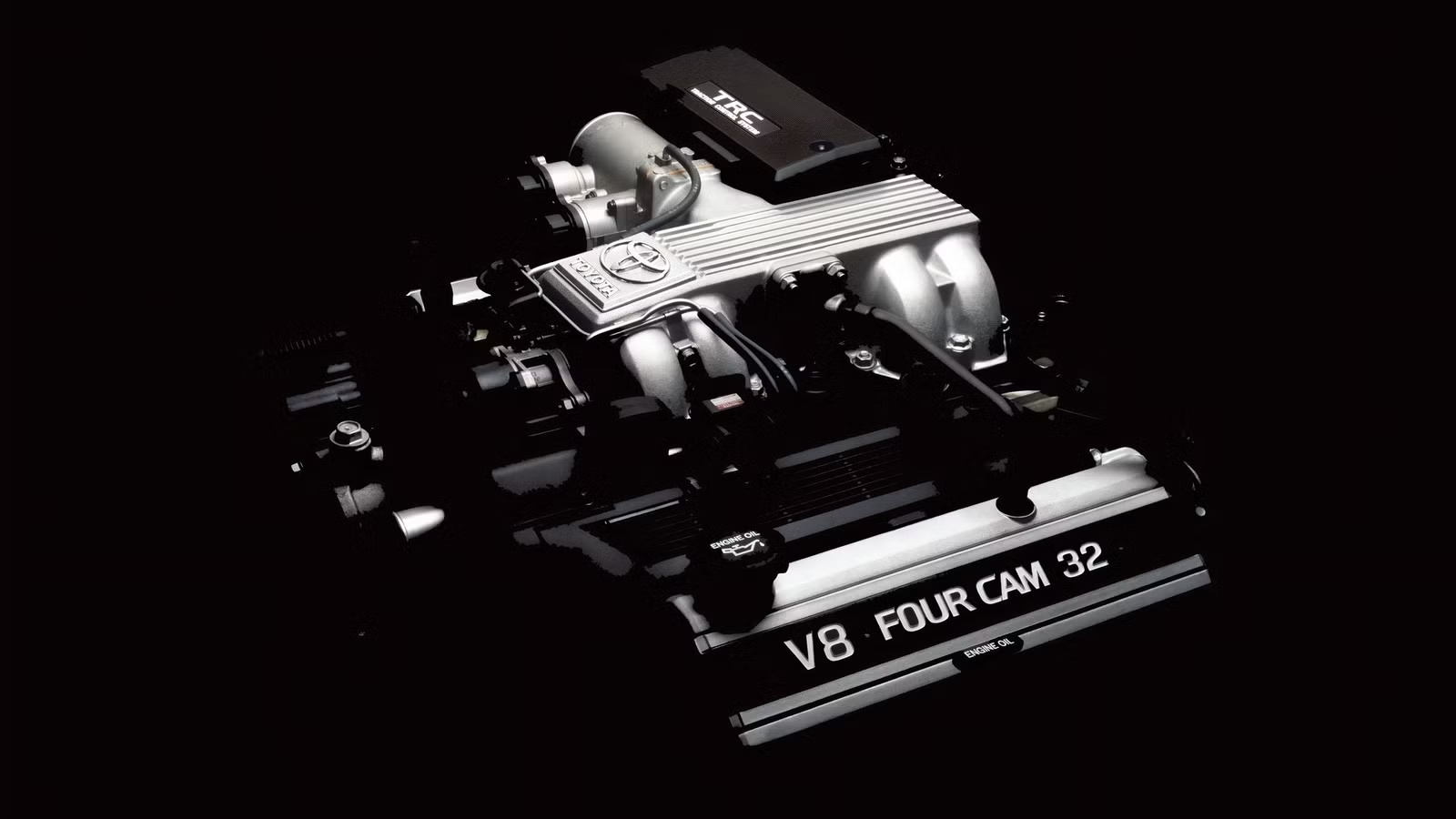
The Lexus LS 400 deserves every ounce of praise it’s ever received, and then some. It powered the car that launched the Lexus brand, and Toyota left no stone unturned during its development. At its heart was a naturally aspirated 4.0-liter V8 that boasted everything from all-aluminum construction to dual overhead camshafts, four valves per cylinder, and a forged-steel crankshaft.
More than a billion dollars went into developing this car, and it really showed. The 1UZ-FE, this V8’s internal designation, even received FAA certification, meaning it was certified for use in aviation, thanks to its impressively balanced, over-engineered design.
Sources: Respective automakers, Wards Auto.
