

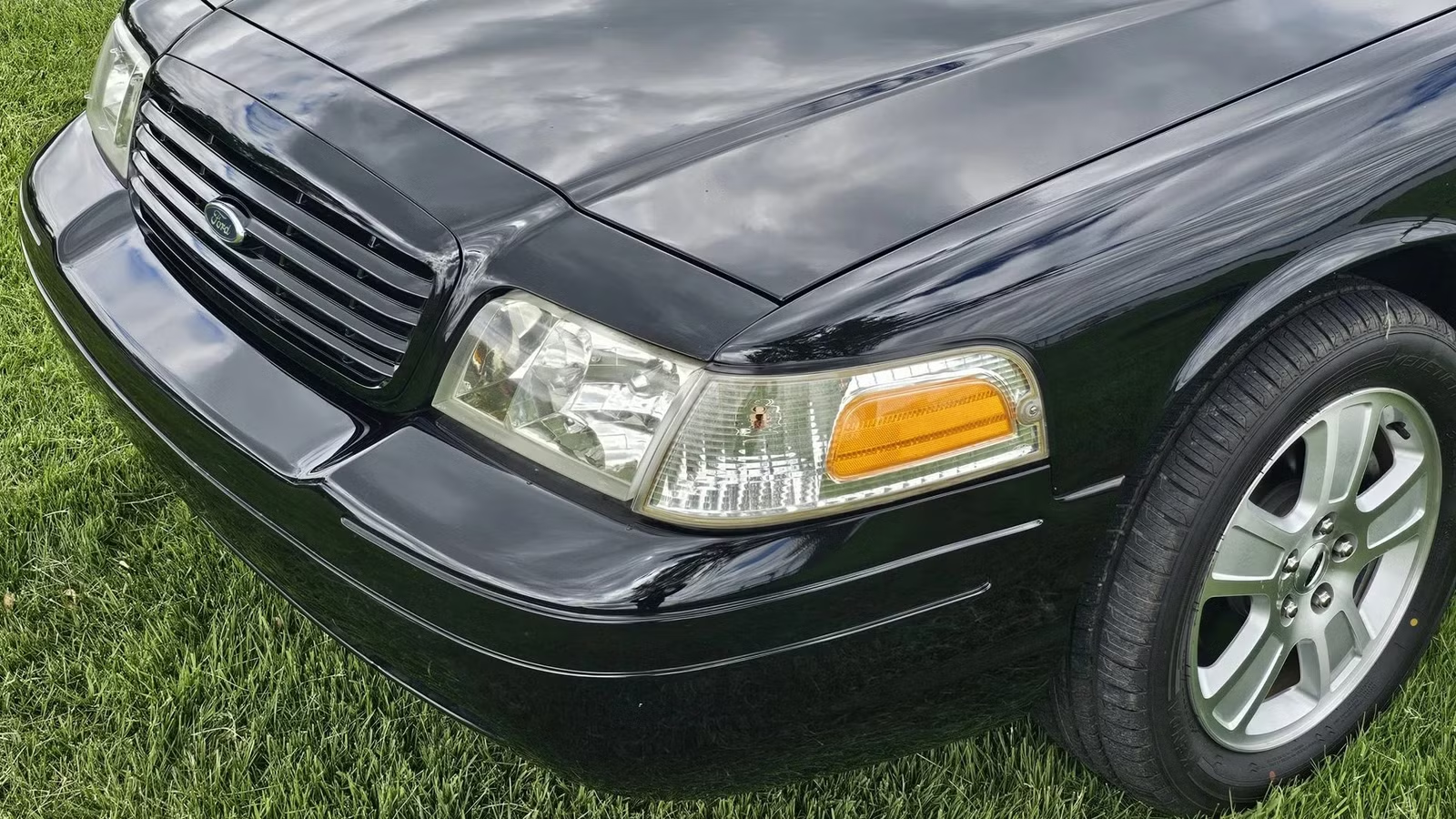
The Ford Crown Victoria may be the most iconic cop car ever produced. In fact, it’s so iconic that some younger folks might assume that the Blue Oval never sold them to civilians in the first place, at least not outside of fleet sales. When you see a civilian model, you might assume it’s a decommissioned cruiser or former taxi, but Ford actually sold these big sedans to the public for years. It wasn’t until 2008 that the car became fleet-exclusive.
Not only was the car for sale to the public, but the cop car was also essentially sold to regular folks, too, under the Sport LX trim. Here’s how that played out.
The 2003 Crown Vic Was Already Police-Oriented
2006 Ford Crown Victoria LX SportBring a Trailer
The second-generation Ford Crown Victoria ran from the 1998 to 2012 model years. But 2003 marked the introduction of the revised third-gen Panther platform, a chassis overhaul that made the later Crown Vics into even more capable police cruisers.
The updated Ford Panther Platform aimed to improve handling with a number of improvements to the frame and suspension. Designed by Ford Chassis Engineer Trever Skilnick, the third-gen platform used a hydroformed steel frame, rack-and-pinion steering, and overhauled suspension in the front and rear, with monotube shocks.
Ford and its sibling brands built mid-2000s era, Lincoln Town Cars, Mercury Marauders, and the Grand Marquis on the platform. The Crown Vic was easily the most iconic of the bunch, though, thanks in no small part to Ford pursuing the fleet market.
Low Repair Costs And Spacious Seating Made Panther Cars Ideal For Fleet Use
2006 Ford Crown Victoria LX SportBring a Trailer
The Crown Vic’s use in fleet applications, whether it be transportation or law enforcement, comes down to a number of key factors.
- Durability. The Crown Vic could withstand hundreds of thousands of miles of stop-and-go traffic, as well as the frequent idling and daily use demanded by fleet use, including police cruisers and taxis.
- Cheap repairs. The 4.6-liter V8 that powered the Crown Vic was familiar to most American mechanics, and common enough that you weren’t going to be waiting weeks for replacement parts to arrive.
- Spacious interior. Depending on model year and trim, the Crown Vic’s interior volume measured up to 132 cubic feet. That was plenty of space for passengers and luggage, or police equipment and perps. It was a comfortable car whether you were staking out a counterfeit money operation or seeing the sites in New York City, with generous bench seats and a 20.6-cubic-foot trunk.
- Quick takeoffs. The police interceptor version could hit 60 mph in seven to eight seconds, and the unrestricted top speed could reach 140 mph. There are quicker cars out there, but for a hefty V8, the Crown Vic was no slouch in a high-stress scenario. That’s just as true whether we’re talking car chases or snagging a good spot in front of the airport before the competition claims it.
- Ford specifically pursued the fleet market. The simple fact that Ford built the Crown Vic specifically for the fleet market went a long way.
Ultimately, the Crown Victoria succeeded with fleet buyers because the car wasn’t simply reconfigured to meet the needs of law enforcement officers and cab drivers; it was built from the ground up for fleet use. This mutually beneficial arrangement kept Ford’s St. Thomas plant humming and fleet drivers happy behind the wheel.
The Civilian Crown Vic Is Rarer Than The Cop Car
2006 Ford Crown Victoria LX SportBring a Trailer
There are no records to tell us exactly how many civilian Crown Vics that Ford sold in total versus fleet sales. But we know Ford averaged around 60,000 Crown Vic sales a year in the mid-2000s, while the brand sold around 14,700 LX Sport models in total. The LX Sport was the performance variant of the civilian model.
The LX Sport was essentially the civilian version of the cop car, minus the sirens and black-and-white paint job. To run down the features that it boasted over a standard civilian model.
- Stiffer suspension: Firmer springs and dampers, plus a stiffer rear stabilizer, gave the LX Sport better driver control.
- The LX Sport featured a 3.27:1 rear axle, compared to a 2.73 ratio in a standard model. This made for stronger acceleration.
- The LX Sport featured a dual-exhaust system, bumping the engine output up to 239 horsepower.
- Interior upgrades included leather bucket seats and a floor-mounted shifter.
- The LX Sport featured more body-colored exterior components and less chrome than a standard Crown Vic.
The LX Sport was a match for the Police Interceptor, but you could definitely feel the car’s limitations when you pushed it to the limit. The model offered more power than most drivers would ever need in a full-size sedan, but reviewers noted its emergency-maneuvering performance was modest.
If you wanted something that could potentially outrun the police cruiser, you were after the Mercury Marauder.
The Mercury Marauder Was The Ultimate Panther Car
2003 Mercury Marauder Brochure Image front 3/4Ford
If the LX Sport is a forgotten trim, then the Mercury Marauder is its more famous brother. Mercury only sold around 11,052 units in 2003 and 2004, finding the market for a Chevy Impala SS-inspired luxury muscle car to be fairly limited. However, they’ve gained a cult following in the years since. This is the car you want if you’re running an illegal moonshine operation in the hills or otherwise trying to outpace Johnny Law.
2003 Mercury Marauder Performance Specs
Engine
4.6-Liter NA 8-Cylinder
Power
302 hp
Transmission
4-Speed Automatic
Drivetrain
Rear-Wheel Drive
0-60
7.5 Seconds
The Mercury Marauder managed to squeeze an extra 63 horses out of the 4.6-liter V8 by way of an aluminum block and 32 valves, whereas the LX Sport’s engine was a 16-valve cast-iron block powerplant. More valves mean more airflow, which means higher output, and the aluminum block helps to keep the weight down. It’s sort of like having an extra set of nostrils, only not as funny-looking.
Other differences from the Crown Vic include the Marauder’s blacked-out grille and darkened headlight and taillight housings, a specialized instrument cluster, and rear electronically-controlled self-leveling air suspension.
That last feature is really cool, but also problematic, with the air suspension proving a common failure point for the Marauder. If you’re shopping for a used Marauder, be prepared to replace the rear suspension with some aftermarket parts.
The Marauder And The LX Sport Are Both Hard To Find
2006 Ford Crown Victoria LX SportBring a Trailer
The Marauder and the LX Sport are both uncommon cars, but not astronomically expensive if you can find one in good condition. Checking in with the used market, we were able to turn up the following Marauders.
- A 68,919-mile Marauder is selling for $24,995 in Michigan.
- An 88,060-mile Marauder is selling for $26,700 in Florida.
- An 8,244-mile Marauder is selling for $44,900 in Michigan.
- A 15,000-mile Marauder is listed for just $15,000 in Texas.
- A 95,237-mile Marauder is selling for $22,995 in Texas.
These listings might not be available by the time you’re ready to buy, or they might not be within driving distance for you, but they should illustrate that the Marauder is affordable, if you can find one. It’s an uncommon car, but it’s also obscure, meaning there are even fewer buyers than sellers.
As for the LX Sport, the only active listings we can find are for a 190,819-mile 2006 model selling for $4,995 in California, and a 178,712-mile 2006 model selling for $5,450 in Missouri. We turned up a couple of recent auctions, as well, with one selling for $9,700 last year, and another for $13,500.
If you can find an LX Sport at a fair price, great, but don’t hold your breath. The Marauder seems to be the easier find. LX Sport drivers seem to be sitting on their cars and refusing to sell.
Sources: Ford, Mercury, Lincoln.
