

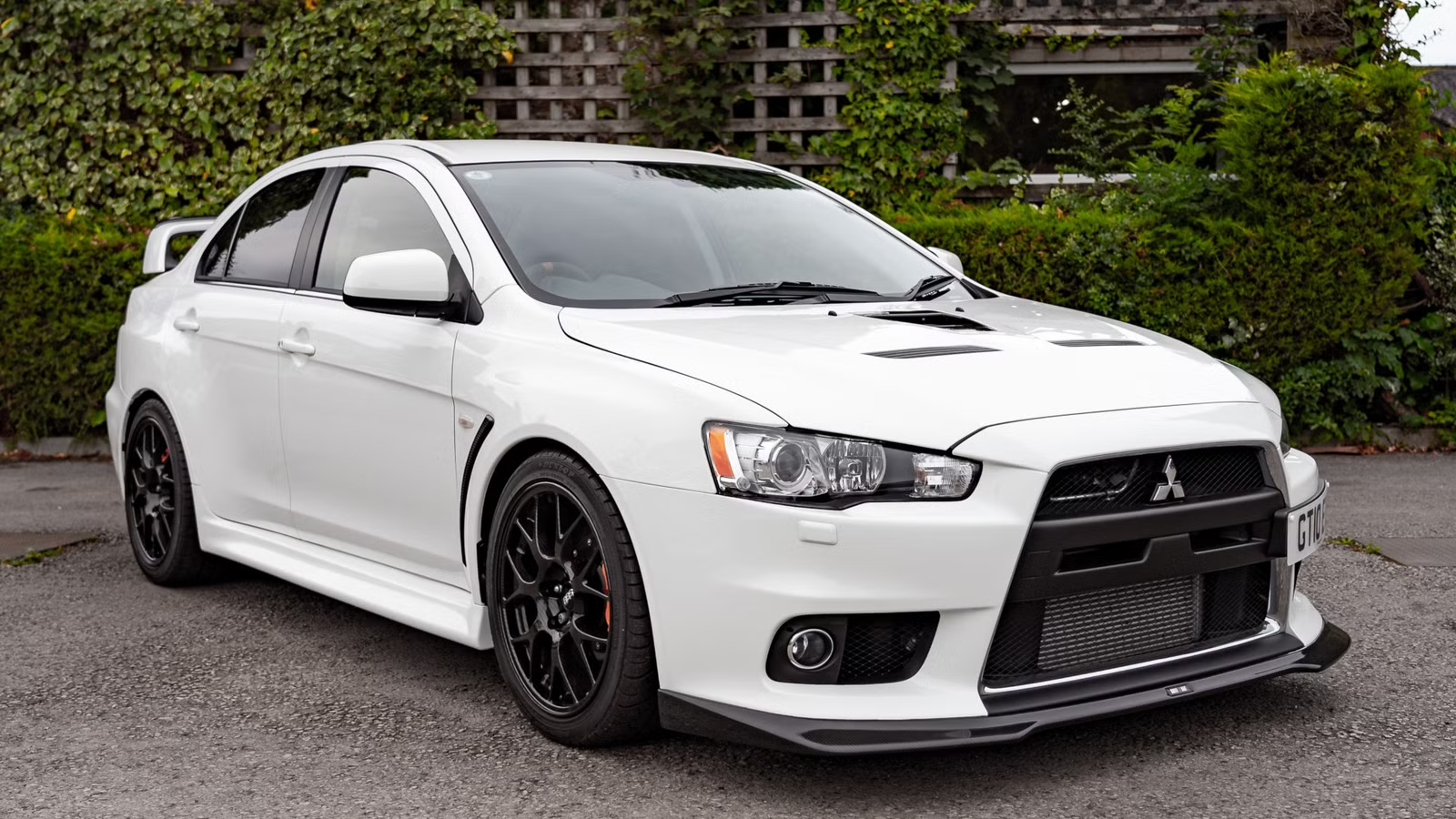
The Mitsubishi Lancer Evolution, the Subaru WRX STI, and the Audi Sport Quattro are often treated as the starting points of their manufacturers’ performance legacies. In reality, each was the product of years of experimentation, competition, and engineering carried out by less celebrated machines.
During the golden age of homologation specials, manufacturers had to build road-going versions of increasingly specialized cars simply to qualify their machinery for competition. While some of these efforts became household names, others quietly disappeared from the spotlight, despite laying much of the technological and motorsport groundwork that made the legends possible.
The Rally Legends Were Not Born As Legends
Cars such as the iconic Evo, WRX STI and Sport Quattro did not emerge fully formed as performance icons. Manufacturers laid their foundations by using relatively conventional road cars as test beds for technology that needed to survive the demands of competition. Homologation rules made this approach possible, requiring manufacturers to produce road-legal versions of cars closely related to their racing machinery.
That transformed otherwise unremarkable sedans into rolling laboratories, allowing engineers to develop turbocharged engines, sophisticated all-wheel-drive systems, stronger drivetrains, and other competition-focused hardware in real-world conditions.
The racing program effectively became an extension of the engineering department, exposing weaknesses and accelerating improvements that could later be transferred to more specialized models. By the time the famous nameplates arrived, much of the hard work had already been done.
Mitsubishi’s Forgotten Sedan Was The Blueprint For Every Evo
The Galant VR-4 helped establish the mechanical recipe Mitsubishi would carry into the Lancer Evolution. Its turbocharged 2.0-liter 4G63 engine paired with full-time all-wheel drive, a viscous-coupling center differential, and four-wheel steering, giving the midsize sedan an unusually sophisticated drivetrain for its era. Called Active Four, it combined these systems with four-wheel independent suspension and the ABS braking system. According to Mitsubishi, the VR-4 was the first time the company integrated all this tech into one vehicle.
Mitsubishi then used the Galant as its platform to compete in rallies from 1989 through 1992, refining the car throughout its competition career before the Lancer Evolution took over in 1993. The Galant claimed six WRC victories, including wins in Finland, Britain, Ivory Coast, and Sweden. Around 20,000 road-going examples were produced, however, making this accomplished family sedan considerably less exotic than the multiple iterations of the Evolution that inherited its technology.
Subaru’s First Rally Sedan Beat The Impreza To The Biggest Prize
Before the Impreza became synonymous with Subaru’s rally success, the Legacy RS was carrying the company’s colors in competition. It used a turbocharged 2.0-liter flat-four engine and was engineered to withstand the demands of the World Rally Championship while Subaru refined the competition package.
The model’s breakthrough came at the 1993 Rally New Zealand, where Colin McRae drove the Legacy RS to victory and secured his first WRC win. The result mattered beyond McRae’s personal milestone: the Legacy had already shown that Subaru’s turbocharged boxer engine and all-wheel-drive approach could succeed at the highest level. When the Impreza subsequently took over, it refined and repackaged an established formula rather than creating Subaru’s rally identity from scratch.
The Legacy RS was also Prodrive’s first Subaru project. When Subaru moved its international motorsport operation to England in 1989, it tapped Prodrive to turn the new Legacy into a competitive Group A rally car. Over the decades, the company has become synonymous with Subaru.
The Military Volkswagen That Inspired Audi’s Rally Revolution
The Audi Sport Quattro’s key predecessor was not an Audi race car at all, but the Volkswagen Iltis, a military all-terrain vehicle Audi developed for Volkswagen. During winter testing in Sweden in 1976/77, Audi engineers took an Iltis along as a comparison vehicle. Despite producing just 75 hp, the four-wheel-drive Iltis easily outperformed much more powerful Audi prototypes fitted with front-wheel drive on snow and ice. The result convinced Audi’s engineers that four-wheel drive could have enormous potential in a high-performance passenger car.
The challenge was developing a system suitable for a road car without the weight and complexity normally associated with four-wheel drive. Audi’s solution was an ingenious hollow secondary shaft inside the transmission, allowing power to be distributed simultaneously to the front and rear axles without requiring a heavy transfer case or second propshaft. This lightweight, compact arrangement became the foundation of the production Quattro, which debuted at the 1980 Geneva Motor Show with a turbocharged five-cylinder engine producing 197 hp.
The Quattro soon became Audi’s rally weapon, while the shorter, more powerful Sport Quattro followed in 1984, laying the groundwork for Audi’s Group B evolution.
The Sierra Cosworth Proved Turbocharged Performance Was Not Just For Rallying
The Ford Sierra RS Cosworth followed a different route to homologation, but its recipe was just as focused. Developed for Group A touring car competition, it combined a turbocharged 2.0-liter Cosworth YB four-cylinder engine with rear-wheel drive and an unmistakable aerodynamic package dominated by its huge rear spoiler and new front air dam. The rear wing reportedly provided up to 45 pounds of downforce at high speeds, while the body received 92 detail changes compared with the standard Sierra.
Ford produced 5,545 examples of the road car, comfortably exceeding the 5,000 required for homologation, before sending 500 to the company Tickford in the United Kingdom for conversion into the more powerful RS500. The latter became particularly formidable in touring car racing, while Sierra Cosworths proved competitive across Europe, Australia and Japan. Rather than simply creating a fast road car, Ford used the Sierra to turn forced induction and serious aerodynamic development into weapons capable of dominating touring car grids around the world.
One Forgotten Mercury Shows Homologation Was Bigger Than Rallying
The homologation game was not confined to European rally stages. During America’s NASCAR Aero Wars, Mercury created the Cyclone Spoiler II specifically to improve its competitiveness on the high-speed super speedways where aerodynamic drag could make the difference.
Its most obvious feature was an extended, tapered nose designed to smooth airflow and reduce resistance at racing speeds. Interestingly, the Spoiler II had its rocker panels “re-rolled,” which created a deeper lower lip. This allowed racing teams to trim the lip, letting the car sit about one inch lower while still meeting NASCAR’s ride-height rules. NASCAR required manufacturers to build at least 500 examples for homologation, making production numbers a crucial part of the program.
Mercury officially claimed that 519 Cyclone Spoiler IIs were produced, but that figure remains disputed. Some historians and registry research suggest only around 351 cars actually received the extended nose, with standard bodyshells allegedly used to satisfy NASCAR inspectors. Either way, its scarcity makes it one of the most intriguing homologation specials ever built.
The Cars That Deserve To Be Remembered Before The Icons
The Evo, WRX STI, and Sport Quattro ultimately became the names enthusiasts remember, but their stories didn’t begin with those badges. Each benefited from earlier machines that manufacturers were prepared to race, develop, and refine under the unforgiving demands of competition.
Keep in mind, the Galant VR-4 won six WRC rounds, the Legacy RS delivered Colin McRae’s important victory, while the Audi 200 Quattro conquered Trans Am. Their competition records prove these were not merely stepping stones to something better, but accomplished racers in their own right.
These less glamorous cars provided valuable lessons in engines, drivetrains, aerodynamics and durability, helping turn ambitious engineering ideas into proven performance technology. That makes their relative obscurity somewhat unfair. They were never intended to become expensive collector pieces or bedroom wall posters. Their purpose was considerably more practical. They were meant to satisfy the rules, make the machinery work, and win races. The famous cars came later, carrying the reputation their forgotten predecessors had helped build. Perhaps that is precisely why these unsung machines deserve another look today.
Sources: Motorsport Magazine, Mitsubishi, Audi, Subaru, Volkswagen, Ford
