

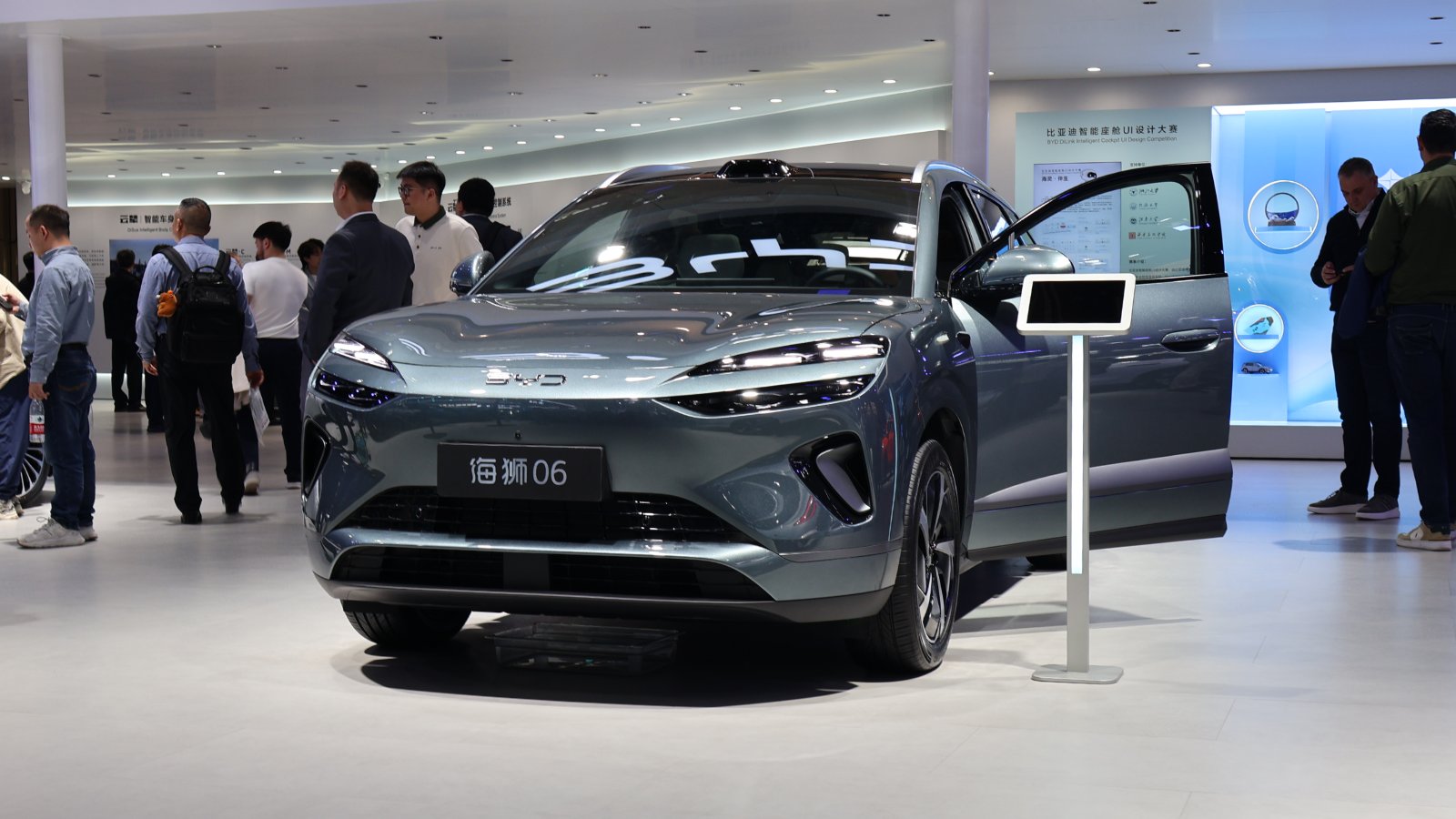
A BYD Sealion 06 SUV on display at the Beijing Auto Show in April 2026. Credit: CnEVPost.
- Chinese automakers could capture 11% of annual US new car sales by 2038 if allowed into the market, according to Mobility Global.
- There is a “low-to-moderate probability” that barriers to those North American-built vehicles will be lifted over the next 10 years.
Chinese automakers could capture more than 10% of the US new car market by 2038 if the country eases market access restrictions.
Bloomberg reported the forecast on Thursday, citing estimates from market research firm Mobility Global.
Under 1 of the scenarios examined by the firm, Chinese automakers could sell 1.7 million vehicles a year in the US by then, accounting for about 11% of the world’s second-largest new car market.
Peter Nagle, Mobility Global’s associate director of US vehicle forecasting, presented the estimates to reporters in Detroit on September 23, Bloomberg noted. The firm spun off from S&P Global in July.
The scenario assumes the US eventually allows vehicles built in North America by Chinese automakers into its market, while high tariffs continue to make direct imports from China effectively unviable.
Nagle said there was a “low-to-moderate probability” that barriers to those North American-built vehicles would be lifted over the next 10 years, making policy changes critical to whether the forecast materializes.
Affordability is a key factor underpinning the estimates. New compact and mid-size crossovers sold by Chinese automakers in other countries cost about the same as the average used car in the US, Nagle said.
He said those prices could appeal to American consumers and generate additional demand in a US new car market where overall sales have remained largely flat in recent years.
Under the scenario of eased restrictions, Chinese automakers including BYD (HKEX: 1211), Geely Auto (HKEX: 0175) and SAIC Motor (SSE: 600104) could begin exporting vehicles to the US from factories in Mexico as early as 2029, Nagle estimated.
The companies could shift to production at new US factories in the 2030s once annual US sales of popular models exceed about 40,000 vehicles each. That is a potential entry path modeled by the firm, rather than investment plans announced by the automakers.
Chinese automakers’ entry could generate about 600,000 additional new car sales a year in the US while taking roughly 1 million annual sales from existing competitors, Nagle estimated.
Other Asian brands, including Nissan, Hyundai and Toyota, would likely bear most of the market share losses, he said, as Chinese automakers’ expansion both enlarges the market and intensifies competition.
The forecast comes as China and the US engage in a new round of high-level talks.
Chinese president Xi Jinping arrived in Washington on the afternoon of September 23 local time for a state visit at the invitation of US president Donald Trump, according to Xinhua News Agency.
Trump said in a September 11 interview with Fox News that he would be open to Chinese automakers building factories in the US, provided they hired American workers. He opposed Chinese automakers producing vehicles in Mexico for export to the US.
The US auto industry, however, continues to push to retain market access restrictions. On September 17, 6 major industry groups jointly wrote to Trump, urging him to keep Chinese automakers out of the US market, including through local production.
Some US lawmakers have also called for maintaining restrictions, opposing entry through either direct imports or local manufacturing. Trump’s comments on US factories do not yet amount to an easing of market access rules.
In China, US automakers are among the major players; in August, their passenger vehicle retail sales in China totaled 86,071 units, accounting for a 5.58% market share, according to data from the China Passenger Car Association (CPCA).
China passenger car retail sales by brand origin
CPCA September 2026 report · Total: 1,541,478 vehicles
China passenger car retail sales by brand origin — CPCA September 2026 report
Brand originRetail sales (vehicles)Market share
Chinese1,077,53369.90%
German192,48712.49%
Japanese168,12510.91%
American86,0715.58%
Korean9,3580.61%
Other European5,9390.39%
French1,9650.13%
Total1,541,478100.00%
Nio said the list is not a sanctions list and will not impact its business or securities trading.
