

UPDATE: 2026/09/13 08:30 EST BY ROGER BIERMANN
Continued Investment In Hybrid Technologies
This article has been updated with new infortmation and additional context surrounding Stellantis’s current and future hybrid vehicle prospects.
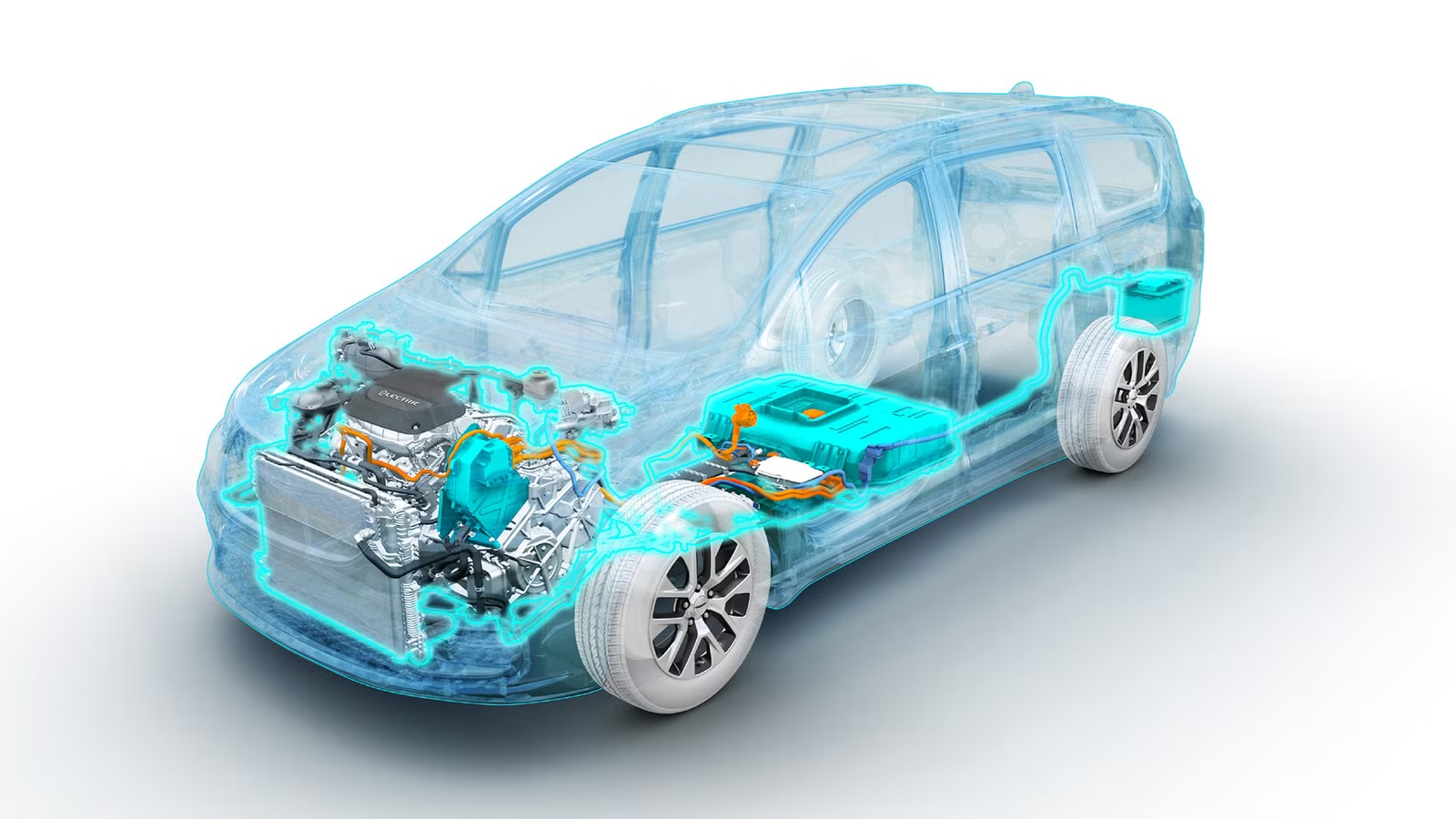
Who’s ready for a little algorithmic science? The CarBuzz investigative team sure is, especially after finding this interesting patent from FCA-US LLC – better known as the North American division of Stellantis – describing a better hybrid powertrain. The conglomerate isn’t quite as hybrid-savvy as other companies, but from what we just read, it sounds like they’re getting serious about building the smoothest-running hybrid ever.
That’s a tall order when you consider just how good competitors like Toyota are when it comes to hybrids. But Stellantis is playing the numbers game to find every possible advantage. And this time, we mean that literally.
Making Engines And Electric Motors Work Together In Harmony
2025 Jeep Grand Cherokee 4xe TaildlightStellantis/Jeep
Hybrid powertrains have been around for decades at this point, but there’s one thing that hasn’t changed very much. Unless you’re talking about a mild hybrid where the combustion engine is always running, syncing up the engine and electric motor (or motors) usually isn’t a seamless operation. It’s not like vehicles shake themselves apart when the various engines and motors go on and off, but there’s often some perceptible sign beyond sound that something is happening.
The problem isn’t so much a lack of harmony between engines and electric motors. Modern hybrid powertrains are very good at reacting to what the driver needs, but therein is the actual problem: reacting. The driver does a thing, sensors detect it, signals are sent, the system reacts. Those signals travel at close to the speed of light, but it’s still a reaction, and that takes some time.
According to the patent, “the presence of time delays, arising from task scheduling and communication latency between control units, can significantly hinder the effectiveness of advanced control algorithms. Closed loop performance is often limited by the equivalent time delay between the control action command, its effect on the system, and the measurement of the reaction. Frequently, commands and measurements originate from different sources, requiring precise coordination to accurately estimate the driveline response.”
In short, delays cause problems. FCA wants to fix that.
How Will FCA Deal With Time Delays?
FCA Hybrid Controller PatentUS Patent & Trademark Office
Engineers want to predict what is needed, thus dialing that delay time down to zero. In theory, anyway. This will happen via a new control unit that “integrates Kalman filtering with horizon prediction techniques to effectively address time delay compensation.” If your eyes glossed over just then, we don’t blame you. In short, Kalman filtering is a type of mathematical algorithm that predicts the operation of a system amid some measure of uncertainty. Horizon prediction helps define just how far out those predictions can go.
That’s the really, really basic description of this complex science. But you don’t have to be an engineer or mathematician to understand what the takeaway is here. FCA’s goal is to integrate a new controller using these advanced algorithms to help match electric motors to engine pulses. In doing so, there’s reduced shock to the vehicle’s driveline and, for driver and passenger, a more serene journey.
The patent further explains this system applies largely to standard hybrid and plug-in hybrid vehicles with “no clutch available to disconnect the engine from the rest of the powertrain…,” which means it’s aimed at hybrids running an eCVT. But it could also be used to some degree on hybrids with geared transmissions.
2021 Jeep Wrangler 4xeStellantis
Stellantis Becoming A Hybrid-Heavy Brand Before Models Even Arrive
Stellantis doesn’t currently have a whole ton of hybrids at US dealers, and those it did have in the form of 4xe models faced a littany of issues, including fiery ones, that eventually led to 4xe models being discontinued entirely. EREVs (extended range EVs), in which the combustion engine never drives the wheels directly and solely acts as a generator, are the next big thing for many of the brand’s models. But hybrids are clearly not off the table, and it’s not just this one patent that proves it.
A recent announcement from SRT debuted performance-enhancing hybrid technology in the form of an electric turbo that could spool up with minimal lag, and in August, another patent for a new control system emerged. The automaker even filed a patent for supercapacitor use in modern performance hybrids, which could bring Lamborghini-derived technology to the mainstream. It’s safe to say we expect hybrids to play a big par in Stellantis’ future product lineup.
CarBuzz Insight – Why This Matters:
We’d venture to say most drivers don’t really notice any clunks, clanks, bangs, pops, or any detrimental noises driving a modern hybrid. But they do exist – are drivers just used to it? In any case, this patent shows just how competitive the automotive landscape has become. Sensors and equipment operating at nearly the speed of light now isn’t good enough. It takes predictive algorithms to move engineers to the next level. That just sounds… insane.
But many of the patents we find are insane, which is why most don’t make it beyond the idea phase. But, incorporating something like this wouldn’t be that difficult – if the numbers actually work as intended.
There are virtually no hybrids left among the FCA brands. At a time when traditional hybrid demand is growing, tech like this could be a major advantage to bringing new buyers into dealers.
Patent filings do not guarantee the use of such technology in future vehicles and are often used exclusively as a means of protecting intellectual property. Such a filing cannot be construed as confirmation of production intent.
Source: US Patent & Trademark Office
