

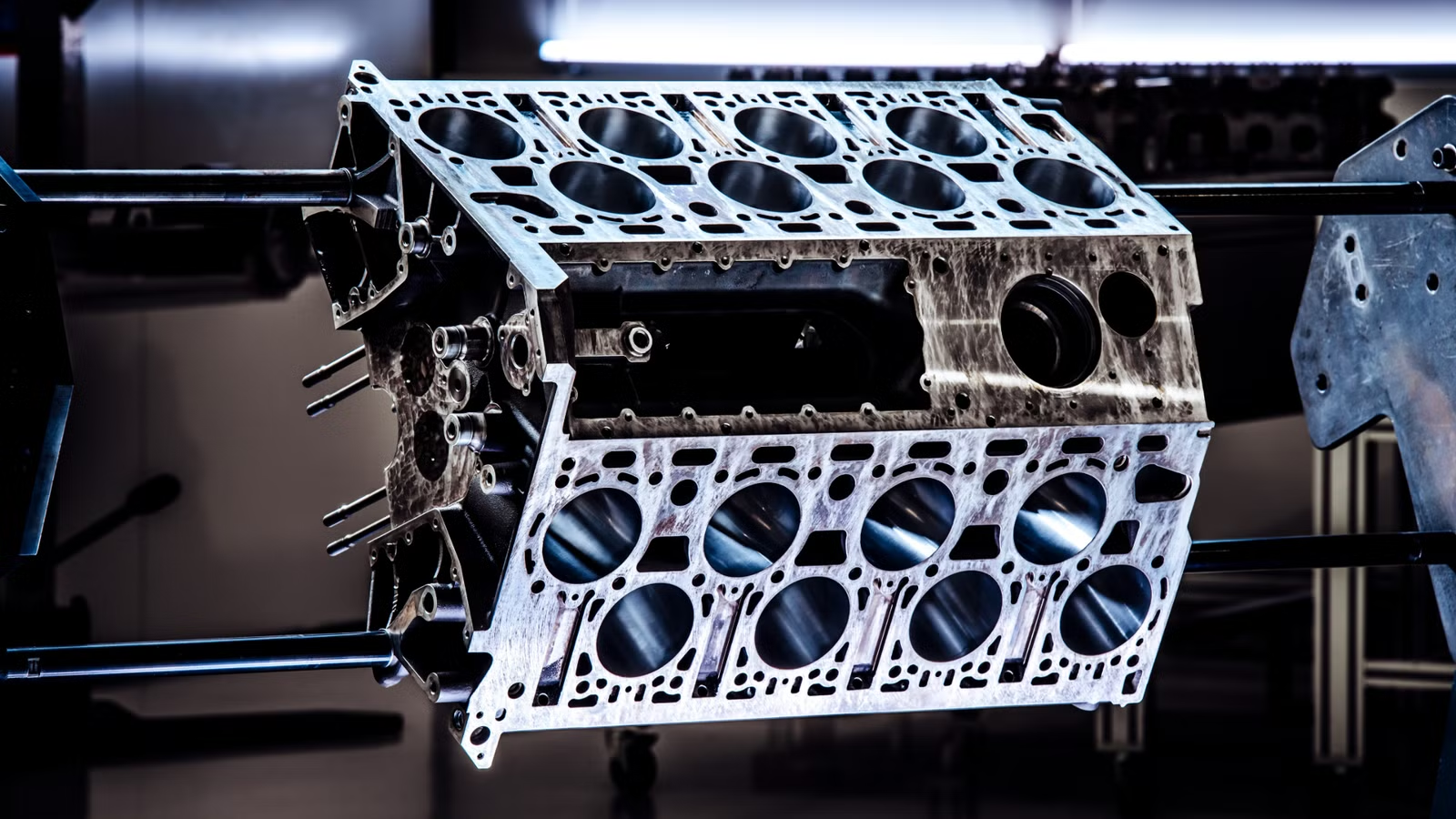
A piston goes up, an explosion happens, and the piston goes down. That’s it, right? Not always. We’ve gotten used to engines being pretty standard nowadays – inline or V-configuration engines, downsized or hybridized, to make as much power as they can while staying within regulations. Whether it’s new technology or just trying to be different, some automakers have done things differently.
These are our ten favorite engines that do things a little…strangely.
Ferrari’s Tiny V8
Built To Dodge Taxes
Every time an automaker makes an automobile, it has to stick to strict regulations. This rule even applies to luxury brands such as Ferrari. For example, after the 1973 oil crisis, Italy instituted a 38% value-added tax on cars with engines over 2.0 liters of displacement. Even then, Ferraris were expensive, but the company wanted to offer a version for Italian customers who didn’t want to pay such a high tax. The company took the 2.9-liter V8 from the 308 GT4 and downsized it to 2.0 liters (1,991 cc) to create the Dino 208 GT4.
The 90-degree V8’s small 2.0-liter size meant that while it could not produce much power – only 170 horsepower – the unit could rev smoothly, with full power available at 7,700 rpm through a five-speed transaxle. The top speed was decently quick at 137 mph, and the 0- 60 mph time was 7.7 seconds. With only 840 units of the 208 ever produced, it was a rare and unique Ferrari from a tricky time for Italian luxury manufacturers.
Tatra’s Air-Cooled V8
A Rear-Engined Luxury Car?
Close
The Tatra T603 is backward. While the engine is at the rear and there’s a swooping roofline, you wouldn’t mistake it for a Porsche 911 thanks to the strange 2.5-liter air-cooled V8 back there. We’re used to air-cooled engines being at most six cylinders in old 911s, making this V8 particularly weird.
Launched in 1956, the T603 had overhead cams, around 100 horsepower, and a top speed of 110 miles per hour. By the standards of other vehicles available in Czechoslovakia at the time, the Tatra could hold its own, especially when there was little to go wrong in such a rudimentary engine. The exterior’s odd shape also made it very aerodynamic, a staple of the brand’s old passenger cars. While reliability is important, the form factor simply didn’t work for public sale, which meant that, apart from USSR leaders at the time, no one got to experience this oddity of an engine.
Chrysler’s Turbine-Powered Car
The Jet Age In Full Force
By the end of the 1950s, jet-powered travel was becoming more popular, and American automakers were adding plane-inspired designs to their cars’ exteriors. Chrysler took this one step further and decided to power a vehicle using this new technology, unveiling a turbine-powered car in 1963. The idea was simple: a traditional internal combustion engine had 300 moving parts, while a turbine had only 60 and could run on anything from peanut oil to alcohol.
It generated around 130 horsepower and 425 lb-ft straight from its 22,000 rpm idle speed. Chrysler gave 45 of these cars out to the public to try. After 1.1 million combined testing miles, this new powerplant proved reliable if a little thirsty on fuel. The incoming Clean Air Act eventually killed this cool idea, which the jet engine simply couldn’t comply with. Only nine examples of this car now exist.
Mazda’s Wankel Rotary Engine Family
The Spinning Dorito
When German engineer Felix Wankel showed off his new rotary engine, only his own country’s NSU carmaker first saw the concept’s automotive potential. On the other side of the world, Mazda also saw the possibilities and incorporated the technology into the Cosmo coupe, which debuted in 1964. A displacement of only 0.9L produced an impressive 110 horsepower.
This tiny sports car kicked off Mazda’s obsession with this engine type. NSU, which made the first Wankel-powered car and even won Car of the Year in 1968 with one, fell away, leaving cars like the RX-7 and RX-8 as the biggest modern examples of rotary-powered machines. The engine relies on a spinning triangle, but its high oil usage and unreliability make the design a rare sight on today’s roads.
Cizeta Moroder’s Transverse Turbocharged V16
A Troubled Car With A Huge Engine
The Cizeta-Moroder story is incredible, so we can’t try to fit it all here, but the V16T placed sideways in the middle of this supercar is something to behold. Many of the philosophies for this car were reminiscent of Lamborghini, as Cizeta Automobili was made up of a team of ex-engineers from that company. In fact, the engine is simply two Lamborghini Urraco V8s with separate crankshafts, routing power through a gear set between them.
Only 11 of these cars were produced as the company died away with financial trouble and internal fighting. Still, this odd arrangement produced a 540-horsepower car with a top speed of 204 miles per hour and a 0-60 mph time of under four seconds. Bugatti is about to release its own V16 engine, but mounting it longitudinally makes packaging much easier. That’ll also be a ‘true’ V16 with all cylinders mounted to one crankshaft.
Bugatti’s W16 Engines
Volkswagen Went A Bit Mad In The 2000s
Under boss Ferdinand Piëch, the Volkswagen Group was a very different company from the one we know today, because each brand had more freedom to experiment with its products. The Bugatti W16 has become nearly as famous as the cars that it powered.
Piëch sketched his idea for the engine on anenvelope while riding a train in Japan. His first concept had 18 cylinders, but the production powerplant is still mighty impressive with 16.
The W16 engine layout was no bigger than a V12 despite having more cylinders, and it produced 1,000 horsepower. The later, track-only Bolide pushed the figure to 1,825 hp. The quad-turbocharged engine was an icon of power at the time.
Nissan’s Variable Compression Engine
The Best Of All Worlds
Compression ratio is one of the first things engine makers have to decide. A higher compression ratio means more efficient combustion of the fuel and air, leading to more power and torque. The problem with a high compression ratio is that the fuel is more susceptible to pre-ignition, where the explosion happens before the piston reaches the ideal position at the top of the engine. So what if a powerplant could change its compression ratio on the fly?
This is what Nissan VC engines do. Reliability aside, these powerplants are impressive because, at low RPM, they can increase the compression ratio when there’s less chance of engine knock, but lower it as engine speed increases to reduce the risk of pre-ignition. There have been complaints about how complex this engine can be to fix, but it does help squeeze more power out of small displacements.
Fiat’s TwinAir Engine
A Two-Cylinder For Modern Times
These days, a two-cylinder engine is usually reserved for motorcycles, but Fiat’s TwinAir is a modern engineering masterpiece. Traffic speed has increased dramatically over the decades, so many smaller engines (especially small-displacement units in Europe) can strain at highway speeds. With 85 hp, 107 lb-ft of torque, and little weight to move, this tiny motor can keep up.
Fiat’s patented MultiAir technology was at the heart of its success. The electro-hydraulic variable valve timing didn’t use a traditional throttle; instead, it relied on oil-filled solenoids that could open the intake valves independently. It increased efficiency through this and the lack of weight. The whole unit weighed around 190 pounds.
Oldsmobile’s Jetfire Turbo
The World’s First Turbocharged Car
Before getting to the engine, we have to mention the name. Jetfire. That’s a cool name for the first-ever turbocharged car, beating the Porsche 911 Turbo by a decade and arriving the same year as the turbocharged Corvair.
Oldsmobile wanted to increase the performance of its 3.5 V8 in the early 1960s, so it turned to Honeywell Aerospace (which is affiliated with the modern Garrett turbocharger manufacturer) to add forced induction to its car. The problem with this early turbocharged tech was engine knock from pre-ignition. This was due to the extremely high temperatures the turbo ran at. The two companies developed a water/methanol injection system that lowered operating temperatures, but they didn’t realize people would forget to fill the engine with the liquid, causing the turbo to overheat and the engine to fail.
Cadillac’s V8-6-4 Engine
Simply Too Ahead Of Its Time
Some innovations are so advanced that the available technology simply wasn’t ready. After the oil crisis, Cadillac introduced the V8-6-4 engine, which featured a novel idea: cylinder deactivation. We’re used to it now in some cars, but the idea is that when performance isn’t needed, the car can intelligently shut off some cylinders to improve fuel economy.
The problem was that the control module simply couldn’t keep up with what the driver wanted, causing shuddering. The 6.0L V8 was a good engine at the time, but when it was neutered through deactivation, it sounded brash and unpleasant while returning marginal efficiency gains. Some dealers even offered the car with a disabled V8-6-4 engine, meaning it ran simply as a 6.0L V8 all the time.
Sources: Cadillac, Volkswagen, Fiat, Nissan, Mazda, Ferrari
