

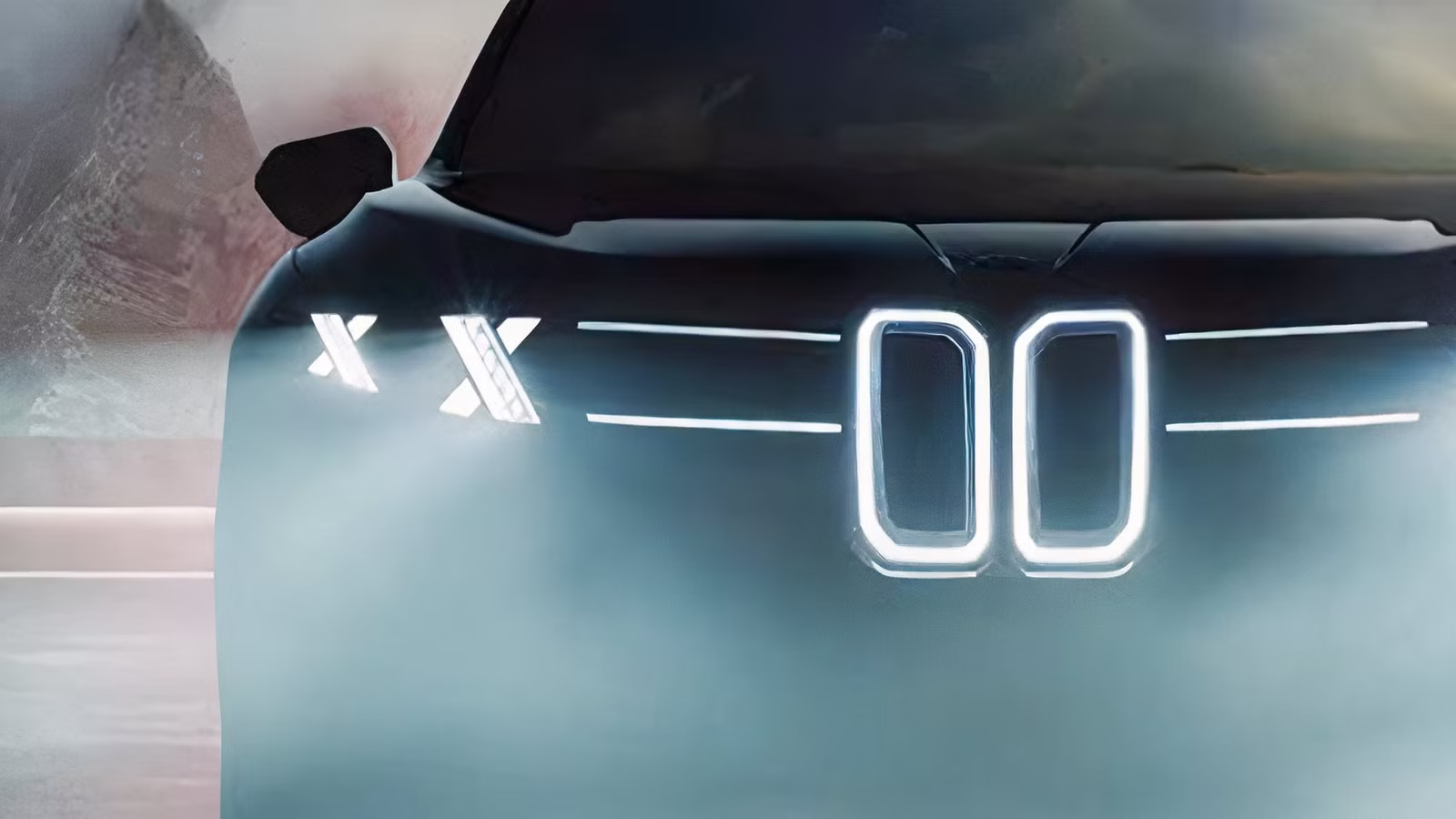
AAA recently ran a study finding that six in 10 drivers on US roads believe headlight glare is getting out of hand. The government apparently has bigger fish to fry than getting us home at night with our eyesight intact, but the consensus has it that we have a serious headlight glare problem.
You’re right to think that pickup trucks account for the worst of it, too. A study by an eyeglasses company found multiple pickups exceeding six times the Insurance Institute for Highway Safety (IIHS) glare limit. Here’s what you need to know.
The Nissan Titan Was Singled Out As One Of The Worst Offenders
LED Headlights (Infiniti)Justin Pritchard / Valnet
The original study finding the Nissan Titan to be problematic comes from eyewear company Overnight Glasses. They’ve got a vested interest in selling you anti-glare glasses, sure, but the data comes directly from the IIHS, which is a non-profit, so the study checks out as being totally above board.
The study found the 2017–2024 Nissan Titan to be one of the worst offenders, generating eye-searing headlight glare to the tune of 615.1% above what the IIHS considers to be the safe limit.
BMW actually beat the Titan’s score with a 677.8% glare rating in the 2017–2024 X5, but the Titan is considered to be more problematic because of its height. That is, the X5 is a mid-size luxury SUV with its headlights situated closer to the ground. The Nissan Titan’s headlights, being attached to a full-size pickup, sit closer to eye level, creating more glare.
The following are the top five worst vehicles for glare, ranked from worst to least.
- Nissan Titan
- Chevrolet Silverado 1500
- Ram 1500
- BMW X5
- GMC Sierra 1500
As you can see, it’s mostly full-size pickups, and a BMW. In other words, you were right all along: it’s those drivers in the lifted trucks and luxury cars who are driving around without a care in the world, blasting everyone else with their headlights.
The 57-Year-Old Safety Standard That Lets Automakers Ignore Headlight Glare
2025 Toyota Corolla Cross Hybrid Nightshade Red Front Angled View at Night in a Parking LotToyota
How is it legal for headlights to be six or seven times as powerful as the IIHS recommends? Well, for one thing, the IIHS is not a government body, it’s a non-profit. Everything the IIHS mandates or dictates or demands is really more of a suggestion. The IIHS publishes guidelines that encourage the automotive industry to self-regulate, but automakers are free to completely ignore those guidelines if they like.
If it doesn’t come from an actual government organization like the Environmental Protection Agency (EPA) or the National Highway Traffic Safety Administration (NHTSA), then it’s not enforceable by law, and it’s not a rule. It is that simple.
So, why are these headlights legal?
LED Headlights Are 10 Times As Powerful As Halogen Headlights
Chevrolet Silverado EV ZR2 off-road race truck concept with Silverado ZR2 and Colorado ZR2 in the desertChevrolet
The problem with legislating and regulating too-bright headlights ultimately comes down to the switchover from halogen to LED lights. The halogen headlights we grew up with typically produced around 1,000 lumens. Newer factory-installed LED headlights produce around 3,000 to 4,000 lumens, and aftermarket lights frequently produce as much as 10,000 lumens.To put that in perspective, 10,000 lumens is roughly equivalent to 17 standard 60-watt household bulbs pointed directly at your eyes.
You can blame this wild west of LED headlights on Federal Motor Vehicle Safety Standard No 108. The law was passed in 1968, and meaningful updates have been few and far between. FMVSS No 108 sees brightness measured and regulated by beam patterns, rather than overall brightness. In short, it’s fairly useless when headlights are three to 10 times as bright as they used to be.
The IIHS ran a blog post last year claiming that, while drivers clearly hate too-bright headlights, “glare-related crashes haven’t increased” since LEDs have become more or less standard, as of the early 2020s. If the IIHS doesn’t see it as a serious safety threat, then the IIHS isn’t prioritizing headlight glare as a problem worth addressing.
Put simply, no automaker is losing a Top Safety Pick+ award because its headlights are too bright. So the IIHS doesn’t prioritize the issue, automakers know that brighter headlights can be a selling point, and the federal government has other priorities.
But there may be a technological fix already in development – one that’s been available in Europe for years.
What About Those Matrix LEDs We’ve Been Hearing About?
2027 Toyota Prius JDM Update Adaptive HeadlightsToyota
Among the many outdated rules in FMVSS No. 108, one of the least helpful in recent years has been a mandate that all headlights have dedicated high and low-beam settings. This meant that adaptive Matrix LED headlights, which automatically light up the road while adapting on the fly to avoid blasting oncoming drivers, weren’t allowed on American roads.
That rule was changed in 2022, and we’ve seen Audi pioneering theseadaptive headlights for the US market. But the rollout is going to be slow, and there is still some regulatory complexity to navigate. The government considers some of these lamps to be “animated” headlights, analogous to movie projectors, which are not permitted on US highways.
Progress is rarely straightforward. There is little doubt that US drivers will eventually have access to the same adaptive headlights available in Europe, though it is unlikely to happen before the end of the decade.
Do Too-Bright Headlights Actually Make Anyone Safer?
2024 Ram 1500 TRX supercharged close up front headlights static Ram
The IIHS tells us that too-bright headlights do not pose a statistical safety threat. That is, LED headlamps are not provably causing a spike in car accidents.
Admittedly, there are some obvious safety benefits for the drivers behind the wheel. You can see more of the road more clearly than you would with halogen bulbs — which matters, for instance, when an oncoming driver begins to drift and you need to react quickly.
According to AAA, 60% of US drivers have had enough of overly bright headlights. As for the remaining 40%, they don’t appear eager to weigh in.
A search of subreddits and car forums reveals that the strongest defense found for high-brightness LED headlights comes from a user in the r/unpopularopinion group, arguing that modern car headlights are by and large “a good thing, and that they shouldn’t be outlawed.” This user blames the blinding effect on drivers not knowing how to aim their beams, rather than on the LED brightness level itself.
The ensuing conversation was notably civil, though the original poster could not find a single commenter to agree with them.
Are LED Headlights Compensating For Bright Infotainment Screens?
The 2026 Cadillac CT6 only available in China screenCadillac
We’ve read a handful of theories as to why better headlights are not a priority for automakers. One hypothesis has it that it goes hand-in-hand with screen creep. We used to have a small infotainment screen tucked below eye level, and maybe a digital instrument gauge. Now drivers are confronted with what amounts to a three-monitor setup every time they get behind the wheel, and they need the intensity of LED headlights to see past the screens.
There might be some truth to that. It does seem consistent with a tendency for automakers to introduce features drivers didn’t ask for, then address the resulting problems with more unwanted features. The slow-moving nature of the regulatory process, however, can be pointed to as concrete evidence of why headlight standards lag. Beyond that, what remains is speculation as to the motives of automakers, legislators, consumers, and the IIHS.
With the majority of drivers opposed to overly bright LED headlights, and brands like Audi and Tesla introducing adaptive headlights to the market, the future looks just bright enough.
Sources: IIHS, Overnight Glasses, AAA , Code of Federal Regulations, Optometry Times.
