

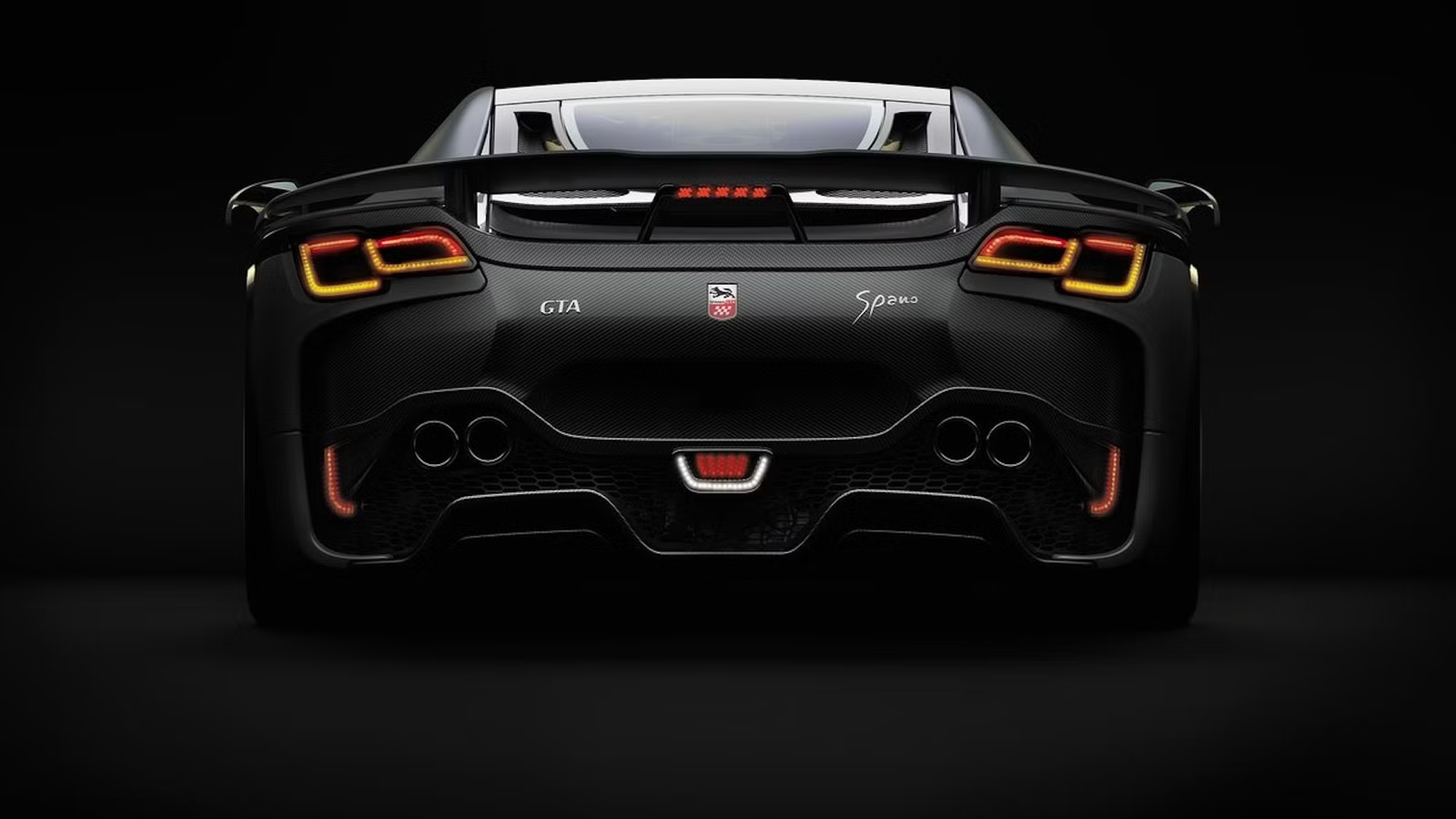
Few engines carry the kind of cult status that the thunderous Dodge V10 does. While most enthusiasts know the Viper V10 from its natural habitat under the long hood of America’s most notorious sports car, Spania GTA had a bolder idea: drop a heavily modified version of that engine into a lightweight, track-focused machine that would leave the Viper itself in the dust. The result was the GTA Spano, a low-volume supercar from Valencia that deserves far more attention than it typically gets.
More Potent Than The Viper
2013 Spania GTA Spano Exterior Finished In Red Driving Along Coastal RoadSpania GTA
Model
Spania GTA Spano
2013 Dodge Viper
Engine
8.4-liter, twin-turbocharged, V10
8.4-liter, naturally aspirated, V10
Horsepower
889 hp
640 hp @ 6,150 rpm
Torque
738 lb-ft
600 lb-ft @ 4,950 rpm
0-62
2.9 seconds
3.9 seconds
Top speed
217 mph
202 mph
The Dodge Viper, regardless of generation or trim level, is a force to be reckoned with and a car not to be taken lightly. Every iteration of the Dodge Viper was famously powered by a V10 engine. Sadly, this particular V10, and every other production engine of its kind, is officially dead. By the end, the Viper was pushing well over 600 horses.
As impressive as that is, it wasn’t enough to outpace the Spanish supercar from a lesser-known automaker called Spania GTA. This tiny manufacturer produced the GTA Spano using the Viper V10, debuting the car at the 2013 Geneva Motor Show. There were two generations of the GTA Spano; the first began after the model’s unveiling and production debut at that show.
2013 Spania GTA Spano Exterior Finished In Yellow Photographed Along PromenadeSpania GTA
Even in its original form, the GTA Spano left the Dodge Viper with little to argue about, besting it in nearly every performance metric. Rather than retaining a naturally aspirated configuration, the extra power was sourced from a twin-turbocharger system grafted onto a heavily revised version of the Dodge Viper V10. Paired with that modified engine was either a seven-speed automatic or a manual sequential transmission. The GTA Spano was quicker, lighter, and faster than the Viper — and at the time of its debut, it ranked among the fastest cars in the world.
Beyond its powerful beating heart, the GTA Spano was built around a chassis constructed from titanium, carbon fiber, and Kevlar. It also offered impressive maneuverability. Notably, it rode on Pirelli tires developed specifically for the 2,976-pound car. Although a small brand, Spania GTA drew on 30 years of automotive experience and 15 years in motorsport to bring the GTA Spano to life. For this first generation, 99 examples were planned for production.
The GTA Spano Evolves
2015 Spania GTA Spano Exterior Finished In White With Doors OpenSpania GTA
GTA Spania 2nd Generation
Engine
8.0-liter, twin-turbocharged, V10
Horsepower
912 hp @ 6,300 rpm
Torque
900 lb-ft
0-60
2.9 seconds
Top speed
230 mph
Spania GTA wasn’t finished with the GTA Spano. The second generation debuted at the 2015 Geneva Motor Show and was notable for being the first supercar to incorporate graphene into its construction. Billed as a completely new car compared to the Viper-slaying Spaniard that arrived in 2013, this second-generation GTA Spano featured a range of mechanical and design changes that pushed the model’s evolution considerably further.
2015 Spania GTA Spano Exterior Finished In Yellow Driving Through Apex On Race TrackSpania GTA
Rapid forward momentum was still sourced from the Dodge Viper’s heavily modified V10 engine. Displacement remained unchanged from the first generation, though power output increased considerably. The 99 planned examples of this second generation would use a seven-speed sequential transmission. The chassis also saw a significant upgrade: the steel tubular frame of the original was replaced by a new carbon fiber monocoque structure, engineered to incorporate graphene alongside titanium for impressive rigidity without a meaningful weight penalty.
Graphene was a defining feature of the second-generation GTA Spano, woven into the chassis, bodywork, and even leather interior elements. Despite those weight-saving efforts, the car was heavier than its predecessor, tipping the scales at 3,086 lbs. Underpinning it was a suspension layout similar to the first-generation car, with double wishbone setups at both ends. Adjustable shock absorbers and a front axle lift system rounded out the chassis package.
Potent Enough To Contend With The Best Of The 2010s
Model
2015 Spania GTA Spano
Ferrari LaFerrari
McLaren P1
Porsche 918 Spyder
Engine
8.0-liter, twin-turbocharged, V10
6.3-liter, naturally aspirated, hybrid, V12
3.8-liter, twin-turbocharged, plug-in-hybrid, V8
4.6-liter, plug-in-hybrid, V8
Horsepower
912 hp @ 6,300 rpm
949 hp (combined)
903 hp
887 hp
Torque
900 lb-ft
664 lb-ft @ 6,750 rpm
664 lb-ft
944 lb-ft @ 5,000 rpm
0-60
2.9 seconds
2.6 seconds
2.8 seconds
2.6 seconds
Top speed
230 mph
217 mph
217 mph
211 mph
The second-generation GTA Spano was the most powerful iteration of the Spanish supercar. Despite commanding a level of performance that could rival some of the most potent offerings of the 2010s, some critics pointed to the fact that its impressive output came from a Dodge engine. Ultimately, though, performance defines a car more than the origin of its power, and the second generation extracted enough power and torque from its Viper V10 to sit in the same conversation as every member of the hallowed Holy Trinity — a group we’ve previously compared to modern supercars.
Retaining the Viper V10 throughout its production life, the GTA Spano was more powerful than every version of the Dodge Viper. On paper, at least, it was capable of contending with nearly everything on the road, save for the first production car to breach 1,000 hp and the wave of hypercars that emerged around the mid-2010s.
Where is Spain’s Viper-Powered Supercar Now?
Extremely striking, with an impressive level of performance drawn from its Viper V10 engine, the GTA Spano — across both generations — was a genuinely compelling package. Despite leaning on core components from other production cars and emerging from a small, lesser-known manufacturer, it was undoubtedly capable of rivaling the best. So where does the GTA Spano stand today?
Production numbers for the GTA Spano are not easy to verify, but a handful of examples left the production line, many of which are likely still in Spain. While each car wears a plaque indicating its number out of the 99 units planned, it remains unclear whether all 99 were ever sold. It wasn’t the cheapest route to V10 ownership. In more recent years, Spania GTA has shifted its focus toward importing the Fisker Karma into Spain and developing an electric off-road buggy concept called the Vinco. Meanwhile, the GTA Spano endures as one of the most powerful expressions of the Viper V10 ever put into a production car.
Sources: GTA Spania
