

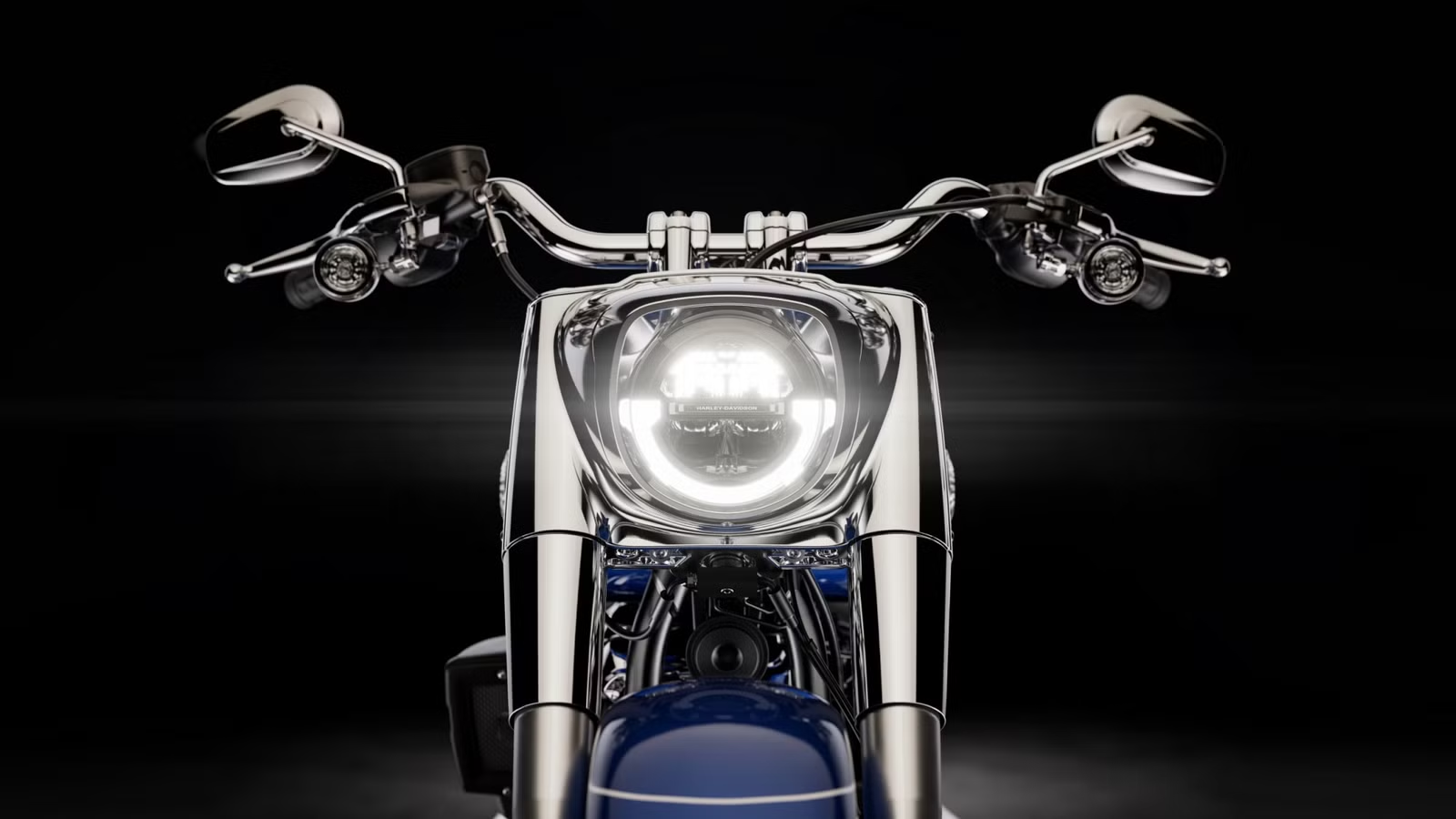
In an era when motorcycle manufacturers refresh their lineups with little more than new paint and a revised badge, it takes something genuinely special to endure for more than three decades without losing its identity. Stricter emissions regulations tighten every year, rider expectations keep climbing, and yet one machine keeps showing up — not by reinventing itself, but by evolving with purpose. It remains unmistakable at first glance, it has earned a place in pop culture that no marketing budget could buy, and it is still rolling off the production line today. That motorcycle is the Harley-Davidson Fat Boy, an old-school cruiser with more than 30 years of continuous production behind it.
The Harley-Davidson Fat Boy Gives Out Old-School Vibes
Price: $22,599
The Fat Boy was launched in 1990, making it well over 30 years old. It earned its name from its substantial width, and even today that rear tire measures 240 mm (9.5 inches) across — genuinely wide by any standard. It has always been a Softail model, meaning it has featured rear suspension from the very first example that went on sale.
That combination of distinctive looks, generous chrome, and big-screen fame gave the Fat Boy a celebrity status all its own. Changing it too dramatically — as Harley-Davidson did with the Sportster series — would have done more harm than good. As a result, the Fat Boy has seen careful evolution rather than wholesale reinvention. It works, so why fix something that isn’t broken? The Fat Boy remains an old-school cruiser with modern technology underneath, and it is still in production more than 30 years on.
Why We Picked The Harley-Davidson Fat Boy
- A design icon, and the look has remained over the decades
- An integral part of Americana, and a part of pop culture as well
- Big V-twin, and loads of chrome – it doesn’t get any more old-school than this
Harley-Davidson Fat Boy Engine: Incremental Updates
Latest Version Gets 117 CI Engine
2025 Harley-Davidson Fat Boy feature
Harley-Davidson
Harley-Davidson has updated the Fat Boy’s engine at regular intervals over the years. From 2020 through 2024, it was powered by the Milwaukee Eight 114. For the 2025 model year, displacement grew with the arrival of the Milwaukee Eight 117 Custom engine. This unit produces 104 horsepower and 126 pound-feet of torque — not the highest-output engine in the Harley lineup at that displacement, an honor that belongs to the Low Rider S — but the Fat Boy’s tune prioritizes strong low-end torque, exactly what you’d expect from an old-school cruiser. For 2026, Harley has made no mechanical updates.
Harley-Davidson Engine Specifications
Engine Configuration
‘Milwaukee Eight 117 Custom’ 45 degree V-twin, pushrod actuated OHV, 4 valves per cylinder
Displacement
1,917 cc
Bore x Stroke
103.5 x 114.3 mm
Compression Ratio
10.3:1
Power
104 HP @ 4,800 RPM
Torque
126 LB-FT @ 3,000 RPM
Fuel System
Electronic sequential port fuel injection
Transmission
6 speed manual
Final Drive
Belt drive
The massive 1,917 cc V-twin delivers on that promise, and vibrations are kept well in check by dual counterbalancers. The transmission remains a six-speed unit with belt final drive. Cornering-enhanced traction control and drag torque slip control are standard, which should allow you to hustle it along and pretend to be a Terminator, should you want to.
Harley-Davidson Fat Boy Chassis: Quietly Impressive
Some Good Hardware To Back Up The Good Looks
2025 Harley-Davidson Fat Boy feature
Harley-Davidson
The Fat Boy uses a traditional downtube frame that has been brought up to modern standards. Suspension duties are handled by Showa specialists: the front dual-bending valve forks wear distinctive ‘beer can’ covers, while a single rear shock with tool-free preload adjustment takes care of the back end. Braking hardware mirrors that of the Low Rider ST, with twin 300 mm front discs gripped by four-piston fixed calipers. The wheel size is an unusual choice for a cruiser — 18-inch rims at both ends — but it contributes to one of the lowest seat heights in the segment, coming in at under 26 inches. Cornering ABS and a tire pressure monitoring system round out the chassis-level safety package.
Harley-Davidson Fat Boy Chassis Specs And Dimensions
Chassis
Downtube frame
Front Suspension
49 mm Showa dual bending valve forks, 5.1 inches travel
Rear Suspension
Showa hidden single shock with 1.7 inch stroke, tool-free hydraulically adjustable preload; 3.4 inches travel
Front Tire And Wheel
160/60 R18
Rear Tire And Wheel
240/40 R18
Front Brakes
Dual 300mm discs with four-piston fixed calipers
Rear Brakes
292 mm disc with two-piston floating caliper
Fuel Tank Capacity
5.0 Gallons
Length/Width/Height
93.1/40/43.1 inches
Wheelbase
65 inches
Rake
30 degrees
Trail
4.1 inches
Seat Height
25.9 inches (laden)
Ground Clearance
4.9 inches
Curb Weight
694 LBs (wet)
Mix Of Old-School And New Features
Harley-Davidson Fat Boy LCD in huge analog cluster on the fuel tankHarley-Davidson
The Fat Boy is a retro-styled cruiser, and Harley-Davidson has kept that theme running through the instrumentation. The setup is similar to what you’ll find on the Nightster and Low Rider S, but here it sits on the tank. A USB-C charging port is a welcome practical addition — it’s the connection you’ll need to keep a navigation device alive on longer runs. An adjustable front brake lever is also included.
On the riding and safety fronts, a ride-by-wire throttle offers four selectable ride modes, and ABS, traction control, and drag torque slip control are all cornering-enabled. A tire pressure monitoring system is also fitted. The accessories catalog is predictably extensive, but the wheels deserve a special mention even if they don’t qualify as a traditional feature. Harley-Davidson has done an exceptional job with their styling, making them evocative of the original disc wheels while giving them a thoroughly contemporary look.
Harley-Davidson Fat Boy Notable Features
- 5-inch analog/reverse LCD
- Ride modes
- Cruise control
- Cornering-enabled ABS
- Traction control
- Drag torque slip control
- Tire pressure monitoring system
- USB-C charging socket
It’s Got Rivals From All Major Players
Something From All Over The World
The Fat Boy doesn’t have any truly direct competition at its price point, but we’ve assembled a handful of cruisers that challenge it on retro aesthetics, sheer visual muscle through width, or both — with large-displacement engines as a non-negotiable requirement. That shortlist includes some well-known names, starting with the Indian Super Chief Limited. Strip away the windshield and soft luggage, and it becomes a genuine Fat Boy rival, though it takes a very different approach to the retro brief — relying on a large, two-valve air-cooled Thunderstroke engine, spoke rims, and bobbed fenders.
Harley-Davidson Fat Boy vs. Rivals
Harley-Davidson Fat Boy
Indian Super Chief Limited
BMW R 18
Suzuki Boulevard M109R
Price
$20,499
$21,999
$15,395
$15,799
Engine
45 degree V-twin, 4 valves/cyl
49 degree V-twin, 2 valves/cyl
Boxer twin, 4 valves/cyl
52 degree V-twin, 4 valves/cyl
Cooling
Air cooled
Air cooled
Air/oil cooled
Liquid cooled
Displacement
1,917 cc
1,901 cc
1,802 cc
1,783 cc
Power
104 HP @ 4,800 RPM
89 HP @ NA RPM
91 HP @ 4,750 RPM
123 HP @ 6,200 RPM
Torque
126 LB-FT @ 3,000 RPM
120 LB-FT @ 2,900 RPM
120 LB-FT @ 3,000 RPM
118 LB-FT @ 3,200 RPM
Gearbox
6 speeds
6 speeds
6 speeds
5 speeds
Curb Weight (Wet)
694 LBs
739 LBs
825 LBs
764 LBs
The BMW R 18 offers yet another interpretation of the large retro cruiser, though its styling has grown more restrained in recent years, making it a less visually arresting proposition than the Fat Boy. Rounding out the group and matching the Fat Boy in rear tire width is the Suzuki Boulevard M109R — the value pick of the bunch. It delivers the most outright power from the most technically advanced engine here, yet it is paradoxically also the oldest model in the comparison and lacks safety features that are now considered essential.
Sources: Harley-Davidson, Indian Motorcycles, BMW Motorrad, Suzuki Motorcycles
