

So far, 2026 has been tumultuous, as automakers have retired many powertrains. Only a handful of the engines killed off by manufacturers in 2026 have overstayed their welcome, but the rest? We think they’ve come and gone just a little too quickly.
Whether it’s been the final model year for engines and entire models, announcements of replacements, or new models arriving on the scene acting as the final nail in the coffin, this year has both given and taken away. It’s not all sad, but it’s not all good, either. Here are the engines that fell victim to both emissions and obsolescence in 2026.
The engines and models mentioned in this article are either discontinued after the 2026 model year or have replacement plans announced or solidified this year. They are listed in no particular order.
Toyota 2UR-GSE – 5.0-Liter V8
Last Use: 2026 Lexus LC500
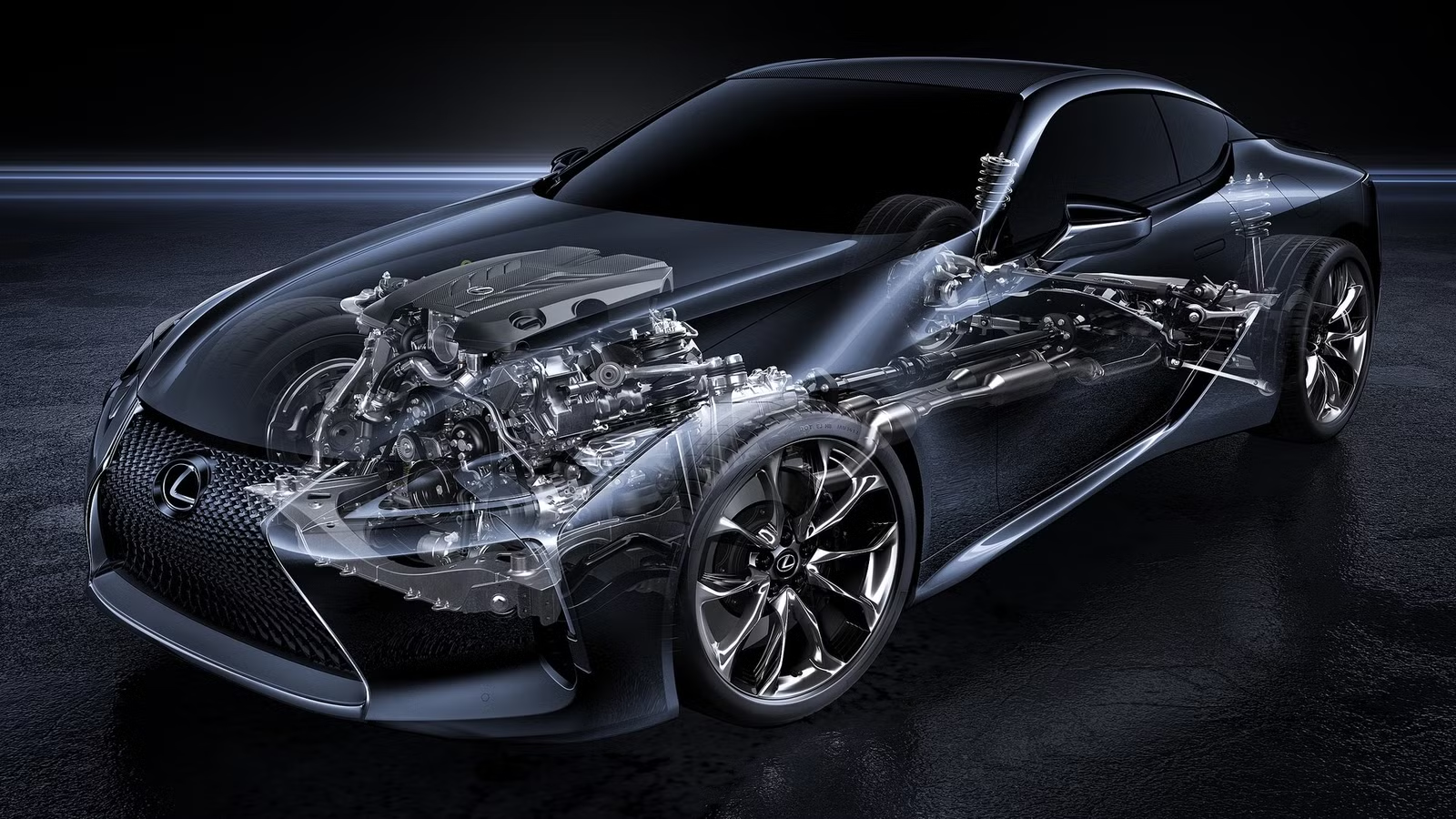
The Lexus LC 500 might be the best way to send off Toyota’s 2UR-GSE V8 engine. Co-developed with Yamaha, the eight-cylinder displaced 5.0 liters to make 416 horsepower at the beginning and 471 hp in later variants across four production vehicles. Its first home was in the original IS F, and the late IS 500 was among the brand’s last machines playing Taps for this fantastic powerplant.
The IS F, GS F, RC F, and LC 500 all utilized this V8, and now that the last of the LC coupes and convertibles have rolled off the line for 2026, it’s officially dead. Long live the Lexus V8. As for now, the only new Toyota product packing eight cylinders is the 4.0-liter twin-turbocharged hybrid GR GT. New performance Lexus models from here on will be either hybrids or fully electric.
Audi 2.5 TFSI – 2.5-Liter Turbo Inline-5
Last Use: 2027 Audi RS3
Few brands have tucked 5-cylinder engines into their vehicles, and Audi was the first to use a gasoline-fed 2.1-liter variant in its 100 sedan in the 1970s. It found glory in the Quattro, the infamous two-door Audi built to homologate its Group B rally car, and has been a staple of the four rings since. It survived well into the 2000s and 2010s in everything from the TT to the RS3, remaining only in the latter in 2026 until Euro 7 emissions standards killed it.
After 2027, the RS3’s 394-hp 2.5-liter turbocharged inline-five is gone from the European market, but the engine could potentially live on outside of Europe after the five-cylinder is cut from the continent, though we have our doubts. Electrification is coming for all brands within the Volkswagen Group, something we learned after the RS5 returned with a 2.9-liter twin-turbo V6 plug-in hybrid powertrain.
Bugatti W16 – 8.0-Liter Quad-Turbo W16
Last Uses: 2026 Mistral, Destrier
Each time Bugatti hears an outlet call its latest W16-powered creation the “last W16 Bugatti,” it tends to crank out another one and prove us wrong. The Mistral, which the marque produced 99 examples of from 2024 to 2026, is the last Bugatti to carry the 1,578-pony 8.0-liter quadruple-turbo W16. This year marks the last model year, but something tells us there might be one or two more one-off creations arranging 16 cylinders in a W-configuration.
The Destrier, unveiled before the 2026 Monterey Car Week festivities, is a bespoke vehicle made for one lucky customer using the underpinnings of the Bolide. Bugatti took one of its few remaining W16s off the shelf for use in the Destrier, both to make room and pay for its upcoming fleet of naturally aspirated 8.3-liter V12 engines used in the new Tourbillon. The W16 arrived in 2005 in the back of the Veyron, later finding work in the Chiron and a plethora of bespoke builds based on it. The last of the Piëch-era engineering marvels are slowly fading into the obscure, but there’s still a lot to look forward to from the brand.
Honda K20C1 – 2.0-Liter Turbo Inline-4
Last Use: 2026 Civic Type R (European & UK Markets)
Don’t fret just yet: the Honda Civic Type R, as we know it, is staying put in the US. However, the UK and European markets will soon lose this treasured hot hatch. Its 2.0-liter turbo-four won’t meet the impending Euro 7 regulations that subject new cars to broader emissions testing, but Honda’s parting gift to the UK and the continent is one heck of a consolation prize.
Used in both the Civic Type R and the Acura Integra Type S, the 315 hp and 310 lb-ft. of torque from the K20C1 is up nine ponies since it debuted in 2015. In 2017, the first CTR arrived on US soil and was the only Honda vehicle to pack the power-dense four-cylinder. With the addition of the Integra Type S, it’s double trouble for Honda when it comes time to revamp this powertrain for the US, something it’s already looking to do with the 1.5-liter turbo unit in the Civic Si and Integra.
Jaguar Land Rover AJ133S – 5.0-Liter Supercharged V8
Last Use: 2026 Jaguar F-Pace SVR & Land Rover Defender V8
Jaguar’s dearly departed F-Pace was the brand’s last gas-powered model to ride the production line, taking with it into the automotive afterlife the last of the JLR-built 5.0-liter supercharged V8 engines. Shared with both the F-Type and Land Rover Defender, the AJ133S was the secret sauce that made each sound and move like nothing else in its class.
The Defender loses two powertrains for 2027: the standard 2.0-liter turbo-four that came on base models, as well as the supercharged V8 shared with others. The only two engines left beginning in the 2027 model year are two variants of JLR’s 3.0-liter inline-six and the BMW-sourced 4.4-liter twin-turbo V8 used in the Octa.
Mercedes-Benz M139 – 2.0-Liter Turbo Inline-4
Last Uses: 2027 Mercedes-Benz AMG C 43/63 & GLC 43/63
We learned early this year that Mercedes plans to yank its 2.0-liter turbocharged four-cylinder from a handful of AMG models after the 2027 model year. Don’t think we’re not excited by that announcement, but we think if the V8 wasn’t killed at the hands of the four-cylinder, it would’ve gone over far better with owners who had the choice between the two.
Both the mild-hybrid C43 with 416 hp and the C63 PHEV with 671 hp start with the same 2.0-liter turbo and build upon its high power density to deliver a compact sports sedan bursting at the seams. New variants after 2027 will get the same inline-six from the CLE and E-Class, and a new V8 coming to the S-Class was revealed to be Euro 7-compliant and will get shoehorned into the C63. A V8 that’s environmentally friendly? More of that, please!
Chevrolet LT2 – 6.2-liter V8
Last Use: 2026 Corvette Stingray
Say goodbye to the LT2 in the Corvette, but get ready to introduce yourself to the LS6 that’s replacing it come 2027. We absolutely adore the 490-hp 6.2-liter V8, good for 465 lb-ft. of torque, but the upcoming 6.7-liter will deliver 535 ponies and 520 lb-ft. in the base Stingray as well as in the Grand Sport. Taking over the E-Ray’s hybrid responsibilities is the newly launched Grand Sport X, pairing the new LS6 with a 186-hp electric motor spinning the front axle.
The LT2 was tailored specifically for the first mid-ship Corvette, but GM’s change to a small block LS brings to light what the “LT” and “LS” designations for its V8 engines actually represent. The LT nomenclature denotes Chevrolet’s own family of high-tech engines built to handle more power with greater efficiency by way of variable valve timing. The LS engines use an older architecture that has extensive aftermarket support.
General Motors L84 & L87 – 5.3-Liter & 6.2-Liter V8
Last Uses: 2026 Chevy Silverado, Tahoe, Suburban, GMC Sierra, Yukon, Cadillac Escalade
It became crystal clear why GM invested hundreds of millions in new V8 engines after so many of its L87 6.2-liter V8 engines imploded. Both this engine and the decades-old 5.3-liter V8 in L84 form are being replaced by a new generation of small block V8s, something that can’t come soon enough for the Chevy, GMC, and Cadillac trucks and SUVs that rely on these engines.
The next round of small block V8s will come in two flavors: 5.7-liter and 6.6-liter. Both the 2.7-liter TurboMax-four and diesel-fed 3.0-liter Duramax inline-six will also join the lineup for 2027. While we’re still unaware of raw power figures, GM has said the 6.6-liter V8 will be the most powerful naturally aspirated V8 in its class, which means it will either match the outgoing 6.2’s 420 horsepower or surpass it to remain king of the hill.
Sources: Bugatti, General Motors, Honda, Jaguar Land Rover, Mercedes-Benz, Toyota, Volkswagen Group
