

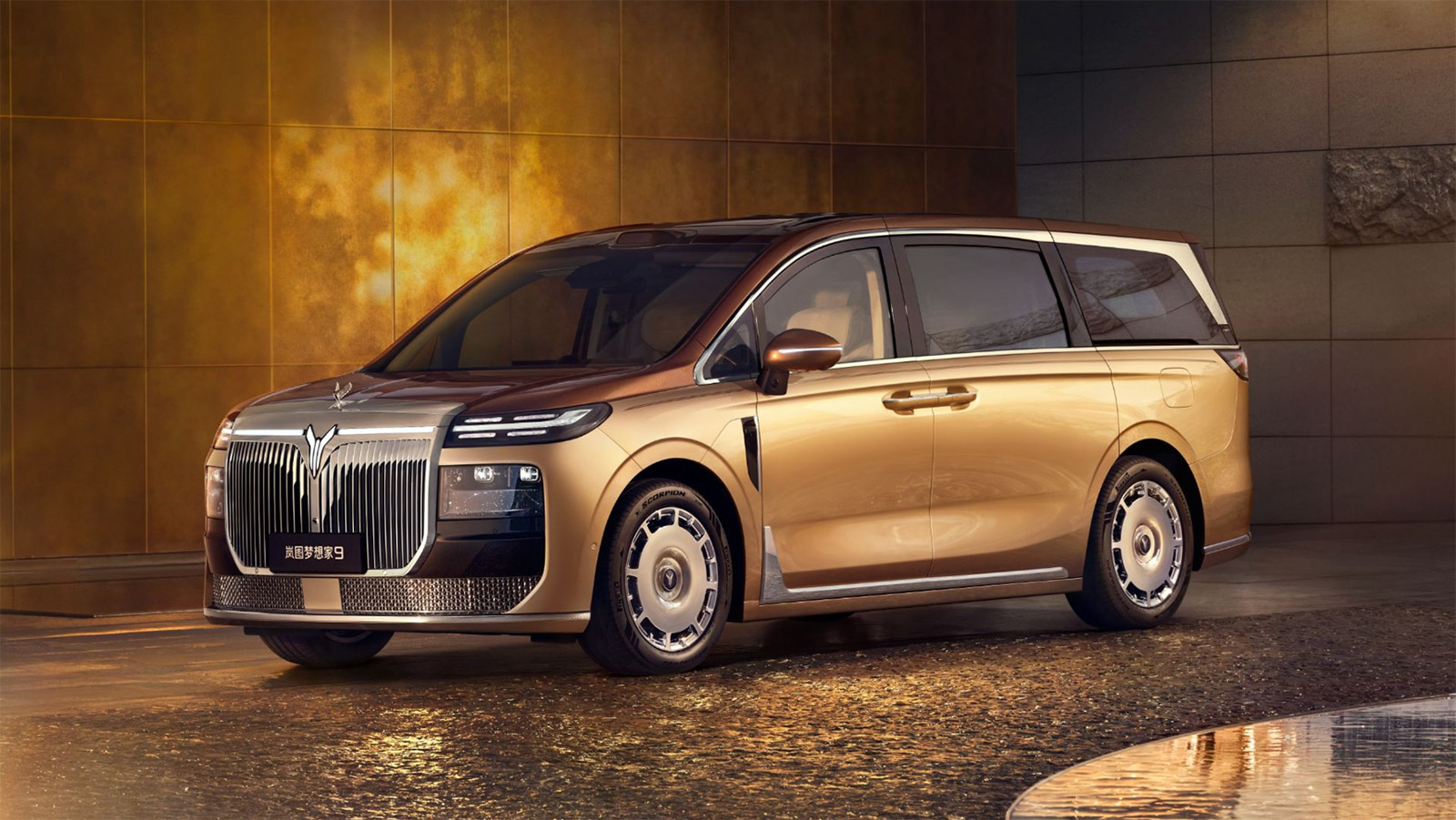
The Voyah Dream 9. Credit: Voyah
- The Voyah Dream 9 features Huawei ADS 5 and HarmonySpace 6, along with 4 LiDARs.
- The BEV version uses a 120-kWh battery pack, which Voyah says is the largest currently available in the MPV market.
Dongfeng Motor subsidiary Voyah (HKEX: 7489) began pre-sales of the Dream 9 multi-purpose vehicle (MPV) on Saturday, targeting China’s premium MPV market with Huawei technology and luxury features.
The Dream 9 is available in 5 variants, comprising 3 plug-in hybrid electric vehicle (PHEV) versions and 2 battery electric vehicle (BEV) versions.
Pre-sale prices range from 429,900 yuan ($63,420) to 529,900 yuan across the Ultra, Ultra+ and Lizun editions. Voyah is also offering pre-sales incentives worth up to 50,000 yuan.
Display vehicles have begun arriving at Voyah stores across China, allowing potential buyers to experience and test-drive the model. The company has yet to announce an official launch date for the Dream 9.
Voyah said the Dream 9 is built on an L3-capable electrical and electronic architecture and features Huawei’s Qiankun ADS 5 and HarmonySpace 6.
The vehicle is equipped with 37 sensors, including a 896-channel dual-optical-path main LiDAR and 3 solid-state LiDARs, covering urban, highway and parking scenarios.
HarmonySpace 6 uses the MoLA 2.0 architecture and incorporates a new-generation multimodal large language model. Voyah said its end-to-end SystemAgent model has hundreds of billions of parameters.
All Dream 9 variants use an 800-volt high-voltage platform. The PHEV versions feature a 65-kWh battery and support 5C charging, taking 12 minutes to charge from 20% to 80%.
The BEV versions use a 120-kWh battery pack. Voyah said it is the largest battery currently available in the MPV market.
The PHEV models feature a 1.5-liter turbocharged engine and front and rear electric motors, delivering a combined output of 555 kW. The BEV models have front and rear motors with maximum outputs of 175 kW and 300 kW, respectively.
The Dream 9 also features triple-chamber air suspension, dual-valve EDC dampers and bidirectional 10-degree rear-wheel steering. Its VMC intelligent domain-control system coordinates adjustments to propulsion, braking and suspension settings.
The vehicle measures 5,325 mm in length and 1,998 mm in width, with a wheelbase of 3,200 mm. Its 3-row cabin features second-row seats that support rotation, lateral movement, a zero-gravity mode and mechanical massage.
The Dream 9 also features a retractable illuminated hood ornament and Huawei XPixel smart projection headlights. The headlights can project navigation arrows and lane-departure warnings onto the road.
Voyah did not hold an event for the pre-sales launch. Its chairman Lu Fang previously said the company wanted to reduce unnecessary marketing hype and allow consumers to experience the product first.
The Dream 9 is also tasked with helping Voyah improve its product mix and profitability. The company’s revenue rose 42.4% year-on-year to 18.16 billion yuan in the first half of the year, while deliveries increased 35.9% to 76,264 units.
However, Voyah’s gross margin fell to 17.7% during the period, and it recorded a net loss of 389 million yuan, compared with a net profit of 460 million yuan a year earlier.
The Voyah Passion S has limited-time prices of 223,900 yuan ($33,000) to 273,900 yuan, undercutting the Xiaomi YU7.
($1 = 6.7787 yuan)
